(function(){“use strict”;var QUESTION_BANK=[[“At the start of a pre-trip inspection, why should you look for fresh puddles beneath the vehicle?”,”They may reveal leaks from fuel, coolant, oil, brake, or other systems”,[“They prove the tires are properly inflated”,”They show the parking brake is released”,”They confirm the cargo is balanced”],”Fresh fluid beneath a parked vehicle can be the first visible sign of a serious system failure. Identify the fluid and correct unsafe leaks before moving.”],[“What should you check on the engine oil dipstick?”,”The oil level is within the safe range and the oil shows no obvious contamination”,[“The dipstick is the same color as the engine”,”The oil reaches above every marking”,”The engine is running at high speed”],”Check oil according to the vehicle manufacturer’s procedure, usually with the engine off. Too little oil can cause rapid engine damage, while abnormal appearance may signal contamination.”],[“Why should coolant level be checked only when the system can be opened safely?”,”Hot pressurized coolant can cause severe burns”,[“Coolant becomes poisonous only when warm”,”The radiator cap controls tire pressure”,”Cold coolant cannot be measured”],”A hot cooling system may release steam and scalding fluid when opened. Use the sight glass or reservoir when available and never remove a hot pressure cap.”],[“What belt condition should place a vehicle out of service until repaired?”,”A belt that is badly cracked, frayed, soaked, or visibly loose”,[“A belt with readable manufacturer lettering”,”A belt that is dark in color”,”A belt located near a pulley”],”Drive belts must reliably operate equipment such as the alternator, water pump, or other accessories. Severe wear, contamination, or improper tension can cause sudden failure.”],[“When inspecting steering components, what should you look for?”,”Missing hardware, looseness, cracks, bends, and fluid leaks”,[“Decorative paint on the steering box”,”Matching colors on every joint”,”Extra grease on the tire tread”],”The steering box, hoses, linkage, and mounting parts must be secure and undamaged. A loose or cracked component can cause delayed response or complete loss of steering.”],[“Why are missing or damaged suspension spring leaves dangerous?”,”They can reduce load support, alter handling, and damage nearby parts”,[“They make the horn quieter”,”They increase windshield glare”,”They prevent the fuel gauge from working”],”Springs carry and stabilize the load. Broken, shifted, or missing leaves can change vehicle height and control or contact a tire, frame, brake line, or other component.”],[“What should be checked on shock absorbers during a walk-around?”,”They are securely mounted and not leaking excessively”,[“They are warm to the touch”,”They match the cab upholstery”,”They rotate freely by hand”],”Loose, broken, or leaking shocks cannot properly control suspension movement. Excessive bouncing can reduce tire contact and vehicle stability.”],[“A brake hose has a visible rub spot exposing reinforcement. What should you do?”,”Have it repaired before driving because it may leak or rupture”,[“Cover it with paint and continue”,”Increase tire pressure”,”Tie it to a moving suspension part”],”Brake hoses must be secure, flexible, and free of cuts, abrasion, bulges, and leaks. Exposed reinforcement means the hose has lost protective material and may fail under pressure.”],[“Why must brake linings and drums or rotors be free of oil and grease?”,”Contamination can sharply reduce braking friction”,[“Oil makes the brakes apply too quickly”,”Grease increases tire tread depth”,”Clean brakes use more fuel”],”Brakes depend on controlled friction. Oil or grease can cause weak, uneven, or unpredictable braking and may indicate a leaking seal or component.”],[“What does an unusually large gap at a brake adjustment point suggest?”,”The brake may be out of adjustment and provide reduced stopping force”,[“The wheel is properly balanced”,”The tire has extra tread”,”The battery is fully charged”],”Excessive brake travel can delay application and reduce the braking force at that wheel. Adjustment and component condition must meet applicable specifications.”],[“When inspecting a wheel rim, which defect is most serious?”,”A crack, unauthorized weld, or elongated bolt hole”,[“A small amount of road dust”,”A visible manufacturer’s stamp”,”A uniform painted finish”],”Rims carry heavy loads and experience repeated stress. Cracks, damaged bolt holes, or improper repairs can lead to wheel separation or sudden structural failure.”],[“Rust trails around wheel nuts may indicate what?”,”The nuts have been moving and may be loose”,[“The tire is overfilled with nitrogen”,”The brakes are new”,”The axle has too much fuel”],”Movement between a nut and wheel can leave rust streaks or shiny metal. Loose or missing fasteners can allow the wheel to wobble or separate.”],[“Why should valve stems have caps and show no damage?”,”Caps keep out dirt and moisture, while damaged stems can leak air”,[“Caps add enough weight to balance the wheel”,”They prevent tread wear”,”They control brake adjustment”],”A valve stem is part of the tire’s air-retention system. Cracks, contact with the rim, or a missing sealing cap can contribute to pressure loss.”],[“What is the minimum acceptable condition for tire tread during an inspection?”,”Tread must meet legal depth requirements and be free of dangerous damage”,[“Any visible tread is acceptable”,”Only the tire color matters”,”Tread may be missing if pressure is high”],”Adequate tread channels water and supports traction. Steering tires generally require more tread depth than other positions, and no tire should have exposed cord, major cuts, or bulges.”],[“Why should dual tires be inspected for spacing and debris between them?”,”Contact or trapped objects can damage the tires and create heat”,[“Close spacing improves fuel economy”,”Debris keeps the tires aligned”,”Dual tires should rub during turns”],”Duals need adequate separation under load. Stones or other objects can become wedged between them, and touching sidewalls may overheat and fail.”],[“What should you confirm when inspecting exterior lights and reflectors?”,”They are the correct color, clean, securely mounted, and operating”,[“Every light flashes continuously”,”Reflectors are covered during daylight”,”All lenses are painted blue”],”Lights and reflective devices communicate the vehicle’s size, position, braking, and intended movement. Dirt, damage, incorrect color, or failed bulbs reduce that warning.”],[“Why should the windshield and mirrors be clean and undamaged?”,”Clear glass and properly adjusted mirrors are necessary to see hazards and blind areas”,[“Clean glass increases engine power”,”Mirrors replace all shoulder checks”,”Windshield damage improves night vision”],”Safe observation depends on an unobstructed view. Significant cracks, illegal obstructions, poor adjustment, or dirty surfaces can hide road users and hazards.”],[“What should be checked on windshield wipers and washers?”,”Wiper arms and blades are secure, blades contact the glass, and washer fluid works”,[“Wipers match the steering wheel color”,”Blades operate only on dry glass”,”Washer nozzles point at the mirrors”],”Wipers must clear rain, snow, and road spray without damaged blades or loose arms. Washer fluid helps remove dirt and salt that wipers alone cannot clear.”],[“During an in-cab inspection, why test the service-brake pedal for unusual softness or sinking?”,”It may indicate air, fluid loss, or another brake-system problem”,[“A sinking pedal confirms strong brakes”,”It measures engine oil level”,”It adjusts the driver’s seat”],”The pedal should feel and behave normally for that vehicle. A spongy feel or continued sinking can signal a leak or hydraulic problem requiring immediate attention.”],[“What is the purpose of testing the parking brake before driving?”,”To confirm it can hold the vehicle against movement”,[“To warm the transmission”,”To check the headlights”,”To measure cargo weight”],”With the area clear and using the proper procedure, gently test that the parking brake holds. A brake that cannot secure the vehicle is a serious safety defect.”],[“Why should the horn be included in a pre-trip inspection?”,”It must be available to warn other road users of danger”,[“It controls the engine idle speed”,”It replaces turn signals”,”It confirms the doors are locked”],”The horn is an important communication and emergency-warning device. Test it briefly and ensure it is loud enough to be useful.”],[“What emergency equipment should be verified before a trip?”,”Required warning devices, spare fuses when applicable, and a charged, secured fire extinguisher”,[“A household candle and glass bottle”,”Only a paper road map”,”Extra decorative lights”],”Emergency equipment must be present, accessible, in usable condition, and properly secured. Requirements vary by vehicle, but warning devices and an appropriate extinguisher are fundamental.”],[“When inspecting cargo doors, what must be confirmed?”,”Doors, hinges, latches, and seals are secure and cannot open in transit”,[“The doors are left partly open for ventilation”,”Only one hinge is attached”,”The latch can be reached from the driver’s seat”],”An unsecured door can open into traffic or allow cargo to fall. Check all hardware and use required locks, seals, or securement devices.”],[“Why should you inspect steps, handholds, and deck plates?”,”Loose, contaminated, or damaged surfaces can cause a fall”,[“They determine engine horsepower”,”They control axle weight”,”They replace the parking brake”],”Three points of contact only help when steps and grips are secure. Oil, ice, mud, missing hardware, or damage can cause serious slips and falls.”],[“After completing the walk-around, what is a good final check before moving?”,”Verify the area is clear, all compartments are secured, and no tools or chocks were left behind”,[“Assume anyone nearby will move”,”Leave the hood unlatched for cooling”,”Drive immediately without checking mirrors”],”A final 360-degree check catches open doors, forgotten equipment, nearby people, and newly developed hazards. It completes the inspection before the vehicle enters motion.”]];/* EDIT ONLY QUESTION_BANK TO BUILD FUTURE QUIZZES. Format: [question, correct, [3 wrong], explanation]. */var S={q:[],i:0,s:0},$=function(x){return document.getElementById(x)},E={quiz:$(‘quiz’),results:$(‘results’),reviewScreen:$(‘reviewScreen’),qcount:$(‘qcount’),score:$(‘score’),progress:$(‘progress’),bar:$(‘bar’),question:$(‘question’),answers:$(‘answers’),feedback:$(‘feedback’),prev:$(‘prev’),next:$(‘next’),review:$(‘review’),reviewList:$(‘reviewList’)};function sh(a){a=a.slice();for(var i=a.length-1;i;i–){var j=Math.floor(Math.random()*(i+1)),t=a[i];a[i]=a[j];a[j]=t}return a}function esc(s){var d=document.createElement(‘div’);d.textContent=s;return d.innerHTML}function top(){$(‘tr-cdl-app’).scrollIntoView({behavior:’smooth’,block:’start’})}function start(){S.q=sh(QUESTION_BANK).map(function(x){return{t:x[0],a:sh([{t:x[1],ok:true}].concat(x[2].map(function(w){return{t:w,ok:false}}))),e:x[3],p:null}});S.i=0;S.s=0;E.quiz.hidden=false;E.results.hidden=true;E.reviewScreen.hidden=true;render();top()}function render(){var q=S.q[S.i],done=q.p!==null,n=S.q.filter(function(x){return x.p!==null}).length;E.qcount.textContent=’Question ‘+(S.i+1)+’ of ‘+S.q.length;E.score.textContent=S.s;E.bar.style.width=n/S.q.length*100+’%’;E.progress.setAttribute(‘aria-valuenow’,n);E.question.textContent=q.t;E.answers.innerHTML=”;q.a.forEach(function(a,i){var b=document.createElement(‘button’);b.type=’button’;b.className=’answer’+(done&&a.ok?’ good’:”)+(done&&i===q.p&&!a.ok?’ bad’:”);b.textContent=a.t;b.disabled=done;b.onclick=function(){pick(i)};E.answers.appendChild(b)});E.prev.disabled=S.i===0;E.next.disabled=!done;E.next.textContent=S.i===S.q.length-1?’View Results’:’Next Question’;if(done)feed(q);else E.feedback.hidden=true}function pick(i){var q=S.q[S.i];if(q.p!==null)return;q.p=i;if(q.a[i].ok)S.s++;render()}function feed(q){var a=q.a[q.p],c=q.a.filter(function(x){return x.ok})[0];E.feedback.className=’feedback ‘+(a.ok?’good’:’bad’);E.feedback.innerHTML=’‘+(a.ok?’ Correct!’:’ Incorrect’)+’‘+(!a.ok?’
Correct answer: ‘+esc(c.t)+’
Why your answer is incorrect: It does not follow the inspection standard or safety principle being tested.
‘:”)+’
Explanation: ‘+esc(q.e)+’
‘;E.feedback.hidden=false}function finish(){var n=S.q.length,b=n-S.s,p=Math.round(S.s/n*100);E.quiz.hidden=true;E.reviewScreen.hidden=true;E.results.hidden=false;$(‘percent’).textContent=p+’%’;$(‘final’).textContent=S.s+’/’+n;$(‘correct’).textContent=S.s;$(‘incorrect’).textContent=b;$(‘message’).textContent=p>=90?’Outstanding! You are well prepared on vehicle inspection.’:p>=80?’Great job! Review the missed inspection questions.’:p>=70?’Good progress. Keep practicing this inspection section.’:’More vehicle-inspection study is recommended.’;E.review.disabled=!b;top()}function review(){E.reviewList.innerHTML=”;S.q.filter(function(q){return!q.a[q.p].ok}).forEach(function(q,i){var c=q.a.filter(function(a){return a.ok})[0],d=document.createElement(‘article’);d.className=’review-item’;d.innerHTML=’
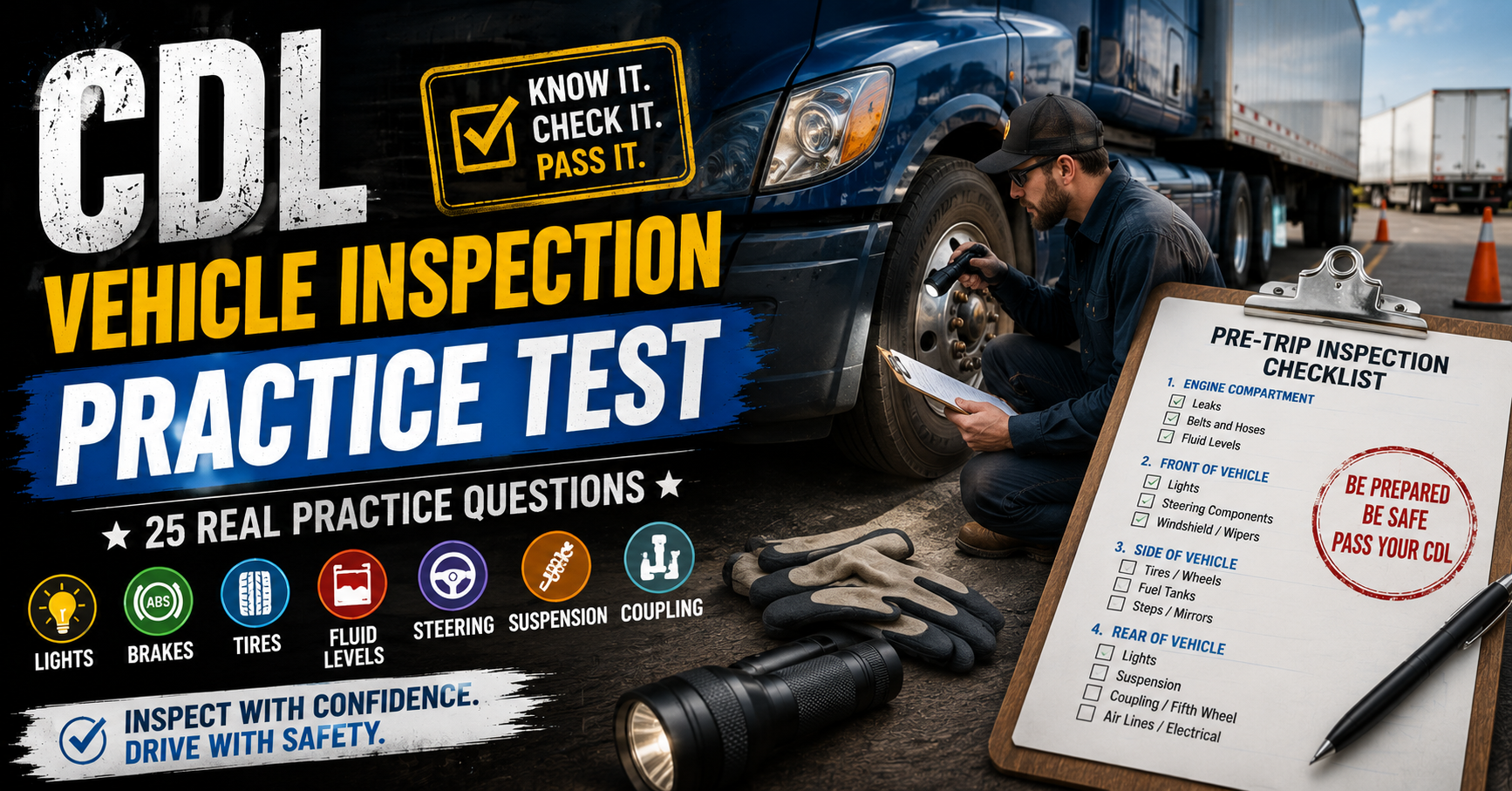
Passing the vehicle inspection portion of your CDL exam is just as important as passing the General Knowledge test. Our Free CDL Vehicle Inspection Practice Test gives you the opportunity to practice 25 realistic inspection questions that cover many of the same topics you’ll encounter while preparing for your Commercial Driver’s License.
Every question includes instant feedback and a detailed explanation to help you understand not only the correct answer but also why it matters. Learning the reasoning behind each inspection step makes it much easier to remember what you’ll need to know during your CDL training and on test day.
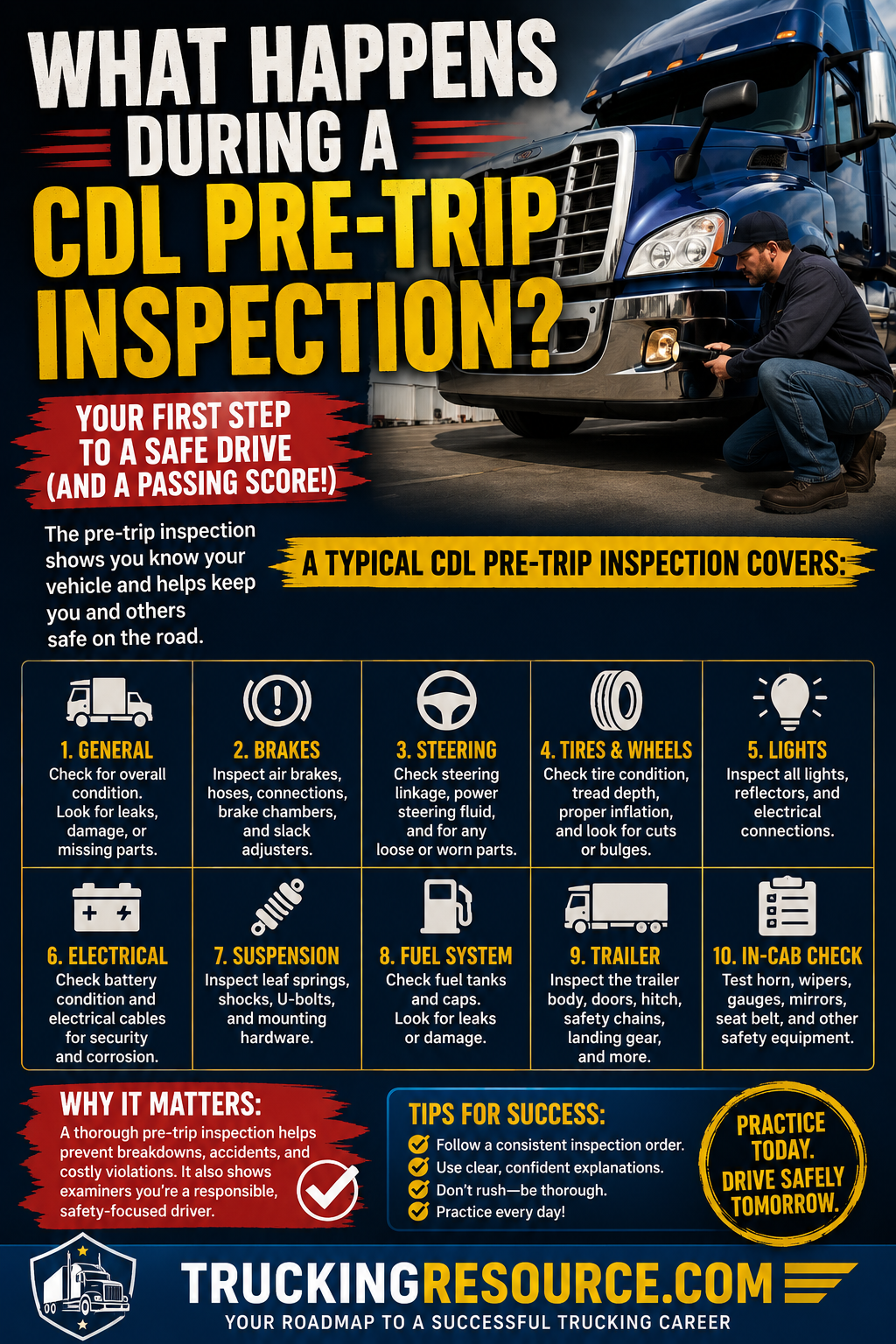
The CDL Vehicle Inspection test, often called the pre-trip inspection test, is designed to make sure commercial drivers can identify safety problems before operating a commercial vehicle. For a practical explanation of the skills-test process, see What Happens During a CDL Pre-Trip Inspection?.
Unlike the General Knowledge exam, this section focuses on your ability to recognize unsafe conditions and understand what should be inspected before every trip.
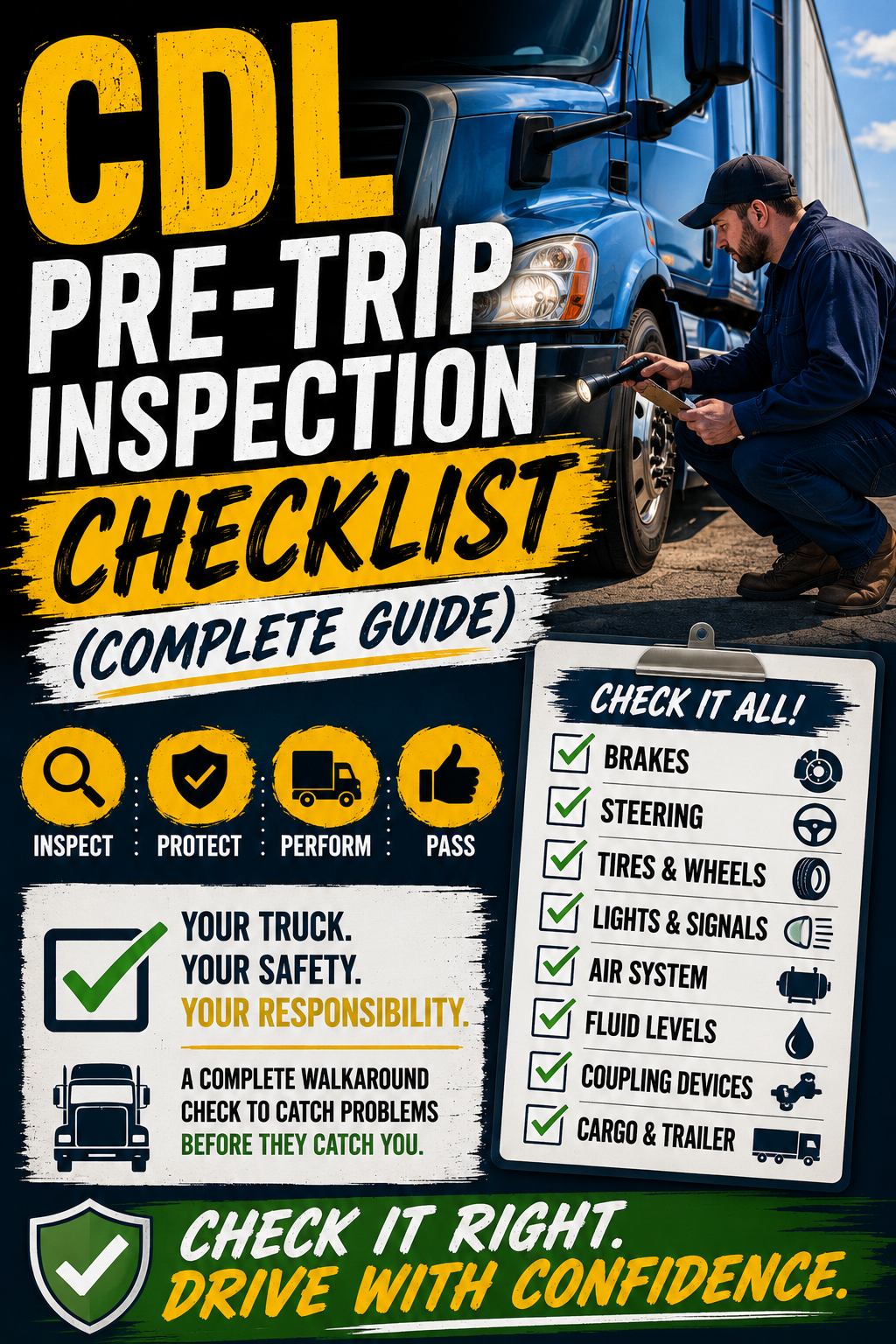
Learning how to properly inspect a commercial vehicle isn’t simply about passing your CDL exam. It’s an important habit that helps prevent breakdowns, mechanical failures, and accidents throughout your trucking career. The CDL Pre-Trip Inspection Checklist (Complete Guide) breaks this safety habit into the major areas drivers need to examine.
What You’ll Learn With This Practice Test
This practice test includes questions covering many of the most important inspection topics found in CDL manuals across the United States.
Some of the areas you’ll practice include:
Engine compartment inspections
Steering components
Suspension systems
Brake inspections
Tire safety
Wheels and rims
Lights and reflectors
Mirrors and windshield
Emergency equipment
In-cab inspections
Parking brake checks
Cargo doors
Steps and handholds
Final walk-around procedures
Understanding each of these areas will help prepare you for both your written CDL exam and your hands-on pre-trip inspection.
Many new CDL students focus most of their attention on learning how to drive a commercial vehicle. While driving skills are certainly important, every trip should begin with a thorough vehicle inspection.
Professional truck drivers perform pre-trip inspections because they help identify problems before those problems become dangerous.
Finding a damaged tire, leaking brake hose, loose steering component, broken light, or fluid leak before leaving the yard could prevent an expensive repair or even save lives.
Federal regulations require commercial drivers to inspect their vehicles, and employers expect drivers to take these inspections seriously.
How to Study for the Vehicle Inspection Exam
The best way to prepare is by combining several different study methods.
Start by reading your state’s CDL manual carefully. Most state manuals include detailed inspection procedures and explain exactly what examiners expect during your CDL skills test.
Next, complete multiple practice tests like this one. Every practice exam exposes you to different inspection questions and reinforces important safety concepts.
Finally, spend time physically walking around a commercial vehicle whenever possible. Seeing the actual components in person makes it much easier to remember them during your exam.
Common Mistakes During the CDL Pre-Trip Inspection
Many students lose points because they rush through the inspection instead of following a consistent routine.
Some of the most common mistakes include:
Forgetting to inspect one side of the vehicle.
Missing damaged brake hoses or air lines.
Failing to mention loose or missing mounting hardware.
Overlooking tire damage or improper inflation.
Forgetting emergency equipment.
Missing steering or suspension components.
Forgetting to check lights or reflectors.
Skipping the final walk-around.
Developing the same inspection routine every time helps prevent these common mistakes.
Learn the Reason Behind Every Inspection
One of the biggest mistakes CDL students make is trying to memorize a script without understanding why each inspection item matters.
For example, checking tire tread isn’t simply about remembering another inspection point. Adequate tread helps maintain traction during rain, snow, and emergency braking.
Inspecting brake hoses isn’t just part of the test. A damaged hose could lead to brake failure.
Understanding the purpose behind every inspection step makes the entire process much easier to remember.
Most experienced truck drivers don’t have to think about the inspection process because they’ve repeated it hundreds or even thousands of times.
That’s exactly why practice is so valuable.
The more questions you answer and the more time you spend inspecting real trucks, the more comfortable you’ll become before taking your CDL exam.
Don’t worry if you miss a few questions on your first attempt. Review the explanations, retake the quiz, and continue practicing until you’re consistently earning high scores.
Continue Building Your CDL Knowledge
A successful trucking career starts with a strong foundation.
After completing this CDL Vehicle Inspection Practice Test, continue improving your knowledge by working through our General Knowledge practice exams.
You’ll build a better understanding of commercial driving safety while preparing yourself for every section of your CDL permit exam.
Whether you’re planning to drive a dump truck, tractor trailer, straight truck, bus, or another commercial vehicle, mastering vehicle inspections is one of the most valuable skills you’ll develop as a professional driver.