(function(){“use strict”;/* QUESTION BANK — replace only this array for future tests. */var Q=[[“Why must cargo be distributed across the vehicle instead of concentrated in one area?”,”Balanced distribution helps keep axle weights legal and handling predictable”,[“Concentrated weight improves every turn”,”Axle limits apply only when empty”,”Cargo location cannot affect steering”],”Poor distribution can overload an axle, lighten the steering axle, damage components, and make braking or cornering unstable even when total weight is legal.”],[“What can happen if too much weight is placed behind the rear axle?”,”The steering axle may become too light for reliable control”,[“Front-tire traction always increases”,”The wheelbase becomes shorter”,”The brakes automatically adjust the load”],”Rear-heavy loading can remove weight from the steering axle. Reduced front-tire contact can make steering response weak or unpredictable.”],[“Why is a high center of gravity dangerous?”,”It increases the chance of rollover during curves or sudden maneuvers”,[“It lowers the cargo temperature”,”It shortens stopping distance”,”It improves crosswind stability”],”Weight carried high creates greater overturning leverage. Slow before curves and place heavy items low when the cargo and vehicle design allow it.”],[“What is the main purpose of cargo securement?”,”To prevent cargo from shifting, rolling, tipping, leaking, or falling”,[“To make cargo legally weightless”,”To replace axle-weight limits”,”To increase engine power”],”Cargo must remain stable during acceleration, braking, turns, and normal road vibration. Securement protects vehicle control and everyone near the vehicle.”],[“Why should tie-downs be attached only to suitable anchor points?”,”Weak or damaged points may fail under load”,[“Any painted surface is an anchor”,”Loose sheet metal provides extra flexibility”,”Anchor strength never matters below highway speed”],”A tie-down is only as reliable as its attachment. Use rated, secure anchor points and inspect them for cracks, deformation, corrosion, or looseness.”],[“What should be done with a tie-down that is cut, badly worn, or damaged?”,”Remove it from service and replace it with suitable equipment”,[“Knot it and use it for heavier cargo”,”Hide the damage under the load”,”Coat it with oil”],”Damaged webbing, chain, hooks, or fittings may have greatly reduced strength. Securement devices must be in serviceable condition and appropriate for the load.”],[“Why are edge protectors used with some tie-downs?”,”They protect the tie-down and cargo where the strap contacts a sharp edge”,[“They reduce the cargo’s legal weight”,”They replace every additional tie-down”,”They make loose straps tighter automatically”],”A sharp edge can cut or weaken webbing, while tie-down pressure can damage cargo. Proper edge protection helps preserve securement strength.”],[“What is working load limit?”,”The maximum load a securement component is rated to handle in normal service”,[“The breaking point multiplied by ten”,”The cargo weight a driver prefers”,”The vehicle’s maximum speed while loaded”],”Securement strength is evaluated through working load limits for tie-downs, fittings, and anchor points. The system must provide enough combined capacity for the cargo.”],[“Why should cargo be blocked or braced when it could move forward?”,”Hard braking can send unsecured cargo toward the cab or front wall”,[“Forward movement improves traction”,”Bracing is needed only when parked”,”Cargo cannot move forward if it is heavy”],”Cargo retains momentum when the vehicle slows. Blocking, bracing, and tie-downs work together to prevent dangerous forward movement.”],[“What is the safest practice for loading heavy items with lighter items?”,”Place heavy items low and secure all pieces against independent movement”,[“Stack heavy items on top”,”Use loose light cargo as padding”,”Secure only the heaviest item”],”Low placement reduces the center of gravity. Every item or unitized group must be secured so smaller pieces cannot escape or shift.”],[“Why should open-top loads be covered when required?”,”A cover can prevent loose material from blowing or falling onto the road”,[“A cover removes the need for securement”,”Covered cargo has no weight”,”It allows the driver to ignore load height”],”Tarps and covers contain materials such as debris or aggregate, but they must also be secured. Covering does not replace proper loading and tie-downs.”],[“When should cargo securement first be rechecked after departure?”,”Soon after beginning the trip, because the load and devices may settle”,[“Only after reaching the destination”,”After the first 1,000 miles”,”Only if another driver reports a problem”],”Road vibration and initial movement can settle cargo and reduce tie-down tension. An early check catches these changes before they become dangerous.”],[“What events should trigger an additional cargo inspection?”,”Hard braking, sharp maneuvers, unusual noises, or any event that may shift the load”,[“Changing the radio station”,”Passing a fuel sign”,”Driving beneath a streetlight”],”Any force or clue suggesting movement deserves attention. Stop safely and inspect rather than assuming the securement system remained unchanged.”],[“Why should a driver know the vehicle’s loaded height?”,”To avoid bridges, wires, tunnels, and other overhead obstructions”,[“Height determines fuel octane”,”The vehicle becomes lower at highway speed”,”Every bridge has unlimited clearance”],”Load height can change from trip to trip. Verify the actual height and plan a route with adequate clearance, accounting for uneven approaches and resurfaced roads.”],[“Why is load width important during route planning?”,”Wide loads may need permits, special routing, markings, or escorts”,[“Width changes the driver’s license photo”,”Wide cargo can use any lane without restriction”,”Width matters only while parked”],”Vehicle and cargo dimensions affect legal routing and clearance from traffic, signs, work zones, and structures. Required permits and warnings must be in place before travel.”],[“What does gross vehicle weight mean?”,”The total actual weight of the vehicle and everything on or in it”,[“Only the cargo weight”,”Only the weight on the steering axle”,”The manufacturer’s empty weight only”],”Gross vehicle weight includes the vehicle, driver, fuel, equipment, passengers, and cargo. It must remain within applicable ratings and legal limits.”],[“What is an axle-weight limit designed to protect?”,”Vehicle components, tires, bridges, and road surfaces from excessive concentrated load”,[“The color of roadway markings”,”The cargo invoice”,”The truck’s radio system”],”A legal total weight does not excuse an overloaded axle. Weight must be distributed so each axle group and component remains within its limit.”],[“Why must tire load ratings be considered when loading?”,”An overloaded tire may overheat or fail even if axle weight is legal”,[“Tire ratings determine cargo color”,”Ratings matter only on parked vehicles”,”Extra pressure always increases the rating”],”Each tire has a maximum load capacity at specified inflation. Axle, wheel, tire, suspension, and vehicle ratings all matter; the lowest applicable limit controls.”],[“What should a driver do if the load shifts and the vehicle begins leaning?”,”Stop safely and have the load corrected before continuing”,[“Steer against the lean and keep driving”,”Increase speed to level the load”,”Deflate tires on the high side”],”A visible lean may indicate dangerous cargo movement, suspension overload, or securement failure. Continuing increases rollover and component-failure risk.”],[“Why are liquid loads especially sensitive to steering and braking?”,”The liquid can surge and shift the vehicle’s center of gravity”,[“Liquids have no weight while moving”,”Surge strengthens tie-downs”,”Liquid loads cannot roll over”],”Liquid movement can push the vehicle during starts, stops, and turns. Smooth control and extra space are essential, especially with partially filled tanks.”],[“What is the danger of loose cargo inside the cab?”,”It can strike occupants or interfere with pedals and controls”,[“It improves crash protection”,”It lowers the center of gravity enough to prevent rollover”,”It makes emergency exits larger”],”Tools, bottles, and other objects become projectiles in a sudden stop and may roll beneath pedals. Secure cab items just as carefully as exterior cargo.”],[“Why should rear doors and tailgates be checked after loading?”,”They must be latched and able to contain the cargo during travel”,[“They should remain open to reduce air pressure”,”One latch is always enough”,”Doors replace interior securement”],”Doors and gates are part of load containment but cannot compensate for improperly secured cargo. Check hinges, latches, locks, and surrounding structure.”],[“What should be verified before removing tie-downs at delivery?”,”The cargo is stable and will not fall, roll, or shift when restraint is released”,[“The engine is at high idle”,”All doors are fully open”,”The truck is parked on the steepest available slope”],”Loads may press against doors or restraints after shifting in transit. Assess the load and unload in a controlled area using proper equipment and procedures.”],[“Why should cargo securement not rely on friction alone?”,”Braking, vibration, bumps, and turns can overcome friction and move the load”,[“Friction makes every load lighter”,”Friction works only at night”,”Road vibration permanently locks cargo in place”],”Even heavy objects can slide or tip under vehicle forces. Positive securement through blocking, bracing, containment, and rated tie-downs is necessary.”],[“Who is responsible for ensuring cargo is safely loaded before the vehicle moves?”,”The driver must verify safe loading and securement within the driver’s responsibilities”,[“Only the customer, regardless of circumstances”,”Only other motorists”,”No one once the doors are closed”],”Drivers must not assume a sealed-looking or preloaded vehicle is safe. Applicable rules may affect what can be inspected, but the driver remains responsible for operating a safe vehicle.”]],S={q:[],i:0,s:0},$=function(x){return document.getElementById(x)},E={quiz:$(‘quiz’),results:$(‘results’),reviewScreen:$(‘reviewScreen’),qcount:$(‘qcount’),score:$(‘score’),progress:$(‘progress’),bar:$(‘bar’),question:$(‘question’),answers:$(‘answers’),feedback:$(‘feedback’),prev:$(‘prev’),next:$(‘next’),review:$(‘review’),reviewList:$(‘reviewList’)};function sh(a){a=a.slice();for(var i=a.length-1;i;i–){var j=Math.floor(Math.random()*(i+1)),t=a[i];a[i]=a[j];a[j]=t}return a}function esc(s){var d=document.createElement(‘div’);d.textContent=s;return d.innerHTML}function top(){$(‘tr-cdl-app’).scrollIntoView({behavior:’smooth’,block:’start’})}function start(){S.q=sh(Q).map(function(x){return{t:x[0],a:sh([{t:x[1],ok:true}].concat(x[2].map(function(w){return{t:w,ok:false}}))),e:x[3],p:null}});S.i=0;S.s=0;E.quiz.hidden=false;E.results.hidden=true;E.reviewScreen.hidden=true;render();top()}function render(){var q=S.q[S.i],done=q.p!==null,n=S.q.filter(function(x){return x.p!==null}).length;E.qcount.textContent=’Question ‘+(S.i+1)+’ of ‘+S.q.length;E.score.textContent=S.s;E.bar.style.width=n/S.q.length*100+’%’;E.progress.setAttribute(‘aria-valuenow’,n);E.question.textContent=q.t;E.answers.innerHTML=”;q.a.forEach(function(a,i){var b=document.createElement(‘button’);b.type=’button’;b.className=’answer’+(done&&a.ok?’ good’:”)+(done&&i===q.p&&!a.ok?’ bad’:”);b.textContent=a.t;b.disabled=done;b.onclick=function(){pick(i)};E.answers.appendChild(b)});E.prev.disabled=S.i===0;E.next.disabled=!done;E.next.textContent=S.i===S.q.length-1?’View Results’:’Next Question’;if(done)feed(q);else E.feedback.hidden=true}function pick(i){var q=S.q[S.i];if(q.p!==null)return;q.p=i;if(q.a[i].ok)S.s++;render()}function feed(q){var a=q.a[q.p],c=q.a.filter(function(x){return x.ok})[0];E.feedback.className=’feedback ‘+(a.ok?’good’:’bad’);E.feedback.innerHTML=’‘+(a.ok?’ Correct!’:’ Incorrect’)+’‘+(!a.ok?’
Correct answer: ‘+esc(c.t)+’
Why yours is incorrect: It does not follow the cargo-loading or securement principle being tested.
‘:”)+’
Explanation: ‘+esc(q.e)+’
‘;E.feedback.hidden=false}function finish(){var n=S.q.length,b=n-S.s,p=Math.round(S.s/n*100);E.quiz.hidden=true;E.reviewScreen.hidden=true;E.results.hidden=false;$(‘percent’).textContent=p+’%’;$(‘final’).textContent=S.s+’/’+n;$(‘correct’).textContent=S.s;$(‘incorrect’).textContent=b;$(‘message’).textContent=p>=90?’Outstanding! You are well prepared on cargo loading and securement.’:p>=80?’Great job! Review the missed cargo questions.’:p>=70?’Good progress. Keep practicing this section.’:’More cargo-loading and securement study is recommended.’;E.review.disabled=!b;top()}function review(){E.reviewList.innerHTML=”;S.q.filter(function(q){return!q.a[q.p].ok}).forEach(function(q,i){var c=q.a.filter(function(a){return a.ok})[0],d=document.createElement(‘article’);d.className=’review-item’;d.innerHTML=’
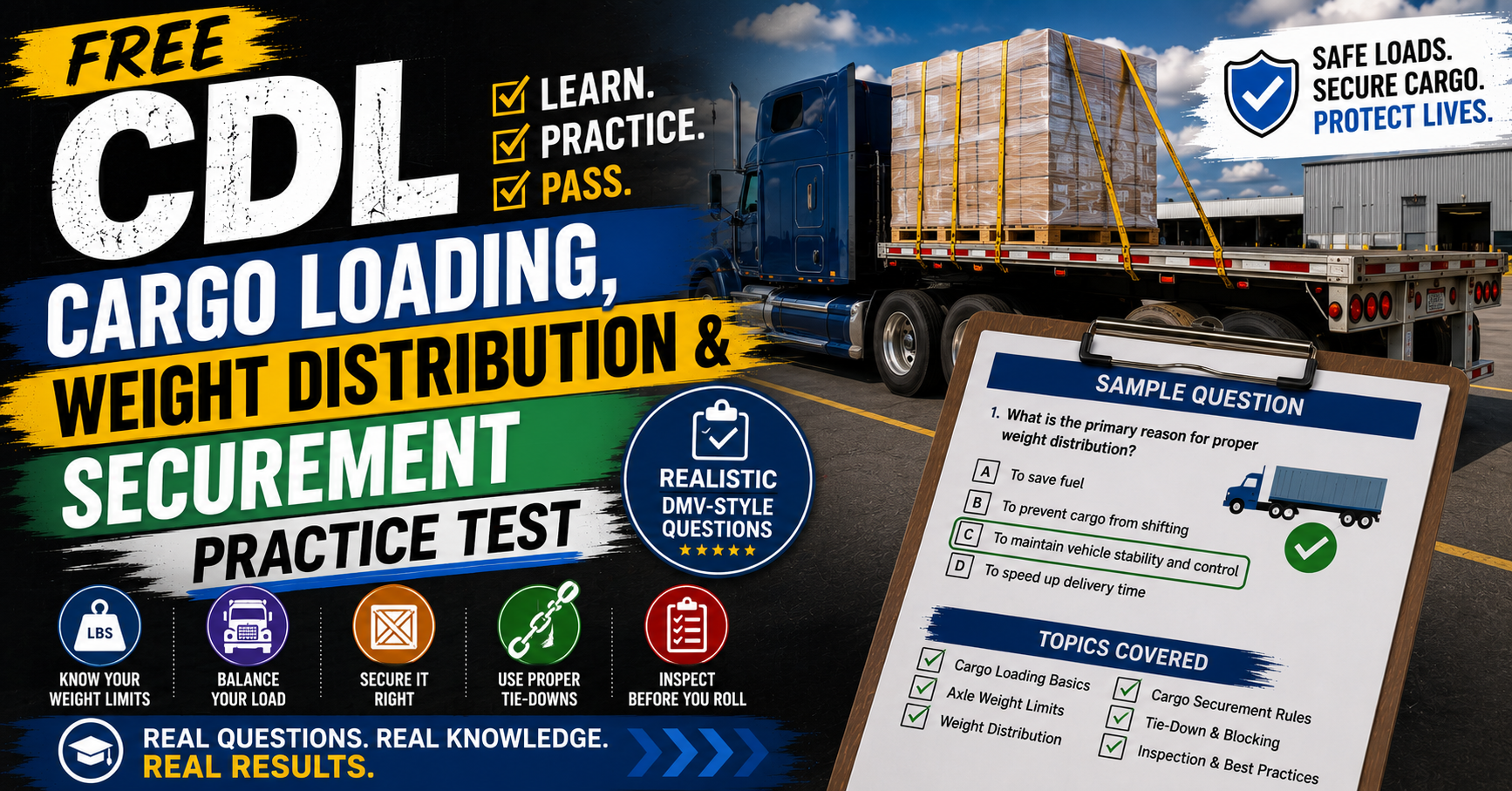
Free CDL Cargo Loading, Weight Distribution & Securement Practice Test
Knowing how to safely load and secure cargo is one of the most important responsibilities of every commercial driver. Improperly loaded cargo doesn’t just damage freight. It can affect steering, braking, vehicle stability, and even cause serious crashes if cargo shifts or falls onto the roadway.
Our Free CDL Cargo Loading, Weight Distribution & Securement Practice Test helps you prepare for this important portion of the CDL General Knowledge exam by presenting 25 realistic multiple-choice questions covering cargo securement, axle weights, weight distribution, tie-downs, cargo inspections, and safe loading practices. Every question includes an explanation so you understand why the correct answer is important, not just which answer to select.
If you’re beginning your CDL journey, you’ll also want to strengthen your foundation by working through our Free CDL General Knowledge Practice Test #1 before moving into specialized topics like cargo loading and securement.
Many new drivers think cargo inspection ends once the truck leaves the loading dock.
In reality, cargo should be checked throughout the trip.
Road vibration, braking, cornering, and weather can all affect securement.
Drivers should inspect their load:
Shortly after beginning the trip.
During required stops.
After hard braking.
Following sudden steering maneuvers.
Whenever something doesn’t feel or sound normal.
Regular inspections help identify problems before they become dangerous.
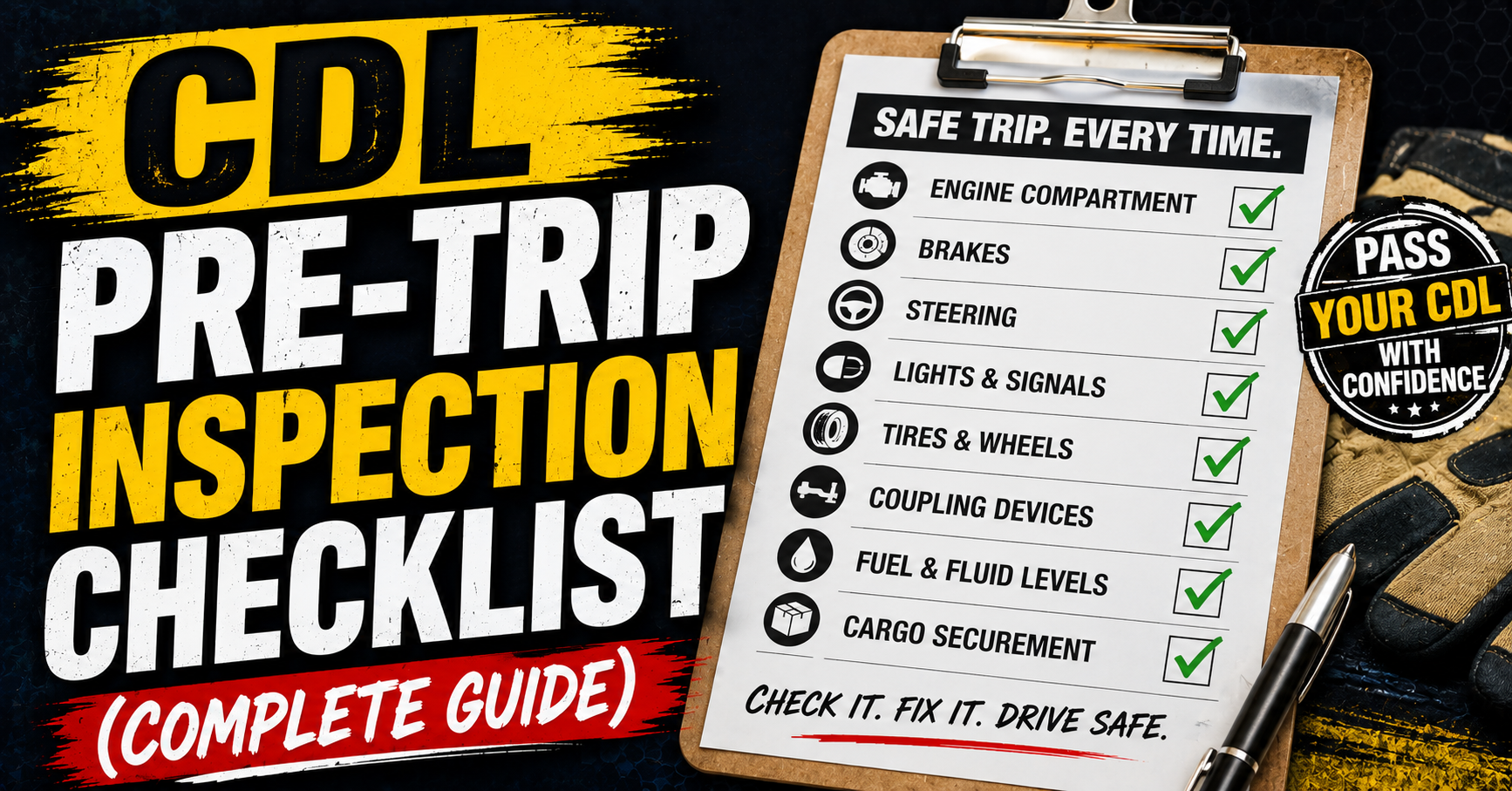
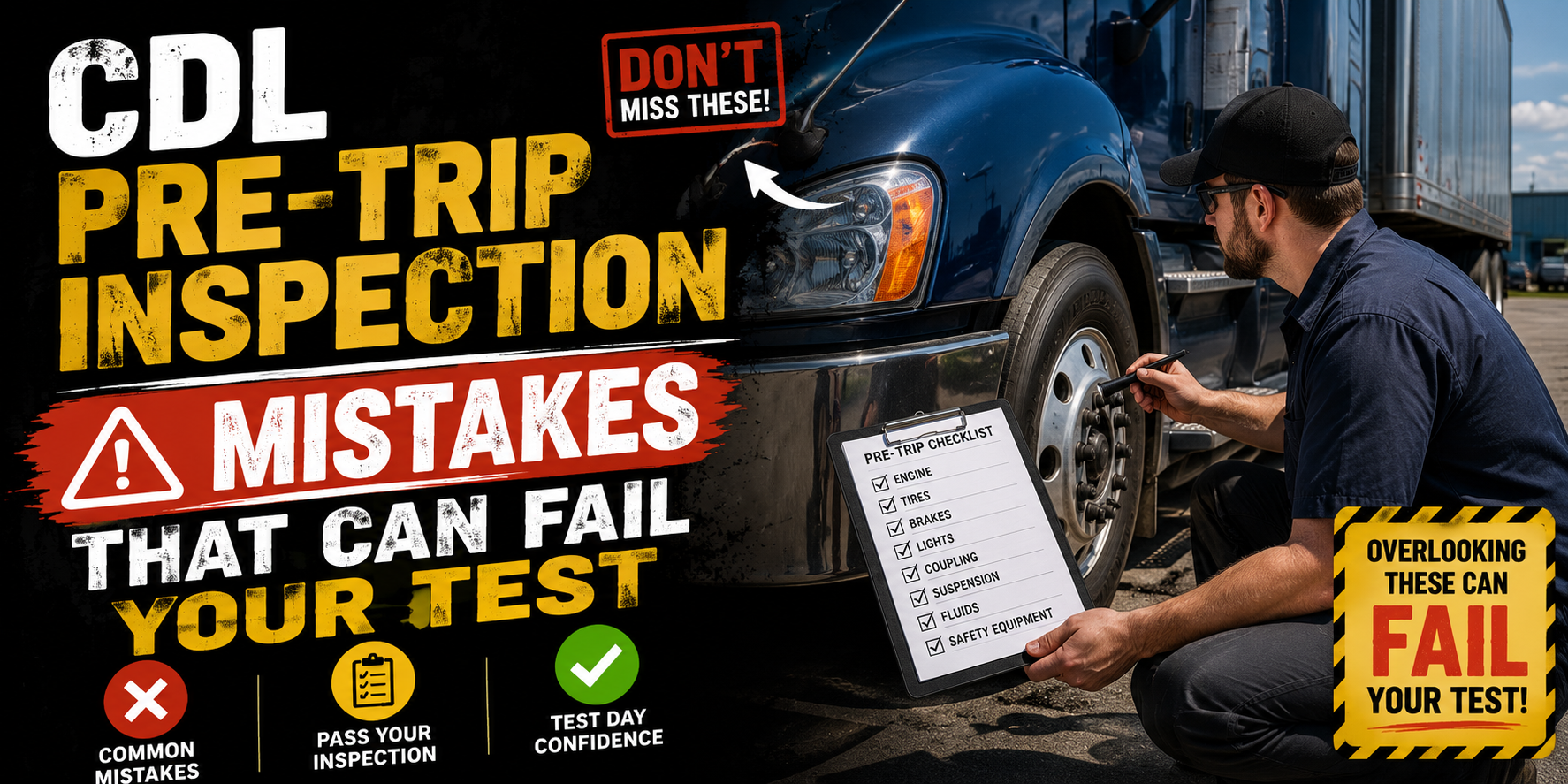
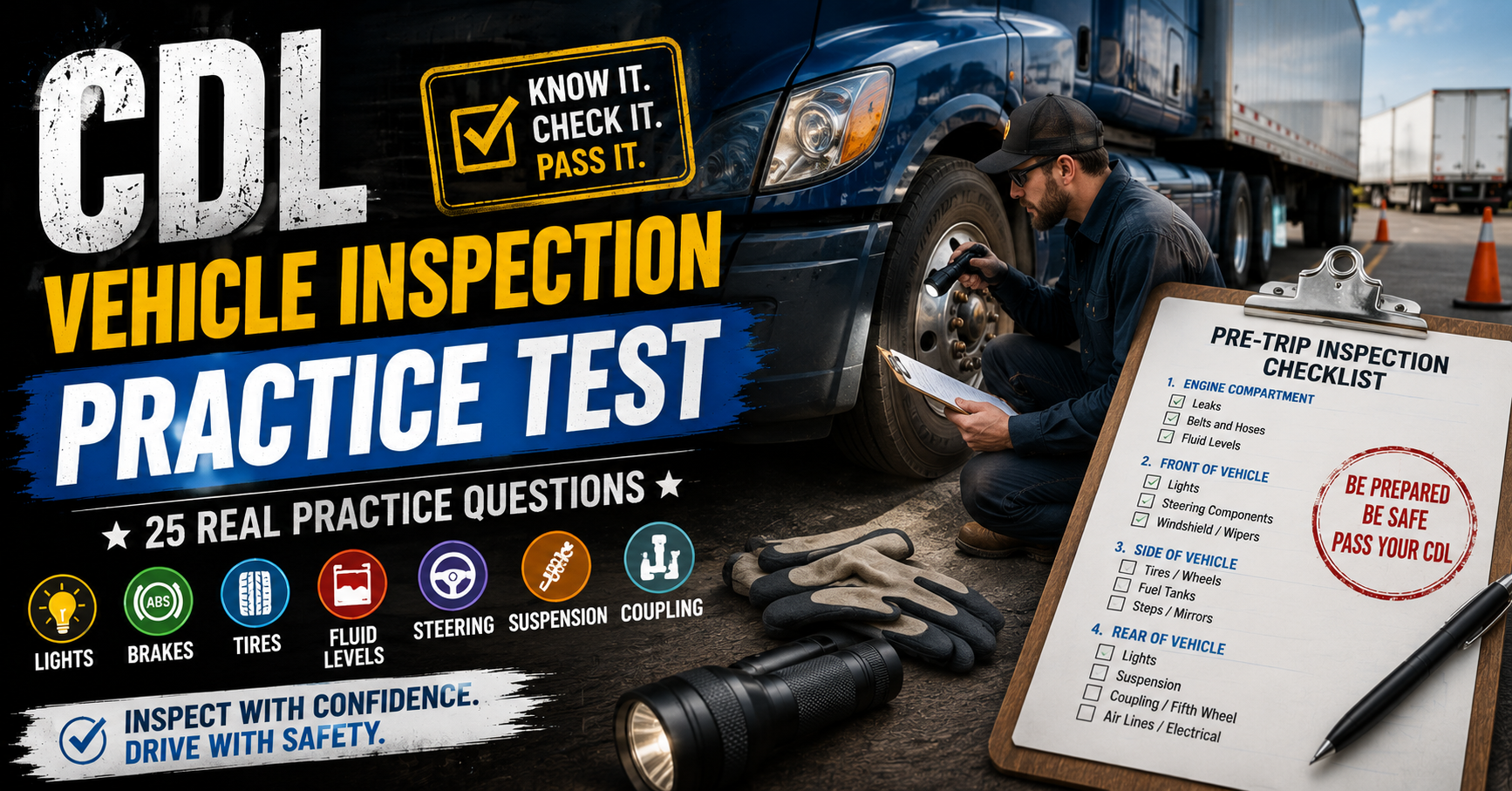
Continue building your understanding of commercial vehicle safety by taking our CDL Vehicle Inspection Practice Test. Knowing how to inspect both your truck and your cargo is an important part of becoming a safe professional driver.
Loose Cargo Can Become Extremely Dangerous
Even small items can create serious hazards if they’re not properly secured.
A shifting pallet can change how the truck handles.
Loose material can fall onto the roadway.
Tools left inside the cab may become dangerous projectiles during sudden stops.
Commercial drivers should think beyond simply keeping cargo inside the trailer.
Every item should remain secure from the moment the vehicle begins moving until the cargo is safely unloaded.
Proper cargo securement protects your equipment, your load, your CDL, and the lives of everyone around you.
Common Cargo Loading Mistakes
Many cargo-related violations happen because drivers overlook simple problems before leaving.
Some of the most common mistakes include:
Uneven weight distribution.
Damaged tie-downs.
Loose binders.
Unsecured equipment.
Overloaded axles.
Failing to inspect the load after departure.
Forgetting to secure loose items inside the cab.
Improperly latched trailer doors or tailgates.
Developing a consistent inspection routine helps prevent these mistakes and improves safety on every trip.
Planning Your Route Before Loading
Professional truck drivers don’t simply load cargo and start driving.
Before the trip begins, they think about the route they’ll be traveling.
Questions to consider include:
Are there low bridges?
Will I travel through mountain passes?
Are there weight-restricted roads?
Will I encounter construction zones?
Are there sharp curves or narrow roads?
Is the weather expected to change?
Knowing your route ahead of time helps prevent situations where a safe load becomes difficult to transport because of unexpected road conditions or restrictions.
Good planning is one of the easiest ways to reduce stress while improving safety.
Open Loads Require Additional Attention
Certain types of commercial vehicles, including dump trucks, flatbeds, and utility trailers, transport cargo that isn’t fully enclosed.
These loads require extra attention to prevent materials from leaving the vehicle.
Depending on the type of cargo, drivers may need to use:
Tarps
Cargo nets
Chains
Ratchet straps
Edge protectors
Blocking and bracing
Drivers should also check that tailgates, side panels, and doors are fully secured before entering public roads.
Even small pieces of loose material can create dangerous situations for other motorists.
Safe Loading Protects More Than Your Cargo
Many new CDL students think cargo securement is mainly about protecting the freight.
While that’s certainly important, properly securing cargo also protects:
You
Other drivers
Your commercial vehicle
Bridges and highways
Your employer
Your CDL
Your company’s reputation
A single improperly secured load can result in expensive damage, traffic citations, delayed deliveries, insurance claims, or serious injuries.
Developing good loading habits from the beginning of your trucking career helps prevent many of these problems.
Why Every Driver Should Understand Cargo Securement
Even if someone else loads your truck, you’re still responsible for operating a safe commercial vehicle.
Professional drivers never assume a load was secured correctly.
Instead, they perform careful inspections before leaving, during the trip, and whenever conditions suggest the cargo may have shifted.
Understanding proper cargo loading, weight distribution, and securement isn’t just about passing your CDL exam.
It’s about protecting yourself and everyone else on the road every time you get behind the wheel.
Frequently Asked Questions
How many questions are on this CDL Cargo Loading Practice Test?
This practice test includes 25 multiple-choice questions covering cargo loading, weight distribution, cargo securement, axle weights, tie-downs, and other important commercial driving topics.
Is cargo securement included on the CDL General Knowledge test?
Yes. Cargo loading and securement are common topics found in CDL manuals and General Knowledge exams because every commercial driver must understand how cargo affects vehicle safety.
Why is weight distribution important?
Proper weight distribution helps maintain steering control, improves braking performance, keeps axle weights within legal limits, and reduces the risk of rollovers or cargo shifting during transport.
What is a Working Load Limit (WLL)?
A Working Load Limit is the maximum load a securement device, such as a chain or strap, is designed to handle during normal use. Every component in the securement system should be properly rated for the cargo being transported.
How often should cargo be inspected?
Drivers should inspect cargo before beginning a trip, shortly after departing, during required stops, and anytime they suspect the load may have shifted because of braking, rough roads, or sharp turns.
What happens if cargo shifts while driving?
A shifting load can affect steering, braking, stability, and overall vehicle control. If you believe your cargo has shifted, safely pull over and inspect the load before continuing your trip.
Continue Building Your CDL Knowledge
Cargo loading and securement are only one part of becoming a safe commercial driver.
To prepare for every section of your CDL permit exam, continue working through our growing collection of free practice tests covering General Knowledge, vehicle inspections, safe driving, braking, stopping distance, and other essential commercial driving topics.
The more practice tests you complete, the more familiar you’ll become with the concepts that appear on CDL exams, while also building the knowledge and confidence needed for a successful career behind the wheel.