
Before I started hauling grain during harvest, I had seen grain augers plenty of times.
I knew they moved corn from one place to another.
What I didn’t understand was how they actually worked or why there seemed to be augers everywhere on a farm.
After spending time hauling grain, it finally clicked.
A grain auger is one of the hardest-working pieces of equipment on the farm.
Without it, moving thousands of bushels of corn between trucks, grain bins, dryers, and storage systems would require far more labor and much more time.
If you’ve ever watched grain disappear into one end of a long tube and magically come out the other, you’ve already watched a grain auger doing its job.
What Is a Grain Auger?
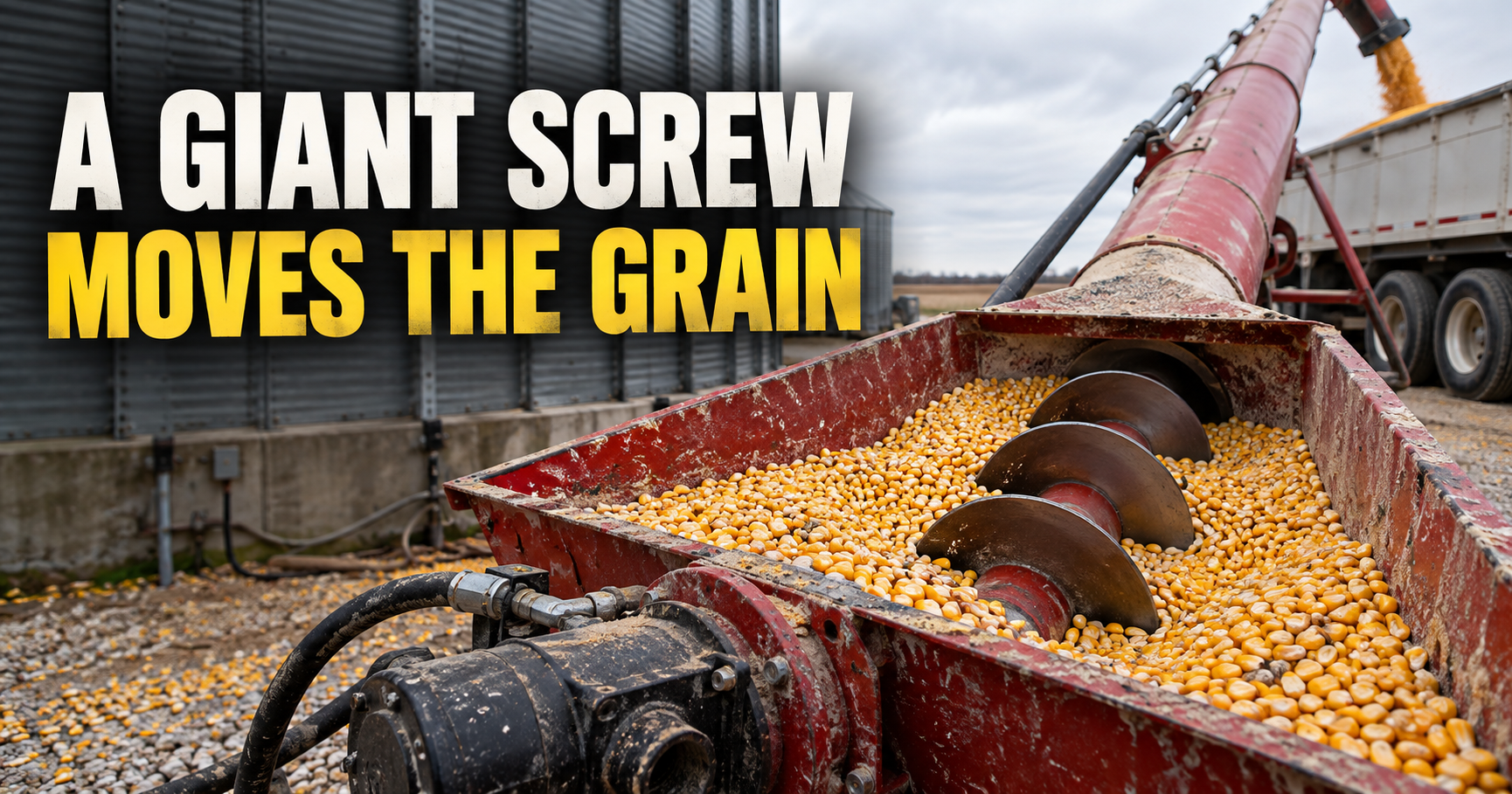
A grain auger is a machine that moves grain using a rotating screw, often called flighting, enclosed inside a steel tube.
As the screw turns, it pushes grain through the tube toward the discharge end.
That simple design allows grain to be moved:
- From trucks into grain bins.
- Between grain bins.
- Out of storage bins.
- Into grain dryers.
- Into grain elevators.
- Into feed systems.
Despite looking fairly simple from the outside, grain augers have become one of the most important pieces of equipment used in modern grain handling because they move large amounts of grain quickly and efficiently. Augers are used throughout the grain production process, from harvest through storage and eventual loading for sale.



The Basic Parts of a Grain Auger
Although grain augers come in many different sizes, most share the same basic components.
Hopper
The hopper sits at the bottom of the auger.
This is where grain enters the system.
It may receive grain directly from:
- A dump truck.
- A hopper-bottom trailer.
- Another auger.
- A grain bin.
- A grain cart.
Flighting
Inside the tube is the flighting.
Think of it as one long steel spiral.
As it rotates, that spiral gently pushes the grain toward the discharge end.
The faster the flighting turns, the faster grain moves through the auger.
This rotating helical flighting is the part that actually transports the grain through the tube.
Tube
The steel tube keeps the grain contained while it’s being transported.
Depending on the job, the tube may be:
- Horizontal.
- Angled.
- Nearly vertical.
Portable augers usually operate at an angle so grain can be lifted into tall storage bins.
Drive System
Every auger needs power.
That power may come from:
- A tractor PTO.
- An electric motor.
- A hydraulic motor.
- A gasoline or diesel engine.
Today I was working with a PTO-powered auger, where the tractor supplied all the power needed to move the corn between grain bins.

Why Farmers Use Grain Augers Instead of Conveyors
People sometimes ask why farms don’t simply use conveyor belts everywhere.
The answer usually comes down to simplicity and cost.
Grain augers are:
- Relatively inexpensive.
- Easy to move.
- Simple to operate.
- Capable of moving thousands of bushels per hour.
- Available in many different lengths and capacities.
That’s why you’ll find them on farms of nearly every size. Portable augers remain one of the most common grain-moving systems because they are versatile, efficient, and relatively economical.
Portable Augers vs Permanent Augers
Not every grain auger is the same.
Some are portable.
Others stay in one place year-round.
Portable augers are the ones most people recognize.
They’re mounted on wheels so they can be pulled from one grain bin to another, positioned where they’re needed, and then moved again when the job is finished.
Permanent augers are built into many grain handling systems.
Instead of being moved around the farm, they’re installed as part of the grain storage setup and move grain between bins, dryers, and loading areas whenever needed.
Both do the same basic job.
They just do it in different ways.



PTO-Powered Augers Are Common on Farms
The auger I was working around today was powered by a tractor.
Instead of having its own engine, it used the tractor’s Power Take-Off, better known as the PTO.
The PTO shaft connects the tractor to the auger’s gearbox.
Once the PTO is engaged, the tractor transfers engine power directly to the auger, allowing it to move thousands of bushels of grain every hour.
It’s a simple system that’s been used on farms for decades because it’s dependable and doesn’t require a separate engine for every piece of equipment.
If you’re not familiar with PTO systems, they’re used for much more than grain augers. They also power equipment like mowers, balers, manure spreaders, and many other farm implements.
Grain Augers Save an Incredible Amount of Labor
It’s hard to imagine moving grain without an auger until you stop and think about how much corn is actually being handled.
A single dump truck or hopper trailer can carry thousands of pounds of grain.
Now imagine unloading that by hand.
It simply wouldn’t be practical.
Grain augers make it possible for one person to move enormous amounts of grain quickly and efficiently with very little physical effort.
That’s one reason you’ll find augers on farms of almost every size.
Grain Augers Need to Be Respected
One thing that became obvious to me the first time I stood next to one was how powerful they really are.
They may not look intimidating compared to a combine or tractor, but they’re capable of causing life-changing injuries in seconds.
The rotating flighting doesn’t know the difference between corn and a glove, sleeve, or hand.
That’s why experienced farmers are so careful around them.
A few basic rules go a long way:
- Never reach into a running auger.
- Shut the PTO off completely before clearing a blockage.
- Stay away from exposed PTO shafts.
- Keep loose clothing away from moving equipment.
- Never allow children to play around operating augers.
Agricultural safety organizations consistently identify grain augers and exposed PTO shafts as some of the most dangerous pieces of equipment on the farm because they can entangle clothing or body parts almost instantly. (extension.psu.edu)
Maintenance Makes a Big Difference
Like any piece of farm equipment, grain augers need regular maintenance.
Operators commonly inspect things like:
- Flighting wear.
- Bearings.
- Drive chains.
- PTO shaft shields.
- Gearboxes.
- Tires on portable augers.
- Belts, where applicable.
Keeping the auger in good condition doesn’t just help it last longer.
It also helps prevent downtime during busy times like harvest when every hour counts.

Where You’ll See Grain Augers Working
Once I started paying attention, I realized grain augers are everywhere.
You might see them:
- Loading grain bins.
- Emptying grain bins.
- Feeding grain dryers.
- Loading trucks.
- Moving grain between storage bins.
- Filling livestock feed systems.
They’re one of those machines most people never think about until they spend time around agriculture.
Then you realize just how important they are.
Frequently Asked Questions
What powers a grain auger?
Many portable grain augers are powered by a tractor’s PTO, although some use electric motors, hydraulic motors, or their own gas or diesel engines.
Can grain augers move grain uphill?
Yes.
That’s one of their biggest advantages.
Portable grain augers are specifically designed to lift grain into tall storage bins and other elevated locations.
Are grain augers dangerous?
Yes.
The rotating flighting and exposed PTO shafts can cause severe injuries if proper safety procedures aren’t followed. Grain augers should always be shut down completely before maintenance or clearing a blockage. (extension.psu.edu)
How much grain can an auger move?
It depends on the size and design of the auger. Smaller portable augers may move a few thousand bushels per hour, while larger commercial systems can handle significantly more.
One of the Most Important Machines on the Farm
Before I started hauling grain, I honestly didn’t appreciate how important grain augers were.
Now I see them as one of the machines that quietly keeps everything moving.
Without them, loading trucks, filling grain bins, transferring grain between storage bins, and preparing grain for market would take much longer and require far more labor.
They’re simple.
They’re reliable.
And once you understand how they work, it’s easy to see why almost every grain operation depends on them.
Author: Jake Harrison
Jake Harrison is a commercial transportation writer for TruckingResource.com who specializes in commercial trucking, agricultural transportation, CDL training, and equipment. He works with the TruckingResource.com editorial team to create detailed, beginner-friendly guides that explain the equipment and systems that keep farms and the trucking industry moving.