

A gauge marked CHARGE on one side and DISCHARGE on the other can be confusing the first time you really pay attention to it.
Unlike a voltage gauge, an ammeter isn’t mainly telling you whether the electrical system has 12, 13, or 14 volts available.
It’s showing you something different.
The ammeter tells you whether electrical current is flowing into the batteries or out of them.
Once you understand that basic idea, the gauge becomes pretty easy to read. A needle moving toward charge means the charging system has current available to replenish the batteries. Movement toward discharge means the batteries are supplying some of the truck’s electrical demand.
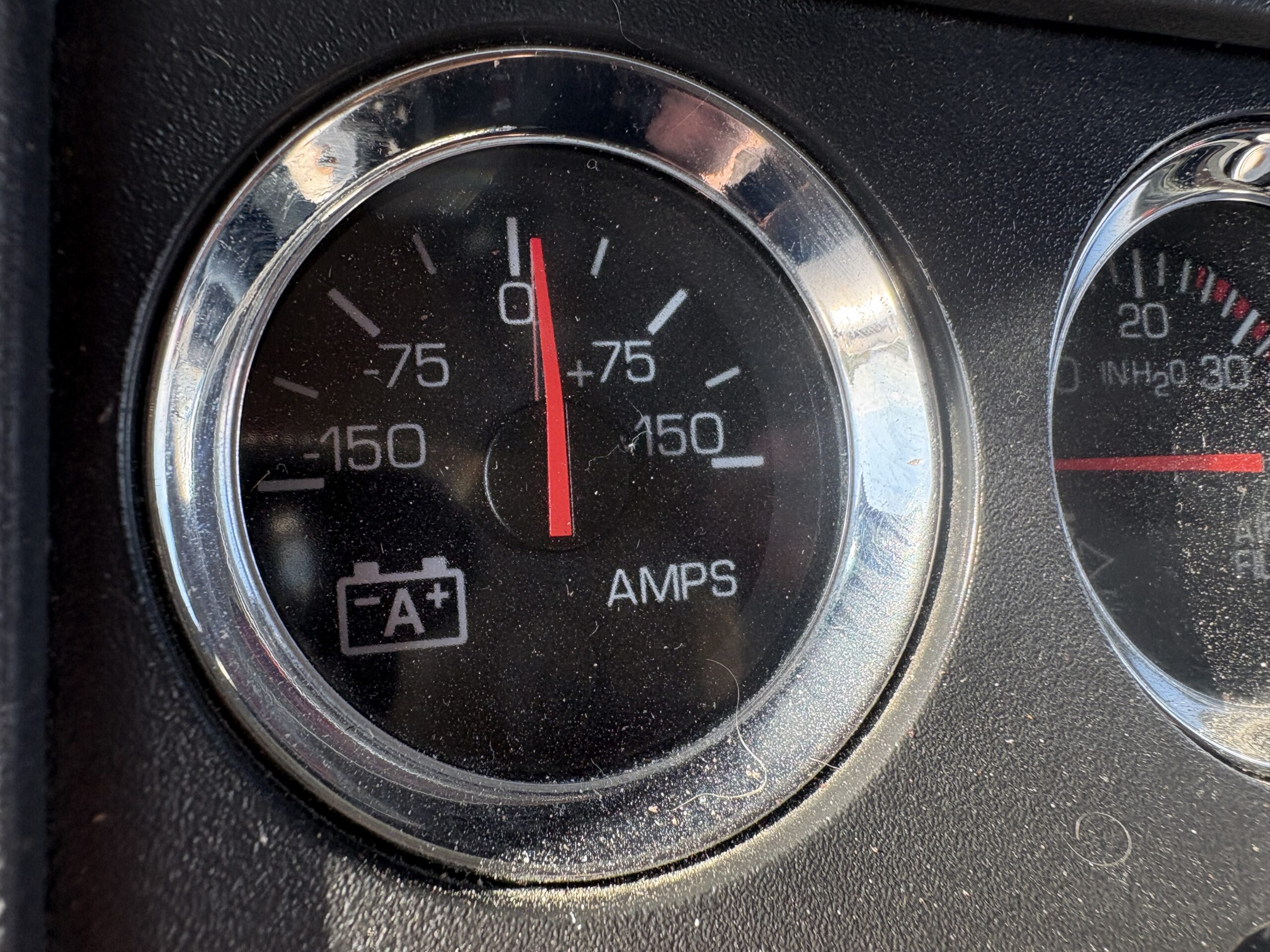
What Does an Ammeter Actually Measure?
An ammeter measures electrical current, normally expressed in amps.
That’s different from the voltmeter we covered in What Is Normal Voltage on a Semi Truck?.
A simple way to think about the difference is this:
Voltage tells you electrical pressure.
Amperage tells you electrical current flow.
On a traditional truck ammeter, the important information isn’t necessarily one exact amp reading. You’re watching which direction current is flowing.
Toward CHARGE means current is available to charge the batteries.
Toward DISCHARGE means the batteries are supplying current because the electrical system is demanding more than the alternator is currently providing.



Why Does the Ammeter Sit Near Zero Most of the Time?
This is where people sometimes think their gauge isn’t working.
You’re driving down the road and the needle is sitting almost dead center.
Shouldn’t the alternator constantly be showing a big charge?
No.
Once the batteries are charged, the alternator doesn’t need to keep hammering them with a huge charging current.
The voltage regulator controls alternator output based on what the electrical system needs. When the alternator is handling the truck’s electrical demand and the batteries don’t need much additional charging, the ammeter can sit very close to zero.
In other words, near zero can be completely normal.



Why Does It Show Charge Right After Starting?
Starting a diesel takes a lot out of the batteries.
The starter needs substantial current to crank that big engine.
Once the engine fires, the alternator begins replacing the energy that was just removed from the batteries.
That’s when you may see the ammeter move toward the charge side.
As the batteries recover, the needle should generally move back closer toward center.
That makes the first few minutes after startup one of the easiest times to understand what the gauge is showing you.
The batteries gave up energy to start the truck.
Now the charging system is putting it back.
What Does Discharge Mean?
A discharge reading means electrical current is leaving the batteries.
That isn’t automatically a problem.
Imagine the engine is shut off but you’ve left the headlights or another electrical accessory running.
The alternator isn’t turning.
Something has to supply that electricity.
The batteries do it.
The ammeter moves toward discharge because current is flowing out of the batteries to power those accessories. Traditional ammeter troubleshooting procedures specifically use headlights and the heater fan with the engine stopped to verify that the gauge moves toward discharge.
That’s completely expected.
A sustained discharge reading with the engine running, however, is much more interesting.



Why Would It Show Discharge With the Engine Running?
With the engine running at normal speed, you’d generally expect the alternator to handle the truck’s electrical demand while keeping the batteries charged.
If the ammeter stays noticeably on the discharge side, the batteries may be supplying power that the alternator isn’t replacing.
Possible causes include:
- Alternator trouble.
- A slipping or broken alternator belt.
- Loose or corroded electrical connections.
- Wiring problems.
- A charging-system fault.
- Electrical demand temporarily exceeding available alternator output.
Freightliner’s operator guidance describes a consistent negative ammeter reading with the engine running as a possible charging-system problem.
That doesn’t tell you exactly which component failed.
It tells you something deserves attention.
Heavy Electrical Loads Can Move the Needle
Turn on enough equipment and the charging system suddenly has a lot more work to do.
Headlights.
Work lights.
Heater blower.
Wipers.
Heated mirrors.
CB radio.
Other accessories.
If those loads temporarily exceed what the alternator is producing, especially at low idle, current can come from the batteries and the ammeter may move toward discharge.
Increase engine RPM and alternator output may increase enough for the needle to move back toward center or charge.
That’s why one quick glance at an ammeter isn’t always enough to diagnose anything.
Watch what the gauge does as conditions change.
Why the Ammeter and Voltage Gauge Can Look Completely Different
This is probably the most important distinction in this article.
You can have a voltage gauge sitting around normal charging voltage while the ammeter is near zero.
That’s not contradictory.
They’re measuring different things.
The voltmeter is showing the electrical system’s voltage.
The ammeter is showing current flow into or out of the battery circuit.
Once the batteries are replenished after startup, they may need very little charging current. The ammeter moves back toward center even though the charging system is still maintaining normal voltage.
That’s why it’s useful to understand both gauges instead of trying to use one as a replacement for the other.
What If the Ammeter Stays on Charge?
Seeing charge immediately after starting can be perfectly normal.
Seeing a strong charge indication that never settles down deserves more attention.
The charging system may be continually trying to replenish batteries that aren’t reaching or holding a proper state of charge.
Possible reasons could include weak batteries or another charging-system issue.
Again, the ammeter isn’t going to tell you exactly which part is bad.
It’s giving you a clue that the electrical system isn’t behaving the way it normally does.



What If It Suddenly Goes Deep Into Discharge?
A sudden major change matters more to me than a tiny needle movement.
If the truck normally runs with the ammeter around center and suddenly it moves well into discharge while you’re driving, something has changed.
Pay attention to the rest of the truck.
Did the voltage gauge also drop?
Did a warning light appear?
Did the alternator belt fail?
Are the headlights getting dimmer?
Did the heater blower suddenly slow down?
Multiple symptoms together can tell you much more than one gauge by itself.

If you’re seeing discharge along with falling voltage, our semi truck voltage guide explains what those voltage readings can tell you about the batteries and charging system.
Can You Keep Driving With the Ammeter Showing Discharge?
A brief discharge under a heavy electrical load isn’t the same thing as a sustained discharge while driving.
If the gauge remains noticeably on the discharge side and the truck’s voltage is also falling, I’d take that seriously.
The truck may be operating from stored battery power rather than receiving enough output from the alternator.
Eventually those batteries will discharge.
At that point you can start getting electrical problems, warning lights, dimming lights, and potentially a truck that won’t restart after it’s shut down.
Rather than trying to see how far you can make it, find a safe place to diagnose the charging problem.
Why Some Trucks Don’t Have an Ammeter
You won’t find this gauge on every modern semi truck.
Many newer vehicles rely primarily on a voltmeter, warning lights, and electronic monitoring rather than a traditional ammeter.
A voltmeter is simpler to integrate because it doesn’t need to directly measure the heavy current flow of the charging circuit in the same way as a conventional ammeter. Some ammeters instead use a shunt that allows the gauge to infer current flow from a small voltage difference.
That’s why one truck dashboard may have both volts and amps while another only gives you system voltage.
Don’t Confuse a Centered Needle With a Dead Gauge
If your ammeter spends most of the day near center, that can actually be exactly what you want.
The batteries aren’t being heavily discharged.
They also don’t require a huge charging current.
The alternator is essentially keeping up with the truck’s electrical needs.
A centered needle by itself isn’t evidence that the gauge has failed.
What matters is whether it responds when conditions actually change.
Frequently Asked Questions
What should an ammeter read on a semi truck?
There isn’t one universal amp number. On a traditional charge/discharge ammeter, a reading near center can be normal once the batteries are charged. The needle may move toward charge after startup and toward discharge when battery power is being used.
Why does my ammeter show charge after I start the truck?
The starter just pulled energy from the batteries. Once the engine starts, the alternator begins replenishing that energy, which can move the ammeter toward the charge side.
Why does the needle eventually return toward zero?
As the batteries recover, they need less charging current. The regulator reduces alternator output to what the electrical system requires, so the ammeter can settle near center.
Is discharge always bad?
No. Discharge with the engine off and electrical accessories operating is expected because the batteries are supplying the power. Sustained discharge while the engine is running is much more concerning.
What’s the difference between amps and volts on a semi truck?
Voltage represents electrical potential in the system. Amperage represents electrical current flow. That’s why the voltmeter and ammeter can show very different-looking readings while both are operating normally.
Does a discharge reading mean the alternator is definitely bad?
No. The alternator is one possibility, but belts, wiring, connections, batteries, regulators, and unusually high electrical loads can also contribute to abnormal charging behavior.
Watch the Direction More Than the Exact Number
The ammeter becomes much easier to understand when you stop treating it like an oil pressure gauge.
You’re not necessarily waiting for the needle to reach one perfect number.
You’re watching what direction electricity is moving.
Toward charge after starting makes sense.
Back toward center once the batteries recover makes sense.
Toward discharge with the engine off and accessories running makes sense.
A sustained discharge while you’re driving is the situation that should get your attention.
Once you understand those patterns, that little CHARGE/DISCHARGE gauge stops looking mysterious and starts becoming another useful way to catch an electrical problem before it leaves you sitting beside the road.
Author: Ryan Cole
Ryan Cole writes about diesel trucks, electrical systems, and everyday commercial vehicle maintenance for TruckingResource.com. His work focuses on turning confusing dashboard readings and truck problems into straightforward information drivers can actually use.