
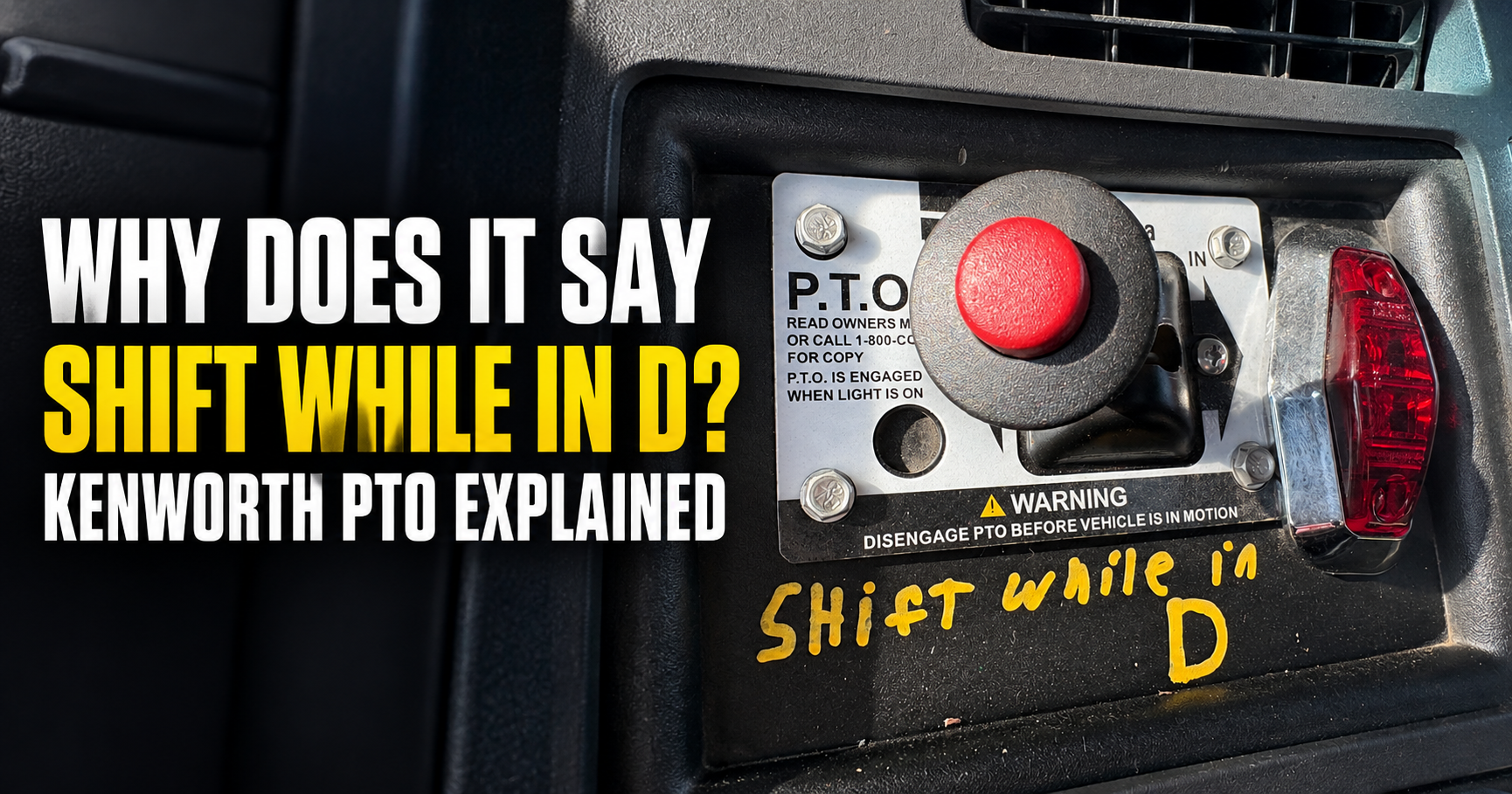
I took a close look at this PTO control in a Kenworth because the handwritten note below it caught my attention. In yellow marker, someone wrote “SHIFT while in D.” Right above that note, the printed warning says “DISENGAGE PTO BEFORE VEHICLE IS IN MOTION.”
At first glance, those instructions seem to clash. Why would someone write “D” for Drive beside a control that also warns you to disengage the PTO before moving?
I would not treat the handwritten note as a complete operating procedure. The photo gives us useful clues about the control, but it does not identify the exact PTO model, transmission, or equipment the PTO powers. Those details determine what “shift while in D” means on this particular truck.
What the Photo Actually Shows
The metal plate is labeled P.T.O. It also says “P.T.O. IS ENGAGED WHEN LIGHT IS ON.” Beside the control is a red indicator light. A large red-topped control sits in front of part of the printed instructions, and the handwritten “SHIFT while in D” note is below the plate.
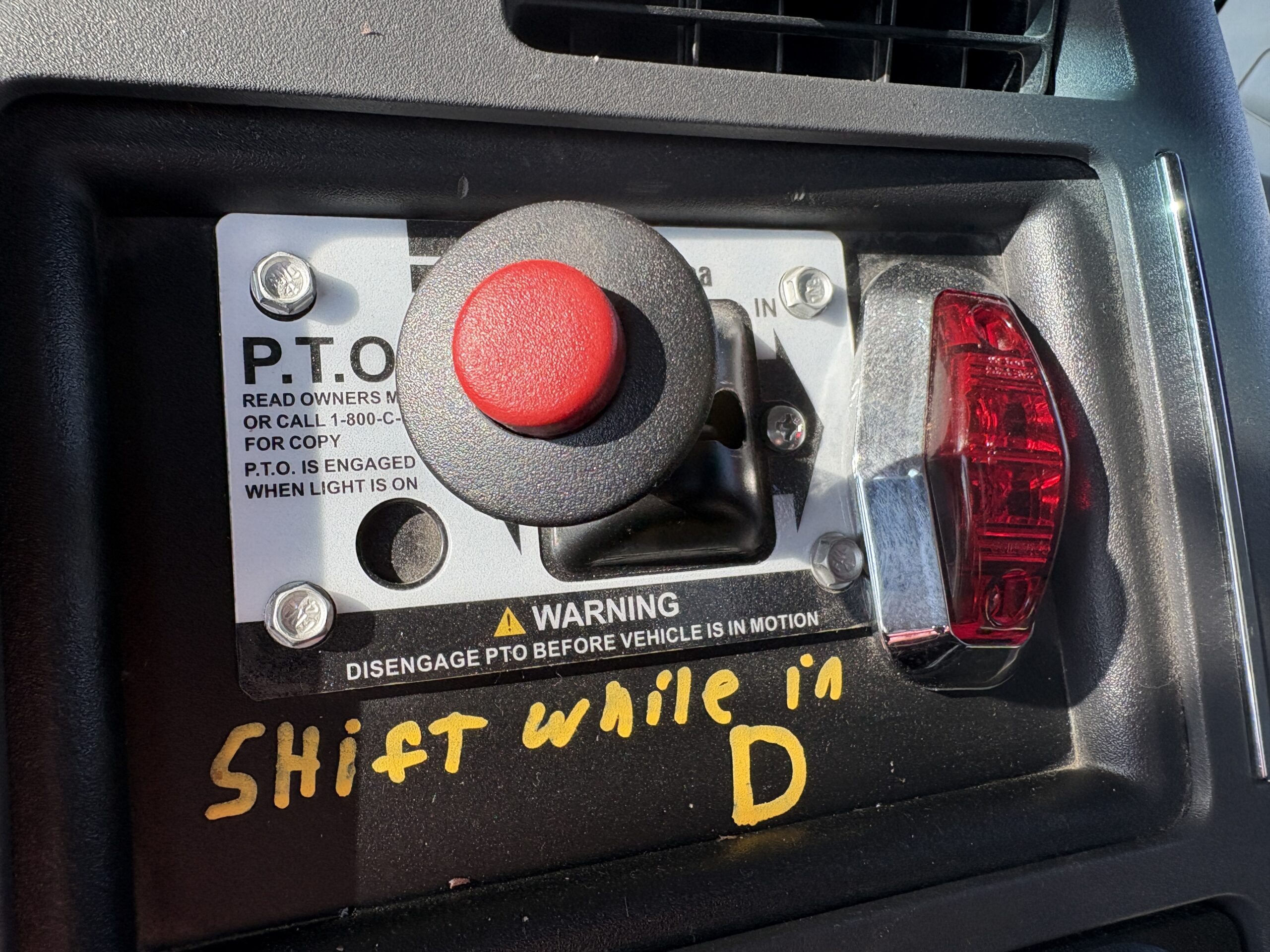
The printed warning at the bottom is clear: disengage the PTO before the vehicle is in motion. The handwritten note appears to tell the driver when to shift the PTO control, but it leaves out the rest of the conditions that would matter, such as brake position, engine speed, and the correct sequence for that transmission.
I can read D as a likely reference to Drive, but I cannot prove from the photo alone that this is what the writer meant. I also cannot tell whether the red light was illuminated when the picture was taken. The lens looks red even when unlit, so its color in a still photo is not proof that the PTO was engaged.



Does “Shift While in D” Mean Drive Down the Road With the PTO On?
I would not read it that way. The printed warning directly says to disengage the PTO before the vehicle is in motion.
There is a difference between a transmission being selected in Drive and a truck actually moving. The handwritten note may refer to a particular condition required to engage or disengage this PTO while the truck is held stationary. That is a possible explanation for why both messages appear in the same place, but I would not present it as the confirmed procedure for this Kenworth.
A driver would need the truck’s operating instructions or a demonstration from someone responsible for that equipment before acting on the note. A handwritten reminder may make perfect sense to the person who wrote it while leaving out steps that a new driver needs to know.



What Is That Red Light For?
The plate supplies the answer: the PTO is engaged when the light is on. That makes the light an important indication to check before the vehicle moves.
I would not rely on the light alone if the truck behaved unexpectedly, though. An indicator tells you what its electrical system is reporting. If the light does not respond as expected, the control feels wrong, or the powered equipment acts strangely, stop and have the setup checked.

For a plain-English explanation of what the PTO is powering, see our article on how a dump truck PTO works. A PTO can run a hydraulic pump, but this photo by itself does not show whether this Kenworth operates a dump body, trailer hydraulics, or another piece of equipment.
Is This the Gear Shifter or the PTO Shifter?
From the label around it, the control shown is associated with the PTO. The word “SHIFT” in the handwritten note may mean moving this PTO control between its positions. I would not assume it means shifting the truck’s regular transmission through its driving gears.
That distinction is easy to miss when someone writes a short instruction on the dash. “Shift while in D” sounds like a direction about the truck’s transmission until you notice that the writing is directly beneath a PTO control.
The plate’s IN marking and arrows also suggest positions for that control, but the red top blocks part of the printed label. I would want to see the full plate and the equipment identification before assigning a meaning to every position.



What I Would Check Before Operating This Kenworth
First, I would identify the truck and transmission model, then find the PTO and body equipment instructions for that exact setup. I would also ask what the PTO powers. Operating a dump bed is a different job from operating another hydraulic attachment, even though both may use a PTO.
Next, I would ask an experienced operator to demonstrate what “SHIFT while in D” means here while the truck is secured. I would have them show me what the red light does during engagement and disengagement, what control position is used for travel, and how they confirm the powered equipment is safely stowed.
Finally, I would ask whether that handwritten note is current. Trucks can be repaired or modified while an old instruction remains on the dash. The note may be useful, but the installed equipment and its current instructions are what I would trust.
That might feel like a lot of questions about one short line of marker. To me, it is the reasonable response to two messages that could be misunderstood if you try to fill in the missing steps yourself.
Why Would Someone Write a Reminder Beside a PTO Control?
My best guess is that a driver or mechanic wanted to prevent someone from shifting the PTO under the wrong transmission conditions. The instruction may be specific to this truck’s PTO arrangement.
That is an inference from the location of the writing, not something I can verify from the picture. I would not turn it into a rule for other Kenworth trucks. Another truck with a different PTO or transmission may require a different sequence.
The printed warning, on the other hand, is visible and unambiguous about travel: this installation says to disengage the PTO before the vehicle is in motion. That is the part I would want every driver to notice before pulling away.
Can You Identify the Exact PTO From This Picture?
Not reliably. The photo shows the in-cab control plate, indicator, and handwritten instruction, but the red-topped control covers some of the text. There is no clear PTO model number visible.
A photo of the complete plate, the transmission identification, and the PTO unit itself would help narrow it down. Until then, I would describe this as a Kenworth with a PTO control marked “Shift while in D,” rather than claim it uses one particular PTO model.
The photo is still useful. It shows why I would slow down when getting into a truck I have not operated before. I can read the warning, identify the indicator light, and see that someone thought the shifting condition was important enough to write on the dash. What I cannot get from the photo is a safe, complete sequence for operating that particular truck.
About the author: Dax earned his Class A CDL on his first attempt after an accelerated course at Ross Trucking School. He writes for TruckingResource.com about the equipment and questions new commercial drivers encounter. This article examines his photo of a Kenworth PTO control; it does not claim he operated or tested this PTO.