

You turn the key on and glance at the voltage gauge. It’s sitting a little above 12 volts.
Start the engine and suddenly the gauge climbs into the 13s or 14s.
Nothing went wrong. On a typical 12-volt heavy truck electrical system, that’s exactly the kind of change you’d expect once the alternator starts charging.
The voltage gauge is easy to ignore when everything works. It becomes a lot more interesting when the truck cranks slowly, headlights look dim, warning lights appear, or the needle suddenly isn’t sitting where you’re used to seeing it.
Understanding the difference between normal battery voltage and normal charging voltage can give you an early warning that something isn’t right before you’re sitting somewhere with a truck that won’t restart.
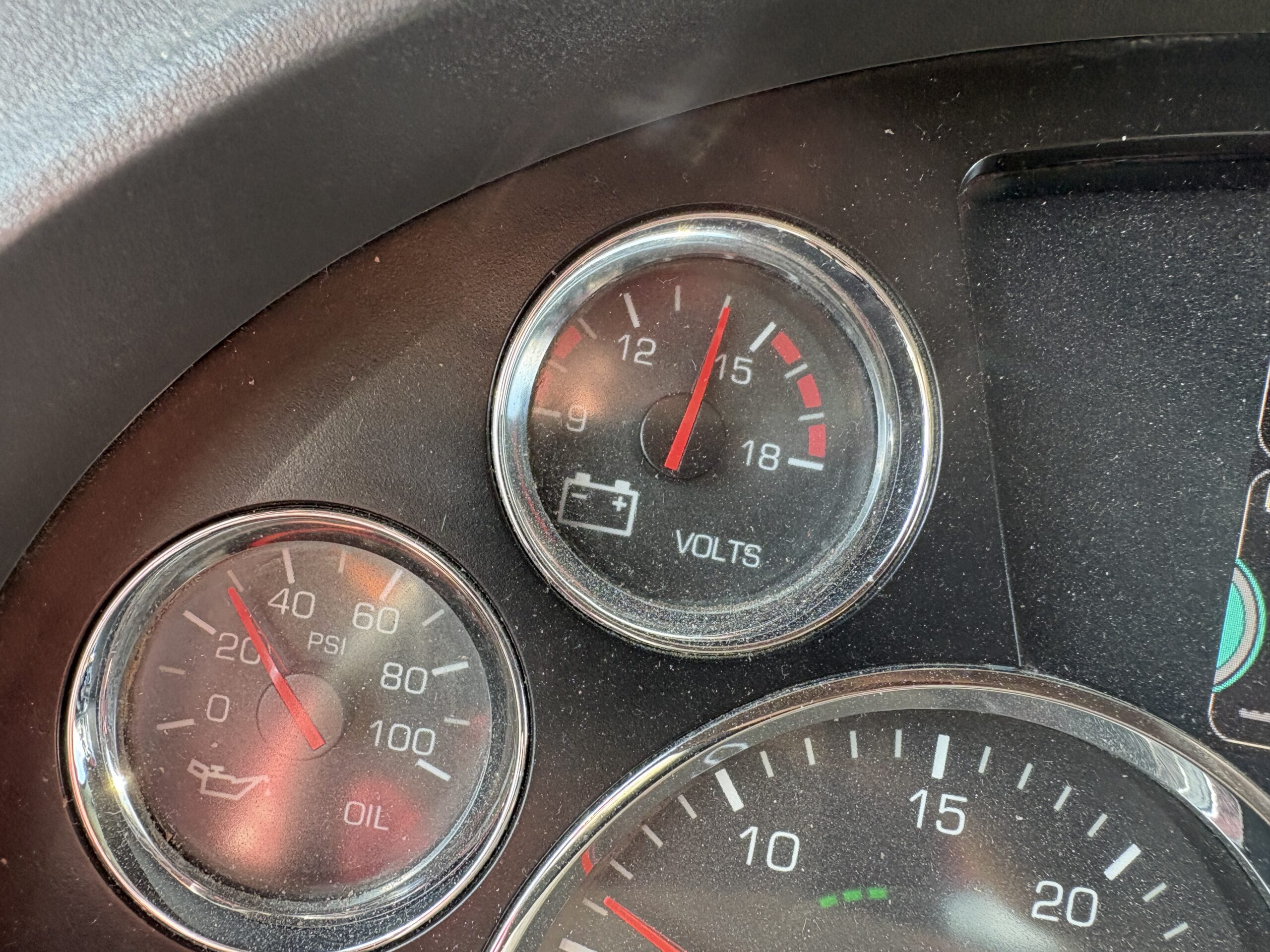
What Does the Voltage Gauge Actually Tell You?
The voltage gauge, or voltmeter, shows the electrical voltage available in the truck’s electrical system.
What the number means depends heavily on whether the engine is running.
With the engine shut off, you’re primarily looking at battery voltage.
With the engine running, you’re seeing the charging system at work while the alternator supplies electrical power and replenishes the batteries.
That’s why 12.5 volts can mean something completely different with the engine off than it does while you’re driving down the highway.

The voltage gauge is another good example of why understanding the dashboard matters instead of simply waiting for a warning light. The same idea applies to gauges such as oil pressure. Our guide to normal oil pressure on a semi truck explains why that reading also changes depending on what the engine is doing.



What’s Normal With the Engine Off?
Most conventional heavy-duty trucks in the United States use a 12-volt electrical system, although they commonly use several batteries to provide the cranking power needed by a large diesel engine.
A fully charged 12-volt lead-acid battery at rest is generally around 12.6 volts.
That doesn’t mean you should panic because the dashboard shows 12.4 instead of 12.6.
Battery state of charge, outside temperature, recent electrical use, how long the truck has been sitting, and the accuracy of the dashboard gauge can all affect what you see.
This is where knowing your particular truck becomes valuable.
If you normally turn the key on every morning and see roughly the same reading, then one morning the gauge is noticeably lower and the engine cranks much slower, that’s useful information.
Something changed.



What’s Normal With the Engine Running?
Once the engine starts, voltage should normally rise above resting battery voltage because the alternator is now charging.
On many conventional 12-volt heavy trucks, something roughly in the upper 13-volt to mid-14-volt range while running is common.
Don’t treat that as a specification for every truck ever built.
Kenworth, Peterbilt, Freightliner, Mack, Volvo, International, Western Star, and other trucks can use different engines, alternators, batteries, regulators, and charging strategies.
Manufacturer specifications for the truck you’re actually driving always take priority.
For everyday driving, however, there’s a simple pattern worth remembering:
Engine off: roughly battery voltage.
Engine running: voltage should normally rise because the charging system is operating.
Why Does the Voltage Jump After You Start the Truck?
Starting a large diesel takes a lot of electrical energy.
When you engage the starter, the batteries have to provide enough current to turn over an engine with considerable compression.
Once the engine fires, the starter disengages and the alternator takes over supplying electrical power.
Now the alternator has to operate the truck’s electrical systems while also replacing the energy the batteries just used during starting.
That’s why watching the voltage climb immediately after startup is usually a good thing.


What Happens to Voltage While You’re Cranking?
Voltage normally falls while the starter is actually cranking the engine.
The starter is one of the largest electrical loads on the truck.
Once the engine starts, the voltage should recover and then rise as the charging system comes online.
What gets my attention is a truck that suddenly cranks much slower than usual while the voltage falls unusually low.
Possible causes can include weak batteries, dirty or loose battery connections, excessive resistance in the cables, a starter problem, or another electrical fault.
Cold weather can expose a marginal battery particularly quickly because starting a cold diesel places a tremendous demand on the electrical system.
Why Doesn’t Having Four Batteries Mean It’s a 48-Volt Truck?
Open the battery box on some heavy trucks and you might find three or four 12-volt batteries.
It’s easy to assume four 12-volt batteries must equal 48 volts.
Not when they’re connected in parallel.
A conventional 12-volt truck can connect multiple 12-volt batteries together while maintaining approximately 12 volts. What you gain is substantially more available cranking capacity and reserve capacity.
That’s important when you’re trying to turn over a large diesel engine.
So seeing four batteries doesn’t mean you should expect the dashboard voltmeter to show 48 volts.
Is 12 Volts Normal While the Engine Is Running?
This is where I’d start paying attention.
If you’re driving a conventional 12-volt truck and the gauge stays around resting battery voltage instead of rising after startup, the charging system may not be providing the voltage it should.
That doesn’t automatically mean the alternator needs replaced.
Possible causes include:
- A loose or damaged alternator belt.
- Poor battery connections.
- Corroded terminals.
- Damaged wiring.
- A poor ground.
- Voltage regulator trouble.
- Alternator failure.
Electrical problems are one of those areas where throwing parts at the truck can get expensive quickly.
Check the basics before condemning the alternator.
A Truck Can Keep Running After the Alternator Stops Charging
This can fool a driver.
An alternator doesn’t necessarily fail and instantly shut the engine down.
If the batteries still have plenty of charge, they can temporarily supply the truck’s electrical needs.
The problem is that nothing is replacing the electricity being consumed.
Voltage gradually falls.
Eventually you may notice dim lights, warning messages, strange electronic behavior, accessories acting up, or other electrical problems.
Eventually the batteries become too discharged to keep everything operating properly.
And there’s another trap.
You may successfully drive somewhere, shut the engine off and then discover you don’t have enough battery power left to restart it.
If the voltage gauge suddenly drops significantly below where it normally runs, don’t ignore it simply because the engine is still running.



Electrical Accessories Can Move the Gauge
A semi truck has plenty of electrical loads.
Headlights.
Work lights.
Heater blower.
Air conditioning controls.
Windshield wipers.
Heated mirrors.
CB radio.
Other accessories.
Switch several of them on simultaneously and the electrical demand increases.
Some gauge movement can be completely normal, particularly while the engine is idling.
What you want to see is the charging system keeping up.
If turning on normal accessories causes the voltage to fall dramatically and it doesn’t recover, that’s worth investigating.

Your HVAC blower can be a surprisingly noticeable electrical load at high speed. If the fan itself is running but airflow from the vents is poor, that’s a different problem entirely. Our Kenworth AC weak-airflow troubleshooting guide covers what to check when the blower sounds like it’s working but you aren’t getting much air.
Voltage at Idle Can Look Different Than Voltage on the Highway
Alternator output can vary with engine speed.
At idle, especially with several electrical accessories operating, the charging system may behave somewhat differently than it does with the engine running at normal road RPM.
That’s another reason one quick glance at the gauge doesn’t always tell the entire story.
Watch what happens.
Does the voltage recover when RPM increases?
Does it stay unusually low?
Is the reading continuing to fall?
Patterns are often much more useful than one isolated number.
What Causes Low Voltage on a Semi Truck?
Low voltage can come from several different places.
Weak Batteries
Truck batteries don’t last forever.
As they age, they gradually lose their ability to hold a charge and provide the enormous current needed during starting.
Slow cranking can be one of the first clues.
Corroded or Loose Battery Connections
Heavy trucks aren’t exactly gentle environments for electrical connections.
Vibration, dirt, water, road salt, temperature swings, and years of use can all cause problems.
A poor connection creates electrical resistance and can produce symptoms that look surprisingly similar to a failing battery or alternator.
Alternator Problems
A worn alternator may not provide enough output to maintain the truck’s electrical system and recharge the batteries.
If voltage remains low while the engine is running, alternator output is one of the things worth checking.
Belt Problems
A belt-driven alternator can’t do much if the belt isn’t driving it correctly.
A loose, worn, damaged, or slipping belt can reduce charging performance.
Wiring and Ground Problems
A perfectly good alternator and perfectly good batteries can still give you trouble if electricity can’t move between them properly.
Damaged cables, corroded connections, loose grounds, and excessive resistance all deserve consideration.
What Causes Voltage to Be Too High?
Low voltage gets most of the attention, but excessive charging voltage isn’t something to ignore either.
If voltage consistently runs substantially higher than the manufacturer’s specified range, the charging system may not be regulating alternator output properly.
Excessive voltage can damage batteries and sensitive electronics.
Again, we’re talking about a sustained abnormal reading.
A needle moving slightly under changing operating conditions isn’t automatically a failure.
What If the Voltage Suddenly Drops While You’re Driving?
Sudden changes are what I pay the most attention to with almost every dashboard gauge.
Suppose your truck has shown roughly the same charging voltage every day for months.
Then you’re driving and suddenly the gauge drops several volts.
That’s different from arguing whether 14.1 or 14.3 volts is “better.”
Something changed.
The alternator may have stopped charging.
A belt could have failed.
A cable may have loosened.
A connection may have failed.
You don’t know exactly what happened from the gauge alone, but you do know it’s time to investigate.

That’s the same basic approach worth taking with your semi truck coolant temperature gauge. Knowing the truck’s normal pattern makes a sudden abnormal reading much easier to recognize.
Can You Keep Driving With Low Voltage?
There’s no responsible universal answer because it depends on why the voltage is low.
If the alternator has completely stopped charging, you’re essentially driving on stored battery power.
That means you’re on borrowed time.
How much time depends on the batteries and how much electrical power the truck is consuming.
If the reading is continuing to fall, warning lights are appearing, or electrical systems are beginning to act strangely, I’d rather stop somewhere safe and deal with the problem than keep driving until the truck shuts down in a much worse location.
Voltage Gauge vs Ammeter
These two gauges get confused constantly.
They aren’t the same thing.
A voltmeter shows electrical system voltage.
An ammeter measures electrical current flowing through the part of the charging system it’s connected to.
That’s why a truck can have a voltage gauge showing around 14 volts while an ammeter sits near the middle of its scale.
They’re answering two different questions.
We’ll cover the ammeter separately because understanding why that needle moves toward charge or discharge deserves its own explanation.
Don’t Forget That Gauges Work Together
One of the most useful things a driver can learn is not to look at every dashboard gauge in isolation.
Suppose the voltage suddenly drops.
Then the coolant temperature starts rising because an accessory drive belt has failed on a particular engine configuration.
Or you notice voltage behaving strangely at the same time other electrical accessories stop operating correctly.
Multiple symptoms can point you toward a problem much faster than one gauge by itself.

The same is true with your semi truck boost gauge. One number alone rarely diagnoses a problem, but knowing what’s normal gives you another piece of information when the truck starts behaving differently.
Frequently Asked Questions
What should a semi truck voltage gauge read while running?
On many conventional 12-volt heavy-duty trucks, you’ll commonly see roughly the upper 13s through mid-14-volt range while the engine is running. The correct specification depends on the truck and charging system.
Is 12 volts too low while driving?
A sustained reading around resting battery voltage on a conventional 12-volt truck while the engine is running can indicate that the charging system isn’t providing normal charging voltage.
Is 14 volts too high for a semi truck?
Not by itself. A reading around 14 volts is common on many 12-volt charging systems while the engine is running.
Why does my voltage drop when I turn the headlights on?
You’ve added electrical load. A small temporary movement can be normal. A large drop that doesn’t recover may indicate a battery, alternator, wiring, or connection problem.
Can bad batteries cause low voltage?
Yes. Weak batteries can contribute to abnormal readings and starting problems, although the batteries aren’t the only possible cause.
Why is my voltage lower at idle?
Alternator output can vary with engine speed, and electrical demand may be relatively high at idle. Some movement can be normal, but consistently low voltage that doesn’t recover deserves attention.
Will my truck keep running if the alternator dies?
It may continue running temporarily on battery power. Once the batteries discharge far enough, electrical systems will begin failing and the truck may eventually stop running or be unable to restart.
Pay Attention to Changes, Not Every Tiny Movement
A voltage gauge shouldn’t turn you into someone who worries because the needle moved a fraction.
The useful part is knowing the truck.
You know what you normally see before startup.
You know where the gauge usually settles once the engine is running.
You know what happens when the lights and blower motor are running.
Then, when something genuinely changes, it stands out immediately.
That’s when the gauge earns its place on the dashboard.
It may give you enough warning to find a charging problem in the yard instead of discovering it later when you’re sitting beside the road with dead batteries.
Author: Caleb Morgan
Caleb Morgan writes about heavy-duty truck electrical systems, diesel equipment, and practical maintenance for TruckingResource.com. His guides focus on helping drivers understand what their trucks are telling them before a small warning turns into a roadside problem.