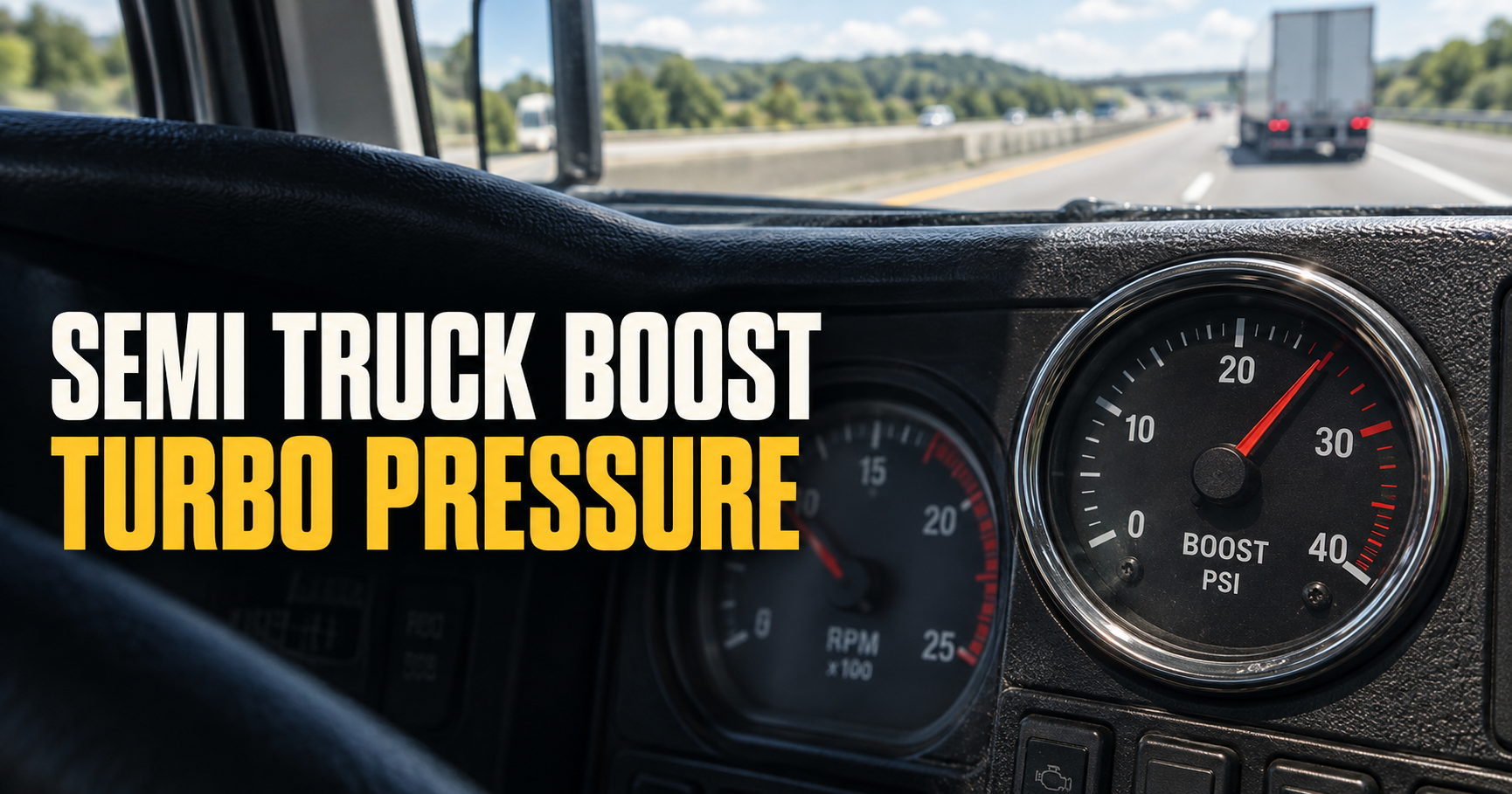
You’re rolling along an easy stretch of road and the boost gauge isn’t showing much of anything. Then you put your foot into the throttle or start pulling a loaded truck uphill and the needle suddenly climbs.
That big change can look strange if nobody has ever explained what the gauge is actually showing you.
Unlike oil pressure or coolant temperature, there really isn’t one boost number you’re trying to maintain. The reading changes constantly based on how hard the engine is working, how much fuel is being commanded, engine RPM, elevation, and the particular engine and turbocharger setup in your truck.
A boost gauge is really giving you a window into what the turbocharger is doing.
Once you understand that, the needle bouncing between low and high readings makes a lot more sense.
What Does a Boost Gauge Actually Measure?
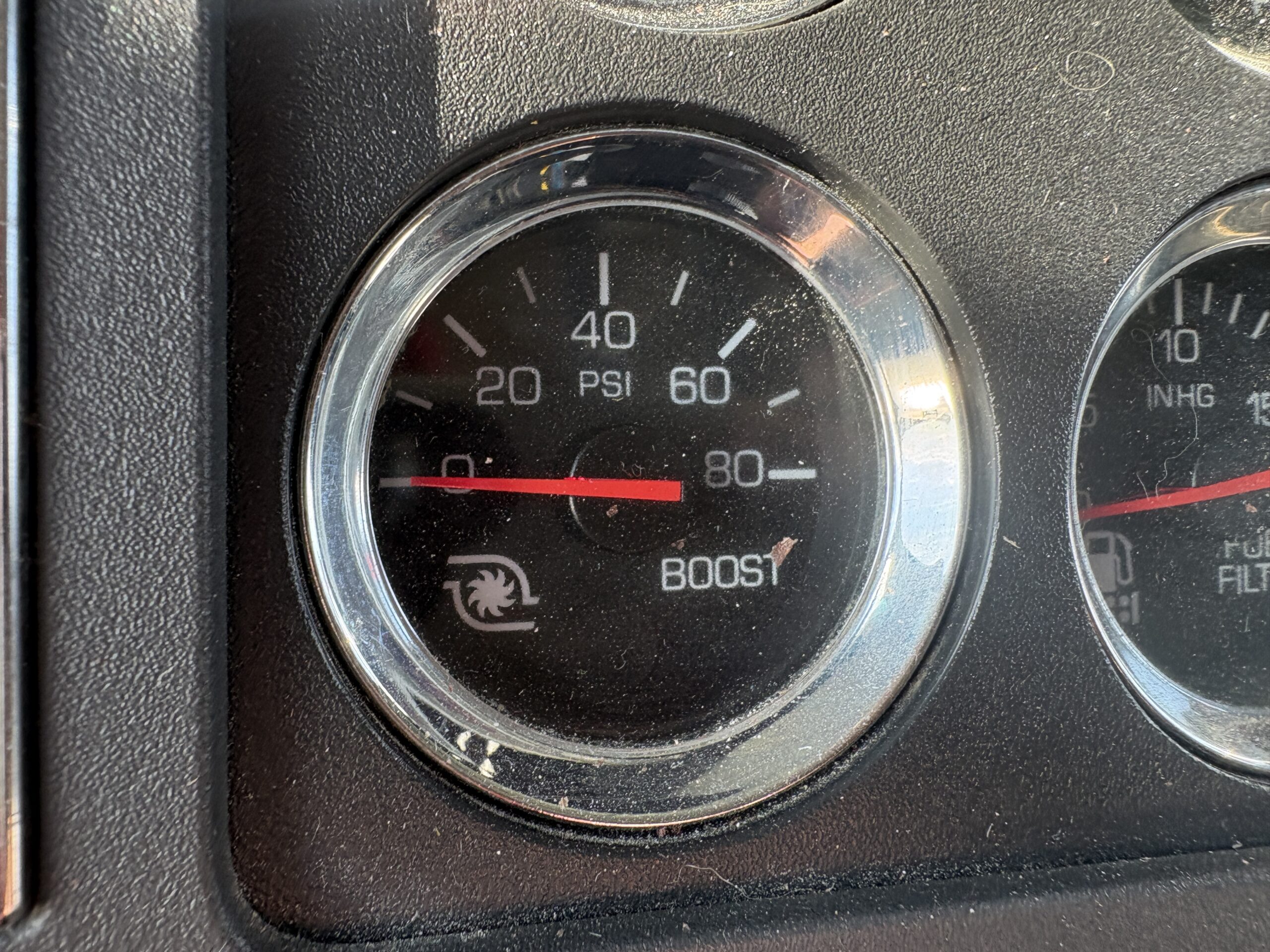
The boost gauge shows the pressure created by the turbocharger as it forces additional air into the engine.
A diesel engine needs air and fuel to produce power.
When you demand more power, the turbocharger uses energy from the exhaust to spin a turbine. That turbine is connected to a compressor that forces additional air into the intake.
More available air allows the engine management system to add the appropriate amount of fuel and produce substantially more power than the engine could without turbocharging.
The boost gauge lets the driver see some of that process happening in real time.


Why Is Boost So Low at Idle?
Seeing little or no boost while idling is normally exactly what you’d expect.
The engine isn’t under much load.
There isn’t a large amount of exhaust energy spinning the turbocharger, and the engine doesn’t need much additional intake pressure simply to sit there and idle.
You might see the gauge sitting near zero.
That doesn’t mean the turbo isn’t working.
Put the engine under load and you’ll see a completely different gauge.


Why Does Boost Increase When You Accelerate?
Push farther into the accelerator and you’re asking the engine for more power.
More fuel is injected.
Exhaust flow increases.
The turbocharger spins faster.
Intake pressure increases.
The boost gauge climbs.
That’s why the gauge can go from almost nothing to a substantial reading within seconds when you’re accelerating with a heavy truck.
Once you back out of the throttle, boost normally falls again.
A Loaded Truck Can Show Much More Boost
This is where the gauge gets interesting.
Imagine two situations.
You’re driving an empty truck across level ground at 55 mph.
The engine doesn’t have to work very hard, so boost may remain relatively low.
Now load the truck and climb a long grade at the same speed.
The engine is working considerably harder.
You’ll generally see much more boost because the turbocharger is supplying the additional air the engine needs under load.
That’s why asking “What should my boost gauge read at 55 mph?” doesn’t really have a useful universal answer.
Speed alone doesn’t determine boost.
Engine load matters enormously.
There Isn’t One Normal Boost PSI for Every Semi Truck
This is important because you’ll find people online throwing around exact numbers.
Someone might say:
“Your truck should make 30 PSI.”
Another driver says:
“Mine makes 40.”
Someone else claims anything above 35 is too high.
Those numbers don’t mean much unless you’re talking about the same engine configuration and operating conditions.
Heavy-duty diesel engines use different turbochargers, calibrations, emissions systems, engine ratings, and boost-control strategies.
Even two trucks from the same manufacturer can behave differently if they have different engines.
Your engine manufacturer’s specifications are the proper reference for its maximum expected boost.
For everyday driving, one of the most useful things you can do is learn what your particular truck normally does under similar loads.
That baseline can help you recognize when something changes.
Boost Can Tell You Something Before a Warning Light Does
This is where the gauge becomes genuinely useful instead of simply being another needle on the dashboard.
Suppose your truck normally reaches a certain general boost range while pulling a familiar hill with a heavy load.
Then one day it feels sluggish and the boost gauge isn’t climbing anywhere near where it normally does.
Something changed.
That doesn’t tell you exactly what’s wrong, but it gives you a clue.
A boost or intake-air leak, turbocharger problem, exhaust restriction, charge-air-cooler leak, sensor problem, fuel-delivery issue, or another engine problem could reduce available power.
The gauge helps you recognize that the truck isn’t behaving normally.
Don’t Diagnose a Turbo From the Gauge Alone
This is equally important.
Low boost doesn’t automatically mean:
Bad turbo.
There are plenty of other reasons an engine may not produce its usual boost.
A leaking charge-air boot can lose pressurized air.
A cracked charge-air cooler can do the same thing.
A dirty air filter can restrict incoming air.
An exhaust leak before the turbo can reduce the energy available to spin it.
Fuel delivery problems can reduce engine output and therefore reduce boost.
Electronic engine controls can intentionally limit power and boost when another problem is detected.
That’s why replacing a turbocharger based solely on a low gauge reading can become a very expensive guess.
Your Air Filter Can Affect Turbo Performance
The turbocharger can only compress the air it receives.
If the engine’s air intake is severely restricted, performance can suffer.
That’s one reason some heavy-duty trucks have an air filter restriction gauge in addition to the boost gauge.
That little restriction gauge is another one we’re going to cover separately because it’s surprisingly useful and a lot of drivers have no idea what it’s showing them.
The two gauges can actually help tell a story together.
If the truck suddenly feels weak, boost is lower than usual, and the air filter restriction reading is unusually high, checking the intake system becomes pretty logical.


High Boost Isn’t Automatically Better
It’s easy to look at a boost gauge like a performance score.
More boost must mean more power and therefore be better, right?
Not necessarily.
The engine and turbo system are designed to operate within specific limits.
The engine computer controls boost based on operating conditions and protects the engine when it detects certain problems.
Your goal as a commercial driver isn’t to see how high you can make the boost gauge climb.
The gauge is there to help you understand what the engine is doing.
A normal high-load reading is fine.
A reading or engine behavior that’s suddenly very different from what you’re accustomed to deserves attention.
What If Boost Suddenly Drops While You’re Pulling?
This is a situation I’d take more seriously.
You’re pulling normally.
The truck is making good power.
Then suddenly boost falls and the truck feels weak.
Possible causes can include a charge-air hose coming loose, a split boot, an intercooler or charge-air-cooler leak, turbocharger trouble, an exhaust-side problem, or an engine control issue.
You may also hear something unusual.
A loud rush of air under acceleration can point toward a boost leak.
Whistling that suddenly sounds different than usual can also deserve investigation.
If the truck loses significant power, warning lights appear, or something obviously doesn’t sound right, don’t simply keep your foot buried in the throttle trying to make the boost come back.
Safely get the truck somewhere it can be checked.
Frequently Asked Questions
What should a semi truck boost gauge read at idle?
Usually very little. An engine sitting at idle isn’t under enough load to require substantial turbo boost, so a reading near zero can be completely normal.
Should boost increase when I press the accelerator?
Generally, yes. As engine load and exhaust flow increase, the turbocharger works harder and boost typically rises.
Why does my boost gauge go down when I let off the throttle?
Because you’re no longer demanding as much power. Engine load decreases, exhaust energy drops, and the turbo doesn’t need to produce the same intake pressure.
Why does my semi make more boost going uphill?
The engine is working harder to move the truck against the grade. That increased load requires more air and fuel, so turbo boost normally increases.
Does low boost mean my turbo is bad?
Not necessarily. Intake restrictions, charge-air leaks, exhaust leaks, fuel-delivery problems, sensors, engine controls, and several other issues can produce low boost or low power.
Is higher boost always better?
No. The correct amount of boost is whatever the engine is designed to produce under those operating conditions. Chasing a higher number isn’t the goal.
Learn the Pattern Instead of Chasing One Number
The boost gauge is different from something like the fuel gauge.
There isn’t one spot where you want the needle to stay.
It should move.
Sometimes a lot.
Light load can mean very little boost. Put a loaded truck on a hill and the gauge can climb quickly. Let off the throttle and it’ll fall again.
What makes the gauge valuable is learning the pattern.
Once you know roughly how your truck normally behaves, you’ll notice when it suddenly doesn’t.
And when a heavy truck feels weak while the boost gauge is showing something completely different from what you normally see, you’ve gained an important clue about where to start looking.
Author: Caleb Morgan
Caleb Morgan writes about heavy-duty trucks, diesel systems, and practical maintenance for TruckingResource.com. His guides focus on explaining what drivers see from behind the wheel, what changes are normal, and which warning signs deserve a closer look.