(function(){“use strict”;/* QUESTION BANK — replace only this array for future tests. */var Q=[[“During a pre-trip inspection, you find one steering tire with a bulge and adequate tread. What is the correct decision?”,”Do not drive until the damaged tire is properly addressed”,[“Drive because tread depth is adequate”,”Move the tire to the rear during the trip”,”Reduce pressure to flatten the bulge”],”A bulge indicates internal structural damage and possible sudden failure. Tread depth does not make a structurally damaged steering tire safe.”,0],[“Exam scenario: during a pre-trip inspection, you find one steering tire with a bulge and adequate tread. What is the correct decision?”,”Do not drive until the damaged tire is properly addressed”,[“Drive because tread depth is adequate”,”Move the tire to the rear during the trip”,”Reduce pressure to flatten the bulge”],”A bulge indicates internal structural damage and possible sudden failure. Tread depth does not make a structurally damaged steering tire safe.”,0],[“Safety review: during a pre-trip inspection, you find one steering tire with a bulge and adequate tread. What is the correct decision?”,”Do not drive until the damaged tire is properly addressed”,[“Drive because tread depth is adequate”,”Move the tire to the rear during the trip”,”Reduce pressure to flatten the bulge”],”A bulge indicates internal structural damage and possible sudden failure. Tread depth does not make a structurally damaged steering tire safe.”,0],[“On a commercial driving trip, during a pre-trip inspection, you find one steering tire with a bulge and adequate tread. What is the correct decision?”,”Do not drive until the damaged tire is properly addressed”,[“Drive because tread depth is adequate”,”Move the tire to the rear during the trip”,”Reduce pressure to flatten the bulge”],”A bulge indicates internal structural damage and possible sudden failure. Tread depth does not make a structurally damaged steering tire safe.”,0],[“A CDL applicant is asked: during a pre-trip inspection, you find one steering tire with a bulge and adequate tread. What is the correct decision?”,”Do not drive until the damaged tire is properly addressed”,[“Drive because tread depth is adequate”,”Move the tire to the rear during the trip”,”Reduce pressure to flatten the bulge”],”A bulge indicates internal structural damage and possible sudden failure. Tread depth does not make a structurally damaged steering tire safe.”,0],[“A loaded truck approaches a downhill curve in rain. What should the driver do before entering it?”,”Reduce speed, select an appropriate gear, and establish extra space”,[“Brake hard only after entering”,”Shift to neutral for smoother steering”,”Accelerate to reduce time in the curve”],”Rain reduces traction, the downgrade adds speed, and the load raises momentum. Manage all three before the curve so braking and steering demands remain controlled.”,1],[“Exam scenario: a loaded truck approaches a downhill curve in rain. What should the driver do before entering it?”,”Reduce speed, select an appropriate gear, and establish extra space”,[“Brake hard only after entering”,”Shift to neutral for smoother steering”,”Accelerate to reduce time in the curve”],”Rain reduces traction, the downgrade adds speed, and the load raises momentum. Manage all three before the curve so braking and steering demands remain controlled.”,1],[“Safety review: a loaded truck approaches a downhill curve in rain. What should the driver do before entering it?”,”Reduce speed, select an appropriate gear, and establish extra space”,[“Brake hard only after entering”,”Shift to neutral for smoother steering”,”Accelerate to reduce time in the curve”],”Rain reduces traction, the downgrade adds speed, and the load raises momentum. Manage all three before the curve so braking and steering demands remain controlled.”,1],[“On a commercial driving trip, a loaded truck approaches a downhill curve in rain. What should the driver do before entering it?”,”Reduce speed, select an appropriate gear, and establish extra space”,[“Brake hard only after entering”,”Shift to neutral for smoother steering”,”Accelerate to reduce time in the curve”],”Rain reduces traction, the downgrade adds speed, and the load raises momentum. Manage all three before the curve so braking and steering demands remain controlled.”,1],[“A CDL applicant is asked: a loaded truck approaches a downhill curve in rain. What should the driver do before entering it?”,”Reduce speed, select an appropriate gear, and establish extra space”,[“Brake hard only after entering”,”Shift to neutral for smoother steering”,”Accelerate to reduce time in the curve”],”Rain reduces traction, the downgrade adds speed, and the load raises momentum. Manage all three before the curve so braking and steering demands remain controlled.”,1],[“Cargo has settled and one tie-down is loose at the first inspection stop. What should the driver do?”,”Retighten and inspect the entire securement system before continuing”,[“Remove the loose tie-down and continue”,”Wait until delivery”,”Drive faster to settle the cargo completely”],”One loose device may signal load movement or tension loss elsewhere. Restore securement and check cargo position, anchors, and every device.”,2],[“Exam scenario: cargo has settled and one tie-down is loose at the first inspection stop. What should the driver do?”,”Retighten and inspect the entire securement system before continuing”,[“Remove the loose tie-down and continue”,”Wait until delivery”,”Drive faster to settle the cargo completely”],”One loose device may signal load movement or tension loss elsewhere. Restore securement and check cargo position, anchors, and every device.”,2],[“Safety review: cargo has settled and one tie-down is loose at the first inspection stop. What should the driver do?”,”Retighten and inspect the entire securement system before continuing”,[“Remove the loose tie-down and continue”,”Wait until delivery”,”Drive faster to settle the cargo completely”],”One loose device may signal load movement or tension loss elsewhere. Restore securement and check cargo position, anchors, and every device.”,2],[“On a commercial driving trip, cargo has settled and one tie-down is loose at the first inspection stop. What should the driver do?”,”Retighten and inspect the entire securement system before continuing”,[“Remove the loose tie-down and continue”,”Wait until delivery”,”Drive faster to settle the cargo completely”],”One loose device may signal load movement or tension loss elsewhere. Restore securement and check cargo position, anchors, and every device.”,2],[“A CDL applicant is asked: cargo has settled and one tie-down is loose at the first inspection stop. What should the driver do?”,”Retighten and inspect the entire securement system before continuing”,[“Remove the loose tie-down and continue”,”Wait until delivery”,”Drive faster to settle the cargo completely”],”One loose device may signal load movement or tension loss elsewhere. Restore securement and check cargo position, anchors, and every device.”,2],[“A driver sees brake-light traffic just beyond a hillcrest. What is the best response?”,”Begin slowing early while maintaining a large following cushion”,[“Wait until reaching the crest”,”Pass before the lane closes”,”Use the shoulder to avoid braking”],”Early observation is valuable only when followed by early action. A heavy vehicle needs distance, and the crest may hide the end of the queue.”,3],[“Exam scenario: a driver sees brake-light traffic just beyond a hillcrest. What is the best response?”,”Begin slowing early while maintaining a large following cushion”,[“Wait until reaching the crest”,”Pass before the lane closes”,”Use the shoulder to avoid braking”],”Early observation is valuable only when followed by early action. A heavy vehicle needs distance, and the crest may hide the end of the queue.”,3],[“Safety review: a driver sees brake-light traffic just beyond a hillcrest. What is the best response?”,”Begin slowing early while maintaining a large following cushion”,[“Wait until reaching the crest”,”Pass before the lane closes”,”Use the shoulder to avoid braking”],”Early observation is valuable only when followed by early action. A heavy vehicle needs distance, and the crest may hide the end of the queue.”,3],[“On a commercial driving trip, a driver sees brake-light traffic just beyond a hillcrest. What is the best response?”,”Begin slowing early while maintaining a large following cushion”,[“Wait until reaching the crest”,”Pass before the lane closes”,”Use the shoulder to avoid braking”],”Early observation is valuable only when followed by early action. A heavy vehicle needs distance, and the crest may hide the end of the queue.”,3],[“A CDL applicant is asked: a driver sees brake-light traffic just beyond a hillcrest. What is the best response?”,”Begin slowing early while maintaining a large following cushion”,[“Wait until reaching the crest”,”Pass before the lane closes”,”Use the shoulder to avoid braking”],”Early observation is valuable only when followed by early action. A heavy vehicle needs distance, and the crest may hide the end of the queue.”,3],[“Tire spray disappears while the road still looks wet and the temperature is 30°F. What should the driver infer?”,”Black ice may be forming”,[“The road has become warm and dry”,”The tires are overinflated”,”The brakes have overheated”],”Near-freezing temperatures and disappearing spray are classic signs that water may be freezing. Reduce speed smoothly without abrupt inputs.”,4],[“Exam scenario: tire spray disappears while the road still looks wet and the temperature is 30°F. What should the driver infer?”,”Black ice may be forming”,[“The road has become warm and dry”,”The tires are overinflated”,”The brakes have overheated”],”Near-freezing temperatures and disappearing spray are classic signs that water may be freezing. Reduce speed smoothly without abrupt inputs.”,4],[“Safety review: tire spray disappears while the road still looks wet and the temperature is 30°F. What should the driver infer?”,”Black ice may be forming”,[“The road has become warm and dry”,”The tires are overinflated”,”The brakes have overheated”],”Near-freezing temperatures and disappearing spray are classic signs that water may be freezing. Reduce speed smoothly without abrupt inputs.”,4],[“On a commercial driving trip, tire spray disappears while the road still looks wet and the temperature is 30°F. What should the driver infer?”,”Black ice may be forming”,[“The road has become warm and dry”,”The tires are overinflated”,”The brakes have overheated”],”Near-freezing temperatures and disappearing spray are classic signs that water may be freezing. Reduce speed smoothly without abrupt inputs.”,4],[“A CDL applicant is asked: tire spray disappears while the road still looks wet and the temperature is 30°F. What should the driver infer?”,”Black ice may be forming”,[“The road has become warm and dry”,”The tires are overinflated”,”The brakes have overheated”],”Near-freezing temperatures and disappearing spray are classic signs that water may be freezing. Reduce speed smoothly without abrupt inputs.”,4],[“A navigation app directs a 13-foot-6-inch truck toward a bridge marked 13 feet. What should the driver do?”,”Stop before the bridge and take a verified alternate route”,[“Trust the app instead of the sign”,”Deflate the tires and proceed”,”Accelerate under the bridge”],”Physical clearance controls. Navigation cannot authorize a vehicle to strike an obstruction, and small mechanical changes do not create a safe margin.”,5],[“Exam scenario: a navigation app directs a 13-foot-6-inch truck toward a bridge marked 13 feet. What should the driver do?”,”Stop before the bridge and take a verified alternate route”,[“Trust the app instead of the sign”,”Deflate the tires and proceed”,”Accelerate under the bridge”],”Physical clearance controls. Navigation cannot authorize a vehicle to strike an obstruction, and small mechanical changes do not create a safe margin.”,5],[“Safety review: a navigation app directs a 13-foot-6-inch truck toward a bridge marked 13 feet. What should the driver do?”,”Stop before the bridge and take a verified alternate route”,[“Trust the app instead of the sign”,”Deflate the tires and proceed”,”Accelerate under the bridge”],”Physical clearance controls. Navigation cannot authorize a vehicle to strike an obstruction, and small mechanical changes do not create a safe margin.”,5],[“On a commercial driving trip, a navigation app directs a 13-foot-6-inch truck toward a bridge marked 13 feet. What should the driver do?”,”Stop before the bridge and take a verified alternate route”,[“Trust the app instead of the sign”,”Deflate the tires and proceed”,”Accelerate under the bridge”],”Physical clearance controls. Navigation cannot authorize a vehicle to strike an obstruction, and small mechanical changes do not create a safe margin.”,5],[“A CDL applicant is asked: a navigation app directs a 13-foot-6-inch truck toward a bridge marked 13 feet. What should the driver do?”,”Stop before the bridge and take a verified alternate route”,[“Trust the app instead of the sign”,”Deflate the tires and proceed”,”Accelerate under the bridge”],”Physical clearance controls. Navigation cannot authorize a vehicle to strike an obstruction, and small mechanical changes do not create a safe margin.”,5],[“A car remains beside the trailer as the truck approaches a lane closure. What is the best plan?”,”Adjust speed early to create separation before changing lanes”,[“Move over and force the car to brake”,”Wait until the cones begin, then swerve”,”Sound the horn continuously”],”Early, predictable speed adjustment can clear the blind area and produce a safe gap without aggressive action or a last-second maneuver.”,6],[“Exam scenario: a car remains beside the trailer as the truck approaches a lane closure. What is the best plan?”,”Adjust speed early to create separation before changing lanes”,[“Move over and force the car to brake”,”Wait until the cones begin, then swerve”,”Sound the horn continuously”],”Early, predictable speed adjustment can clear the blind area and produce a safe gap without aggressive action or a last-second maneuver.”,6],[“Safety review: a car remains beside the trailer as the truck approaches a lane closure. What is the best plan?”,”Adjust speed early to create separation before changing lanes”,[“Move over and force the car to brake”,”Wait until the cones begin, then swerve”,”Sound the horn continuously”],”Early, predictable speed adjustment can clear the blind area and produce a safe gap without aggressive action or a last-second maneuver.”,6],[“On a commercial driving trip, a car remains beside the trailer as the truck approaches a lane closure. What is the best plan?”,”Adjust speed early to create separation before changing lanes”,[“Move over and force the car to brake”,”Wait until the cones begin, then swerve”,”Sound the horn continuously”],”Early, predictable speed adjustment can clear the blind area and produce a safe gap without aggressive action or a last-second maneuver.”,6],[“A CDL applicant is asked: a car remains beside the trailer as the truck approaches a lane closure. What is the best plan?”,”Adjust speed early to create separation before changing lanes”,[“Move over and force the car to brake”,”Wait until the cones begin, then swerve”,”Sound the horn continuously”],”Early, predictable speed adjustment can clear the blind area and produce a safe gap without aggressive action or a last-second maneuver.”,6],[“A driver has missed two signs and cannot remember the last several miles. What should happen next?”,”Stop at a safe location and rest”,[“Open a window and continue”,”Drive faster to finish sooner”,”Use a phone conversation for stimulation”],”Memory gaps and missed signs are advanced fatigue warnings. Temporary stimulation does not prevent microsleep.”,7],[“Exam scenario: a driver has missed two signs and cannot remember the last several miles. What should happen next?”,”Stop at a safe location and rest”,[“Open a window and continue”,”Drive faster to finish sooner”,”Use a phone conversation for stimulation”],”Memory gaps and missed signs are advanced fatigue warnings. Temporary stimulation does not prevent microsleep.”,7],[“Safety review: a driver has missed two signs and cannot remember the last several miles. What should happen next?”,”Stop at a safe location and rest”,[“Open a window and continue”,”Drive faster to finish sooner”,”Use a phone conversation for stimulation”],”Memory gaps and missed signs are advanced fatigue warnings. Temporary stimulation does not prevent microsleep.”,7],[“On a commercial driving trip, a driver has missed two signs and cannot remember the last several miles. What should happen next?”,”Stop at a safe location and rest”,[“Open a window and continue”,”Drive faster to finish sooner”,”Use a phone conversation for stimulation”],”Memory gaps and missed signs are advanced fatigue warnings. Temporary stimulation does not prevent microsleep.”,7],[“A CDL applicant is asked: a driver has missed two signs and cannot remember the last several miles. What should happen next?”,”Stop at a safe location and rest”,[“Open a window and continue”,”Drive faster to finish sooner”,”Use a phone conversation for stimulation”],”Memory gaps and missed signs are advanced fatigue warnings. Temporary stimulation does not prevent microsleep.”,7],[“On a downgrade, the truck requires increasing brake pressure to hold the same speed. What does this suggest?”,”The brakes may be fading from heat”,[“The engine is producing more braking”,”Traction is improving”,”The load is becoming lighter”],”Needing more pressure for less result indicates declining brake effectiveness. Use an escape ramp if control is deteriorating; do not wait for total failure.”,8],[“Exam scenario: on a downgrade, the truck requires increasing brake pressure to hold the same speed. What does this suggest?”,”The brakes may be fading from heat”,[“The engine is producing more braking”,”Traction is improving”,”The load is becoming lighter”],”Needing more pressure for less result indicates declining brake effectiveness. Use an escape ramp if control is deteriorating; do not wait for total failure.”,8],[“Safety review: on a downgrade, the truck requires increasing brake pressure to hold the same speed. What does this suggest?”,”The brakes may be fading from heat”,[“The engine is producing more braking”,”Traction is improving”,”The load is becoming lighter”],”Needing more pressure for less result indicates declining brake effectiveness. Use an escape ramp if control is deteriorating; do not wait for total failure.”,8],[“On a commercial driving trip, on a downgrade, the truck requires increasing brake pressure to hold the same speed. What does this suggest?”,”The brakes may be fading from heat”,[“The engine is producing more braking”,”Traction is improving”,”The load is becoming lighter”],”Needing more pressure for less result indicates declining brake effectiveness. Use an escape ramp if control is deteriorating; do not wait for total failure.”,8],[“A CDL applicant is asked: on a downgrade, the truck requires increasing brake pressure to hold the same speed. What does this suggest?”,”The brakes may be fading from heat”,[“The engine is producing more braking”,”Traction is improving”,”The load is becoming lighter”],”Needing more pressure for less result indicates declining brake effectiveness. Use an escape ramp if control is deteriorating; do not wait for total failure.”,8],[“A liquid load is partially filled and traffic stops ahead. How should the driver brake?”,”Begin early and brake smoothly to manage surge”,[“Wait and brake as hard as possible”,”Swerve into another lane”,”Pump the accelerator”],”Liquid continues moving after the vehicle slows and may push forward and backward. Extra distance and smooth braking reduce surge forces.”,9],[“Exam scenario: a liquid load is partially filled and traffic stops ahead. How should the driver brake?”,”Begin early and brake smoothly to manage surge”,[“Wait and brake as hard as possible”,”Swerve into another lane”,”Pump the accelerator”],”Liquid continues moving after the vehicle slows and may push forward and backward. Extra distance and smooth braking reduce surge forces.”,9],[“Safety review: a liquid load is partially filled and traffic stops ahead. How should the driver brake?”,”Begin early and brake smoothly to manage surge”,[“Wait and brake as hard as possible”,”Swerve into another lane”,”Pump the accelerator”],”Liquid continues moving after the vehicle slows and may push forward and backward. Extra distance and smooth braking reduce surge forces.”,9],[“On a commercial driving trip, a liquid load is partially filled and traffic stops ahead. How should the driver brake?”,”Begin early and brake smoothly to manage surge”,[“Wait and brake as hard as possible”,”Swerve into another lane”,”Pump the accelerator”],”Liquid continues moving after the vehicle slows and may push forward and backward. Extra distance and smooth braking reduce surge forces.”,9],[“A CDL applicant is asked: a liquid load is partially filled and traffic stops ahead. How should the driver brake?”,”Begin early and brake smoothly to manage surge”,[“Wait and brake as hard as possible”,”Swerve into another lane”,”Pump the accelerator”],”Liquid continues moving after the vehicle slows and may push forward and backward. Extra distance and smooth braking reduce surge forces.”,9],[“A truck stalls on a multi-track railroad crossing. What is the immediate priority?”,”Evacuate everyone away from the tracks and call the posted emergency number”,[“Stay inside with hazard lights on”,”Walk down the center of the tracks”,”Try repairs before warning anyone”],”People must leave the danger zone immediately. Emergency responders and the railroad need the crossing identification so train traffic can be warned.”,10],[“Exam scenario: a truck stalls on a multi-track railroad crossing. What is the immediate priority?”,”Evacuate everyone away from the tracks and call the posted emergency number”,[“Stay inside with hazard lights on”,”Walk down the center of the tracks”,”Try repairs before warning anyone”],”People must leave the danger zone immediately. Emergency responders and the railroad need the crossing identification so train traffic can be warned.”,10],[“Safety review: a truck stalls on a multi-track railroad crossing. What is the immediate priority?”,”Evacuate everyone away from the tracks and call the posted emergency number”,[“Stay inside with hazard lights on”,”Walk down the center of the tracks”,”Try repairs before warning anyone”],”People must leave the danger zone immediately. Emergency responders and the railroad need the crossing identification so train traffic can be warned.”,10],[“On a commercial driving trip, a truck stalls on a multi-track railroad crossing. What is the immediate priority?”,”Evacuate everyone away from the tracks and call the posted emergency number”,[“Stay inside with hazard lights on”,”Walk down the center of the tracks”,”Try repairs before warning anyone”],”People must leave the danger zone immediately. Emergency responders and the railroad need the crossing identification so train traffic can be warned.”,10],[“A CDL applicant is asked: a truck stalls on a multi-track railroad crossing. What is the immediate priority?”,”Evacuate everyone away from the tracks and call the posted emergency number”,[“Stay inside with hazard lights on”,”Walk down the center of the tracks”,”Try repairs before warning anyone”],”People must leave the danger zone immediately. Emergency responders and the railroad need the crossing identification so train traffic can be warned.”,10],[“Heavy rain reduces sight distance below the truck’s normal stopping distance. What must change?”,”Speed must be reduced until the truck can stop within the visible distance”,[“Only headlight brightness must change”,”Following distance can be shortened”,”Speed should increase to leave the rain”],”A driver must never travel faster than the available view allows. Rain also reduces traction, making the need to slow even greater.”,11],[“Exam scenario: heavy rain reduces sight distance below the truck’s normal stopping distance. What must change?”,”Speed must be reduced until the truck can stop within the visible distance”,[“Only headlight brightness must change”,”Following distance can be shortened”,”Speed should increase to leave the rain”],”A driver must never travel faster than the available view allows. Rain also reduces traction, making the need to slow even greater.”,11],[“Safety review: heavy rain reduces sight distance below the truck’s normal stopping distance. What must change?”,”Speed must be reduced until the truck can stop within the visible distance”,[“Only headlight brightness must change”,”Following distance can be shortened”,”Speed should increase to leave the rain”],”A driver must never travel faster than the available view allows. Rain also reduces traction, making the need to slow even greater.”,11],[“On a commercial driving trip, heavy rain reduces sight distance below the truck’s normal stopping distance. What must change?”,”Speed must be reduced until the truck can stop within the visible distance”,[“Only headlight brightness must change”,”Following distance can be shortened”,”Speed should increase to leave the rain”],”A driver must never travel faster than the available view allows. Rain also reduces traction, making the need to slow even greater.”,11],[“A CDL applicant is asked: heavy rain reduces sight distance below the truck’s normal stopping distance. What must change?”,”Speed must be reduced until the truck can stop within the visible distance”,[“Only headlight brightness must change”,”Following distance can be shortened”,”Speed should increase to leave the rain”],”A driver must never travel faster than the available view allows. Rain also reduces traction, making the need to slow even greater.”,11],[“After a front-tire blowout, the vehicle is stable but still moving quickly. What should the driver do next?”,”Ease off power, slow gradually, and move off only when control and traffic allow”,[“Brake hard and turn immediately”,”Release the wheel”,”Accelerate toward the shoulder”],”Firm steering establishes initial control. Gradual deceleration prevents a sudden weight shift that could worsen the pull.”,12],[“Exam scenario: after a front-tire blowout, the vehicle is stable but still moving quickly. What should the driver do next?”,”Ease off power, slow gradually, and move off only when control and traffic allow”,[“Brake hard and turn immediately”,”Release the wheel”,”Accelerate toward the shoulder”],”Firm steering establishes initial control. Gradual deceleration prevents a sudden weight shift that could worsen the pull.”,12],[“Safety review: after a front-tire blowout, the vehicle is stable but still moving quickly. What should the driver do next?”,”Ease off power, slow gradually, and move off only when control and traffic allow”,[“Brake hard and turn immediately”,”Release the wheel”,”Accelerate toward the shoulder”],”Firm steering establishes initial control. Gradual deceleration prevents a sudden weight shift that could worsen the pull.”,12],[“On a commercial driving trip, after a front-tire blowout, the vehicle is stable but still moving quickly. What should the driver do next?”,”Ease off power, slow gradually, and move off only when control and traffic allow”,[“Brake hard and turn immediately”,”Release the wheel”,”Accelerate toward the shoulder”],”Firm steering establishes initial control. Gradual deceleration prevents a sudden weight shift that could worsen the pull.”,12],[“A CDL applicant is asked: after a front-tire blowout, the vehicle is stable but still moving quickly. What should the driver do next?”,”Ease off power, slow gradually, and move off only when control and traffic allow”,[“Brake hard and turn immediately”,”Release the wheel”,”Accelerate toward the shoulder”],”Firm steering establishes initial control. Gradual deceleration prevents a sudden weight shift that could worsen the pull.”,12],[“A driver must back into a dark dock while a spotter is helping. The spotter disappears from the mirror. What now?”,”Stop immediately until visual contact and communication are restored”,[“Continue slowly because the spotter was there”,”Use the horn and keep backing”,”Watch only the opposite mirror”],”Losing the spotter removes the agreed warning system. Stop first; never assume the path remains clear.”,13],[“Exam scenario: a driver must back into a dark dock while a spotter is helping. The spotter disappears from the mirror. What now?”,”Stop immediately until visual contact and communication are restored”,[“Continue slowly because the spotter was there”,”Use the horn and keep backing”,”Watch only the opposite mirror”],”Losing the spotter removes the agreed warning system. Stop first; never assume the path remains clear.”,13],[“Safety review: a driver must back into a dark dock while a spotter is helping. The spotter disappears from the mirror. What now?”,”Stop immediately until visual contact and communication are restored”,[“Continue slowly because the spotter was there”,”Use the horn and keep backing”,”Watch only the opposite mirror”],”Losing the spotter removes the agreed warning system. Stop first; never assume the path remains clear.”,13],[“On a commercial driving trip, a driver must back into a dark dock while a spotter is helping. The spotter disappears from the mirror. What now?”,”Stop immediately until visual contact and communication are restored”,[“Continue slowly because the spotter was there”,”Use the horn and keep backing”,”Watch only the opposite mirror”],”Losing the spotter removes the agreed warning system. Stop first; never assume the path remains clear.”,13],[“A CDL applicant is asked: a driver must back into a dark dock while a spotter is helping. The spotter disappears from the mirror. What now?”,”Stop immediately until visual contact and communication are restored”,[“Continue slowly because the spotter was there”,”Use the horn and keep backing”,”Watch only the opposite mirror”],”Losing the spotter removes the agreed warning system. Stop first; never assume the path remains clear.”,13],[“One axle is overweight although the truck’s gross weight is legal. Is the load acceptable?”,”No; axle and component limits must also be satisfied”,[“Yes; only gross weight matters”,”Yes if the tires look normal”,”Yes on local roads”],”Legal total weight can still be distributed unsafely. Axles, tires, suspension, and bridges have individual limits.”,14],[“Exam scenario: one axle is overweight although the truck’s gross weight is legal. Is the load acceptable?”,”No; axle and component limits must also be satisfied”,[“Yes; only gross weight matters”,”Yes if the tires look normal”,”Yes on local roads”],”Legal total weight can still be distributed unsafely. Axles, tires, suspension, and bridges have individual limits.”,14],[“Safety review: one axle is overweight although the truck’s gross weight is legal. Is the load acceptable?”,”No; axle and component limits must also be satisfied”,[“Yes; only gross weight matters”,”Yes if the tires look normal”,”Yes on local roads”],”Legal total weight can still be distributed unsafely. Axles, tires, suspension, and bridges have individual limits.”,14],[“On a commercial driving trip, one axle is overweight although the truck’s gross weight is legal. Is the load acceptable?”,”No; axle and component limits must also be satisfied”,[“Yes; only gross weight matters”,”Yes if the tires look normal”,”Yes on local roads”],”Legal total weight can still be distributed unsafely. Axles, tires, suspension, and bridges have individual limits.”,14],[“A CDL applicant is asked: one axle is overweight although the truck’s gross weight is legal. Is the load acceptable?”,”No; axle and component limits must also be satisfied”,[“Yes; only gross weight matters”,”Yes if the tires look normal”,”Yes on local roads”],”Legal total weight can still be distributed unsafely. Axles, tires, suspension, and bridges have individual limits.”,14],[“A low oil-pressure warning appears together with engine noise. What is the safest response?”,”Stop safely and shut down before severe engine damage or fire develops”,[“Increase engine speed”,”Continue to the next fuel stop”,”Add coolant while moving”],”Low lubrication plus abnormal noise signals immediate mechanical danger. Continuing can seize the engine or create additional hazards.”,15],[“Exam scenario: a low oil-pressure warning appears together with engine noise. What is the safest response?”,”Stop safely and shut down before severe engine damage or fire develops”,[“Increase engine speed”,”Continue to the next fuel stop”,”Add coolant while moving”],”Low lubrication plus abnormal noise signals immediate mechanical danger. Continuing can seize the engine or create additional hazards.”,15],[“Safety review: a low oil-pressure warning appears together with engine noise. What is the safest response?”,”Stop safely and shut down before severe engine damage or fire develops”,[“Increase engine speed”,”Continue to the next fuel stop”,”Add coolant while moving”],”Low lubrication plus abnormal noise signals immediate mechanical danger. Continuing can seize the engine or create additional hazards.”,15],[“On a commercial driving trip, a low oil-pressure warning appears together with engine noise. What is the safest response?”,”Stop safely and shut down before severe engine damage or fire develops”,[“Increase engine speed”,”Continue to the next fuel stop”,”Add coolant while moving”],”Low lubrication plus abnormal noise signals immediate mechanical danger. Continuing can seize the engine or create additional hazards.”,15],[“A CDL applicant is asked: a low oil-pressure warning appears together with engine noise. What is the safest response?”,”Stop safely and shut down before severe engine damage or fire develops”,[“Increase engine speed”,”Continue to the next fuel stop”,”Add coolant while moving”],”Low lubrication plus abnormal noise signals immediate mechanical danger. Continuing can seize the engine or create additional hazards.”,15],[“A motorcyclist moves ahead of the truck and slows for rough pavement. What should the truck driver do?”,”Increase following distance and allow the rider room to maneuver”,[“Follow closely so cars cannot merge”,”Pass within the same lane”,”Use the horn until the rider speeds up”],”Road defects that barely affect a truck can force a motorcycle to change position or speed. A generous gap protects the rider.”,16],[“Exam scenario: a motorcyclist moves ahead of the truck and slows for rough pavement. What should the truck driver do?”,”Increase following distance and allow the rider room to maneuver”,[“Follow closely so cars cannot merge”,”Pass within the same lane”,”Use the horn until the rider speeds up”],”Road defects that barely affect a truck can force a motorcycle to change position or speed. A generous gap protects the rider.”,16],[“Safety review: a motorcyclist moves ahead of the truck and slows for rough pavement. What should the truck driver do?”,”Increase following distance and allow the rider room to maneuver”,[“Follow closely so cars cannot merge”,”Pass within the same lane”,”Use the horn until the rider speeds up”],”Road defects that barely affect a truck can force a motorcycle to change position or speed. A generous gap protects the rider.”,16],[“On a commercial driving trip, a motorcyclist moves ahead of the truck and slows for rough pavement. What should the truck driver do?”,”Increase following distance and allow the rider room to maneuver”,[“Follow closely so cars cannot merge”,”Pass within the same lane”,”Use the horn until the rider speeds up”],”Road defects that barely affect a truck can force a motorcycle to change position or speed. A generous gap protects the rider.”,16],[“A CDL applicant is asked: a motorcyclist moves ahead of the truck and slows for rough pavement. What should the truck driver do?”,”Increase following distance and allow the rider room to maneuver”,[“Follow closely so cars cannot merge”,”Pass within the same lane”,”Use the horn until the rider speeds up”],”Road defects that barely affect a truck can force a motorcycle to change position or speed. A generous gap protects the rider.”,16],[“The truck begins hydroplaning while approaching stopped traffic. Which response is safest?”,”Ease off power, keep steering steady, and brake gently only as traction returns”,[“Brake fully and turn sharply”,”Accelerate for more steering control”,”Shift to neutral and release the wheel”],”Abrupt braking or steering while tires ride on water can cause a skid. Smooth inputs help restore contact before stronger braking is attempted.”,17],[“Exam scenario: the truck begins hydroplaning while approaching stopped traffic. Which response is safest?”,”Ease off power, keep steering steady, and brake gently only as traction returns”,[“Brake fully and turn sharply”,”Accelerate for more steering control”,”Shift to neutral and release the wheel”],”Abrupt braking or steering while tires ride on water can cause a skid. Smooth inputs help restore contact before stronger braking is attempted.”,17],[“Safety review: the truck begins hydroplaning while approaching stopped traffic. Which response is safest?”,”Ease off power, keep steering steady, and brake gently only as traction returns”,[“Brake fully and turn sharply”,”Accelerate for more steering control”,”Shift to neutral and release the wheel”],”Abrupt braking or steering while tires ride on water can cause a skid. Smooth inputs help restore contact before stronger braking is attempted.”,17],[“On a commercial driving trip, the truck begins hydroplaning while approaching stopped traffic. Which response is safest?”,”Ease off power, keep steering steady, and brake gently only as traction returns”,[“Brake fully and turn sharply”,”Accelerate for more steering control”,”Shift to neutral and release the wheel”],”Abrupt braking or steering while tires ride on water can cause a skid. Smooth inputs help restore contact before stronger braking is attempted.”,17],[“A CDL applicant is asked: the truck begins hydroplaning while approaching stopped traffic. Which response is safest?”,”Ease off power, keep steering steady, and brake gently only as traction returns”,[“Brake fully and turn sharply”,”Accelerate for more steering control”,”Shift to neutral and release the wheel”],”Abrupt braking or steering while tires ride on water can cause a skid. Smooth inputs help restore contact before stronger braking is attempted.”,17],[“A small engine-compartment fire begins while the driver has a clear escape route. What is the correct extinguisher approach?”,”Use the proper extinguisher through a small opening without fully raising the hood”,[“Open the hood fully first”,”Use water on every fire type”,”Stand directly over the flames”],”Opening the hood feeds oxygen to the fire. Life safety comes first, and extinguishing should be attempted only when conditions and equipment make it safe.”,18],[“Exam scenario: a small engine-compartment fire begins while the driver has a clear escape route. What is the correct extinguisher approach?”,”Use the proper extinguisher through a small opening without fully raising the hood”,[“Open the hood fully first”,”Use water on every fire type”,”Stand directly over the flames”],”Opening the hood feeds oxygen to the fire. Life safety comes first, and extinguishing should be attempted only when conditions and equipment make it safe.”,18],[“Safety review: a small engine-compartment fire begins while the driver has a clear escape route. What is the correct extinguisher approach?”,”Use the proper extinguisher through a small opening without fully raising the hood”,[“Open the hood fully first”,”Use water on every fire type”,”Stand directly over the flames”],”Opening the hood feeds oxygen to the fire. Life safety comes first, and extinguishing should be attempted only when conditions and equipment make it safe.”,18],[“On a commercial driving trip, a small engine-compartment fire begins while the driver has a clear escape route. What is the correct extinguisher approach?”,”Use the proper extinguisher through a small opening without fully raising the hood”,[“Open the hood fully first”,”Use water on every fire type”,”Stand directly over the flames”],”Opening the hood feeds oxygen to the fire. Life safety comes first, and extinguishing should be attempted only when conditions and equipment make it safe.”,18],[“A CDL applicant is asked: a small engine-compartment fire begins while the driver has a clear escape route. What is the correct extinguisher approach?”,”Use the proper extinguisher through a small opening without fully raising the hood”,[“Open the hood fully first”,”Use water on every fire type”,”Stand directly over the flames”],”Opening the hood feeds oxygen to the fire. Life safety comes first, and extinguishing should be attempted only when conditions and equipment make it safe.”,18],[“Temporary work-zone markings shift the lane left, but faded permanent lines continue straight. Which path should the driver follow?”,”The active temporary controls and channelizing devices”,[“The faded permanent line”,”The path of the fastest car”,”The shoulder”],”Temporary signs, cones, barriers, and flaggers define the current traffic pattern. Slow enough to interpret them correctly.”,19],[“Exam scenario: temporary work-zone markings shift the lane left, but faded permanent lines continue straight. Which path should the driver follow?”,”The active temporary controls and channelizing devices”,[“The faded permanent line”,”The path of the fastest car”,”The shoulder”],”Temporary signs, cones, barriers, and flaggers define the current traffic pattern. Slow enough to interpret them correctly.”,19],[“Safety review: temporary work-zone markings shift the lane left, but faded permanent lines continue straight. Which path should the driver follow?”,”The active temporary controls and channelizing devices”,[“The faded permanent line”,”The path of the fastest car”,”The shoulder”],”Temporary signs, cones, barriers, and flaggers define the current traffic pattern. Slow enough to interpret them correctly.”,19],[“On a commercial driving trip, temporary work-zone markings shift the lane left, but faded permanent lines continue straight. Which path should the driver follow?”,”The active temporary controls and channelizing devices”,[“The faded permanent line”,”The path of the fastest car”,”The shoulder”],”Temporary signs, cones, barriers, and flaggers define the current traffic pattern. Slow enough to interpret them correctly.”,19],[“A CDL applicant is asked: temporary work-zone markings shift the lane left, but faded permanent lines continue straight. Which path should the driver follow?”,”The active temporary controls and channelizing devices”,[“The faded permanent line”,”The path of the fastest car”,”The shoulder”],”Temporary signs, cones, barriers, and flaggers define the current traffic pattern. Slow enough to interpret them correctly.”,19],[“The driver takes a cold medicine labeled ‘may cause drowsiness.’ What is the proper decision?”,”Do not drive until its effects and medical safety are understood”,[“Drive if the window is open”,”Double the dose before driving”,”Ignore the label for daytime trips”],”A legal medicine can still make commercial driving unsafe. Consult a qualified professional and never experiment while operating.”,20],[“Exam scenario: the driver takes a cold medicine labeled ‘may cause drowsiness.’ What is the proper decision?”,”Do not drive until its effects and medical safety are understood”,[“Drive if the window is open”,”Double the dose before driving”,”Ignore the label for daytime trips”],”A legal medicine can still make commercial driving unsafe. Consult a qualified professional and never experiment while operating.”,20],[“Safety review: the driver takes a cold medicine labeled ‘may cause drowsiness.’ What is the proper decision?”,”Do not drive until its effects and medical safety are understood”,[“Drive if the window is open”,”Double the dose before driving”,”Ignore the label for daytime trips”],”A legal medicine can still make commercial driving unsafe. Consult a qualified professional and never experiment while operating.”,20],[“On a commercial driving trip, the driver takes a cold medicine labeled ‘may cause drowsiness.’ What is the proper decision?”,”Do not drive until its effects and medical safety are understood”,[“Drive if the window is open”,”Double the dose before driving”,”Ignore the label for daytime trips”],”A legal medicine can still make commercial driving unsafe. Consult a qualified professional and never experiment while operating.”,20],[“A CDL applicant is asked: the driver takes a cold medicine labeled ‘may cause drowsiness.’ What is the proper decision?”,”Do not drive until its effects and medical safety are understood”,[“Drive if the window is open”,”Double the dose before driving”,”Ignore the label for daytime trips”],”A legal medicine can still make commercial driving unsafe. Consult a qualified professional and never experiment while operating.”,20],[“A trailer door appears secure, but cargo is pressing hard against it. What should happen before opening?”,”Use a controlled unloading plan that prevents cargo from falling or rolling”,[“Stand directly in front and release the latch”,”Open it quickly and step aside”,”Drive with the door open to shift cargo”],”Cargo can move against doors during travel. Releasing the final restraint without controlling the load can seriously injure someone.”,21],[“Exam scenario: a trailer door appears secure, but cargo is pressing hard against it. What should happen before opening?”,”Use a controlled unloading plan that prevents cargo from falling or rolling”,[“Stand directly in front and release the latch”,”Open it quickly and step aside”,”Drive with the door open to shift cargo”],”Cargo can move against doors during travel. Releasing the final restraint without controlling the load can seriously injure someone.”,21],[“Safety review: a trailer door appears secure, but cargo is pressing hard against it. What should happen before opening?”,”Use a controlled unloading plan that prevents cargo from falling or rolling”,[“Stand directly in front and release the latch”,”Open it quickly and step aside”,”Drive with the door open to shift cargo”],”Cargo can move against doors during travel. Releasing the final restraint without controlling the load can seriously injure someone.”,21],[“On a commercial driving trip, a trailer door appears secure, but cargo is pressing hard against it. What should happen before opening?”,”Use a controlled unloading plan that prevents cargo from falling or rolling”,[“Stand directly in front and release the latch”,”Open it quickly and step aside”,”Drive with the door open to shift cargo”],”Cargo can move against doors during travel. Releasing the final restraint without controlling the load can seriously injure someone.”,21],[“A CDL applicant is asked: a trailer door appears secure, but cargo is pressing hard against it. What should happen before opening?”,”Use a controlled unloading plan that prevents cargo from falling or rolling”,[“Stand directly in front and release the latch”,”Open it quickly and step aside”,”Drive with the door open to shift cargo”],”Cargo can move against doors during travel. Releasing the final restraint without controlling the load can seriously injure someone.”,21],[“At night, an oncoming vehicle fails to dim its lights near a curve. What should the truck driver do?”,”Slow, look toward the right lane edge, and avoid staring at the glare”,[“Aim high beams directly at the driver”,”Move toward the centerline”,”Close one eye and maintain speed”],”Using the right edge as a guide reduces direct glare. Lower speed preserves stopping distance while vision is temporarily limited.”,22],[“Exam scenario: at night, an oncoming vehicle fails to dim its lights near a curve. What should the truck driver do?”,”Slow, look toward the right lane edge, and avoid staring at the glare”,[“Aim high beams directly at the driver”,”Move toward the centerline”,”Close one eye and maintain speed”],”Using the right edge as a guide reduces direct glare. Lower speed preserves stopping distance while vision is temporarily limited.”,22],[“Safety review: at night, an oncoming vehicle fails to dim its lights near a curve. What should the truck driver do?”,”Slow, look toward the right lane edge, and avoid staring at the glare”,[“Aim high beams directly at the driver”,”Move toward the centerline”,”Close one eye and maintain speed”],”Using the right edge as a guide reduces direct glare. Lower speed preserves stopping distance while vision is temporarily limited.”,22],[“On a commercial driving trip, at night, an oncoming vehicle fails to dim its lights near a curve. What should the truck driver do?”,”Slow, look toward the right lane edge, and avoid staring at the glare”,[“Aim high beams directly at the driver”,”Move toward the centerline”,”Close one eye and maintain speed”],”Using the right edge as a guide reduces direct glare. Lower speed preserves stopping distance while vision is temporarily limited.”,22],[“A CDL applicant is asked: at night, an oncoming vehicle fails to dim its lights near a curve. What should the truck driver do?”,”Slow, look toward the right lane edge, and avoid staring at the glare”,[“Aim high beams directly at the driver”,”Move toward the centerline”,”Close one eye and maintain speed”],”Using the right edge as a guide reduces direct glare. Lower speed preserves stopping distance while vision is temporarily limited.”,22],[“A rear brake is contaminated with oil during inspection. Why is cleaning the visible surface alone insufficient?”,”The leak source and affected friction components must be properly repaired”,[“Oil improves braking after it warms”,”Only steering brakes matter”,”The contamination will evaporate immediately”],”Oil contamination often indicates a seal or component failure and can soak friction material. The system needs qualified correction, not a cosmetic wipe.”,23],[“Exam scenario: a rear brake is contaminated with oil during inspection. Why is cleaning the visible surface alone insufficient?”,”The leak source and affected friction components must be properly repaired”,[“Oil improves braking after it warms”,”Only steering brakes matter”,”The contamination will evaporate immediately”],”Oil contamination often indicates a seal or component failure and can soak friction material. The system needs qualified correction, not a cosmetic wipe.”,23],[“Safety review: a rear brake is contaminated with oil during inspection. Why is cleaning the visible surface alone insufficient?”,”The leak source and affected friction components must be properly repaired”,[“Oil improves braking after it warms”,”Only steering brakes matter”,”The contamination will evaporate immediately”],”Oil contamination often indicates a seal or component failure and can soak friction material. The system needs qualified correction, not a cosmetic wipe.”,23],[“On a commercial driving trip, a rear brake is contaminated with oil during inspection. Why is cleaning the visible surface alone insufficient?”,”The leak source and affected friction components must be properly repaired”,[“Oil improves braking after it warms”,”Only steering brakes matter”,”The contamination will evaporate immediately”],”Oil contamination often indicates a seal or component failure and can soak friction material. The system needs qualified correction, not a cosmetic wipe.”,23],[“A CDL applicant is asked: a rear brake is contaminated with oil during inspection. Why is cleaning the visible surface alone insufficient?”,”The leak source and affected friction components must be properly repaired”,[“Oil improves braking after it warms”,”Only steering brakes matter”,”The contamination will evaporate immediately”],”Oil contamination often indicates a seal or component failure and can soak friction material. The system needs qualified correction, not a cosmetic wipe.”,23],[“What single habit best ties together safe inspection, driving, and emergency response?”,”Identify hazards early and preserve time and space to act”,[“Depend on other drivers to compensate”,”Use speed to escape every problem”,”Wait for warning lights before planning”],”Early recognition is the common thread: inspect before failure, scan before conflict, leave following room, and plan escape options before an emergency becomes unavoidable.”,24],[“Exam scenario: what single habit best ties together safe inspection, driving, and emergency response?”,”Identify hazards early and preserve time and space to act”,[“Depend on other drivers to compensate”,”Use speed to escape every problem”,”Wait for warning lights before planning”],”Early recognition is the common thread: inspect before failure, scan before conflict, leave following room, and plan escape options before an emergency becomes unavoidable.”,24],[“Safety review: what single habit best ties together safe inspection, driving, and emergency response?”,”Identify hazards early and preserve time and space to act”,[“Depend on other drivers to compensate”,”Use speed to escape every problem”,”Wait for warning lights before planning”],”Early recognition is the common thread: inspect before failure, scan before conflict, leave following room, and plan escape options before an emergency becomes unavoidable.”,24],[“On a commercial driving trip, what single habit best ties together safe inspection, driving, and emergency response?”,”Identify hazards early and preserve time and space to act”,[“Depend on other drivers to compensate”,”Use speed to escape every problem”,”Wait for warning lights before planning”],”Early recognition is the common thread: inspect before failure, scan before conflict, leave following room, and plan escape options before an emergency becomes unavoidable.”,24],[“A CDL applicant is asked: what single habit best ties together safe inspection, driving, and emergency response?”,”Identify hazards early and preserve time and space to act”,[“Depend on other drivers to compensate”,”Use speed to escape every problem”,”Wait for warning lights before planning”],”Early recognition is the common thread: inspect before failure, scan before conflict, leave following room, and plan escape options before an emergency becomes unavoidable.”,24]],S={q:[],i:0,s:0},$=function(x){return document.getElementById(x)},E={quiz:$(‘quiz’),results:$(‘results’),reviewScreen:$(‘reviewScreen’),qcount:$(‘qcount’),score:$(‘score’),progress:$(‘progress’),bar:$(‘bar’),question:$(‘question’),answers:$(‘answers’),feedback:$(‘feedback’),prev:$(‘prev’),next:$(‘next’),review:$(‘review’),reviewList:$(‘reviewList’)};function sh(a){a=a.slice();for(var i=a.length-1;i;i–){var j=Math.floor(Math.random()*(i+1)),t=a[i];a[i]=a[j];a[j]=t}return a}function esc(s){var d=document.createElement(‘div’);d.textContent=s;return d.innerHTML}function top(){$(‘tr-cdl-app’).scrollIntoView({behavior:’smooth’,block:’start’})}function start(){var G={};Q.forEach(function(x){(G[x[4]]||(G[x[4]]=[])).push(x)});var chosen=[];Object.keys(G).forEach(function(k){chosen=chosen.concat(sh(G[k]).slice(0,2))});S.q=sh(chosen).map(function(x){return{t:x[0],a:sh([{t:x[1],ok:true}].concat(x[2].map(function(w){return{t:w,ok:false}}))),e:x[3],p:null}});S.i=0;S.s=0;E.quiz.hidden=false;E.results.hidden=true;E.reviewScreen.hidden=true;render();top()}function render(){var q=S.q[S.i],done=q.p!==null,n=S.q.filter(function(x){return x.p!==null}).length;E.qcount.textContent=’Question ‘+(S.i+1)+’ of ‘+S.q.length;E.score.textContent=S.s;E.bar.style.width=n/S.q.length*100+’%’;E.progress.setAttribute(‘aria-valuenow’,n);E.question.textContent=q.t;E.answers.innerHTML=”;q.a.forEach(function(a,i){var b=document.createElement(‘button’);b.type=’button’;b.className=’answer’+(done&&a.ok?’ good’:”)+(done&&i===q.p&&!a.ok?’ bad’:”);b.textContent=a.t;b.disabled=done;b.onclick=function(){pick(i)};E.answers.appendChild(b)});E.prev.disabled=S.i===0;E.next.disabled=!done;E.next.textContent=S.i===S.q.length-1?’View Results’:’Next Question’;if(done)feed(q);else E.feedback.hidden=true}function pick(i){var q=S.q[S.i];if(q.p!==null)return;q.p=i;if(q.a[i].ok)S.s++;render()}function feed(q){var a=q.a[q.p],c=q.a.filter(function(x){return x.ok})[0];E.feedback.className=’feedback ‘+(a.ok?’good’:’bad’);E.feedback.innerHTML=’‘+(a.ok?’ Correct!’:’ Incorrect’)+’‘+(!a.ok?’
Correct answer: ‘+esc(c.t)+’
Why yours is incorrect: It does not correctly apply the commercial-driving safety principle in this situation.
‘:”)+’
Explanation: ‘+esc(q.e)+’
‘;E.feedback.hidden=false}function finish(){var n=S.q.length,b=n-S.s,p=Math.round(S.s/n*100);E.quiz.hidden=true;E.reviewScreen.hidden=true;E.results.hidden=false;$(‘percent’).textContent=p+’%’;$(‘final’).textContent=S.s+’/’+n;$(‘correct’).textContent=S.s;$(‘incorrect’).textContent=b;$(‘message’).textContent=p>=90?’Outstanding! You are performing at a strong CDL permit-test level.’:p>=80?’Great job! Review the missed simulator questions.’:p>=70?’Good progress. Keep practicing this section.’:’More General Knowledge review is recommended before the permit exam.’;E.review.disabled=!b;top()}function review(){E.reviewList.innerHTML=”;S.q.filter(function(q){return!q.a[q.p].ok}).forEach(function(q,i){var c=q.a.filter(function(a){return a.ok})[0],d=document.createElement(‘article’);d.className=’review-item’;d.innerHTML=’
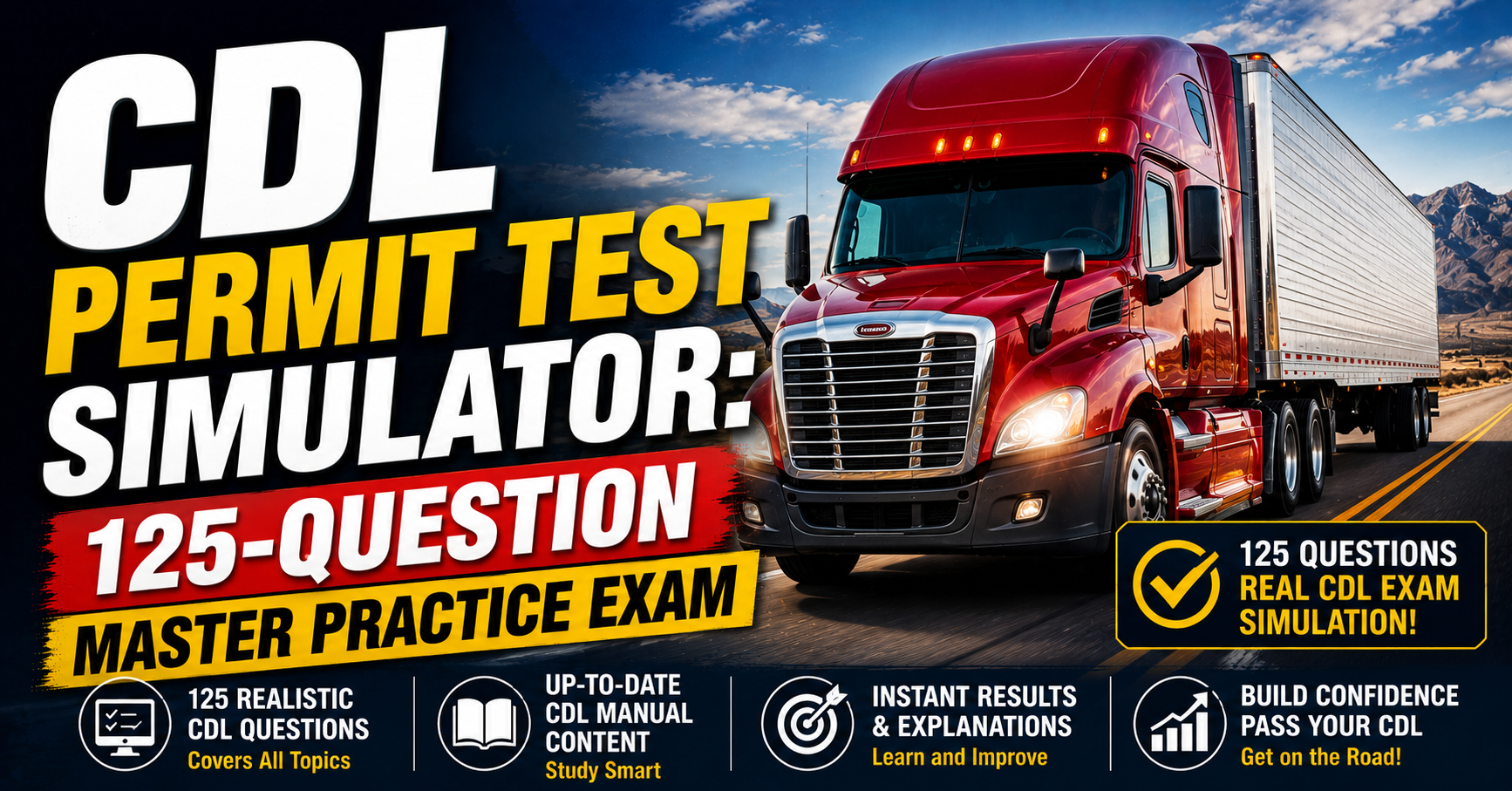
If you’re looking for the closest experience to taking the real CDL General Knowledge permit exam, you’ve come to the right place. Unlike practice tests that ask the same questions every time, our CDL Permit Test Simulator pulls from a 125-question master bank and delivers 50 randomized exam-style questions every time you begin a new attempt. That means no two quizzes are exactly alike, giving you a much better way to prepare for test day.
Every question includes an instant explanation after you answer, helping you understand the reasoning behind the correct response instead of simply memorizing answers. This approach builds the knowledge and confidence you’ll need when it’s time to earn your Commercial Driver’s License.
Many online practice tests repeat the same questions in the same order every time.
Real CDL exams don’t work that way.
This simulator randomly selects 50 questions from a bank of 125 carefully written exam-style questions that cover nearly every major General Knowledge topic.
That means every attempt feels fresh while helping you identify areas that still need additional study.
Subjects covered include:
Vehicle inspections
Safe driving
Defensive driving
Cargo securement
Weight distribution
Railroad crossings
Route planning
Night driving
Driver fitness
Weather driving
Mountain driving
Emergency procedures
Braking and stopping distance
Instead of memorizing question order, you’ll learn the concepts that make you a safer commercial driver.
Study Like You’re Taking the Real CDL Exam
One of the biggest mistakes students make is becoming comfortable with only one version of a practice test.
When the actual CDL permit exam presents questions differently, many people struggle even though they understand the material.
Randomized practice helps prevent this problem.
Each new attempt forces you to:
Read every question carefully.
Apply your knowledge.
Think through realistic situations.
Avoid relying on memory alone.
This creates better long-term learning while increasing your confidence before test day.
Unlike topic-specific quizzes, this simulator combines multiple subjects into one comprehensive exam.
One question may focus on cargo securement.
The next may involve emergency braking.
Another could test your understanding of railroad crossings, mountain driving, or vehicle inspections.
This variety helps measure how well you understand CDL safety as a whole instead of testing only one subject at a time.
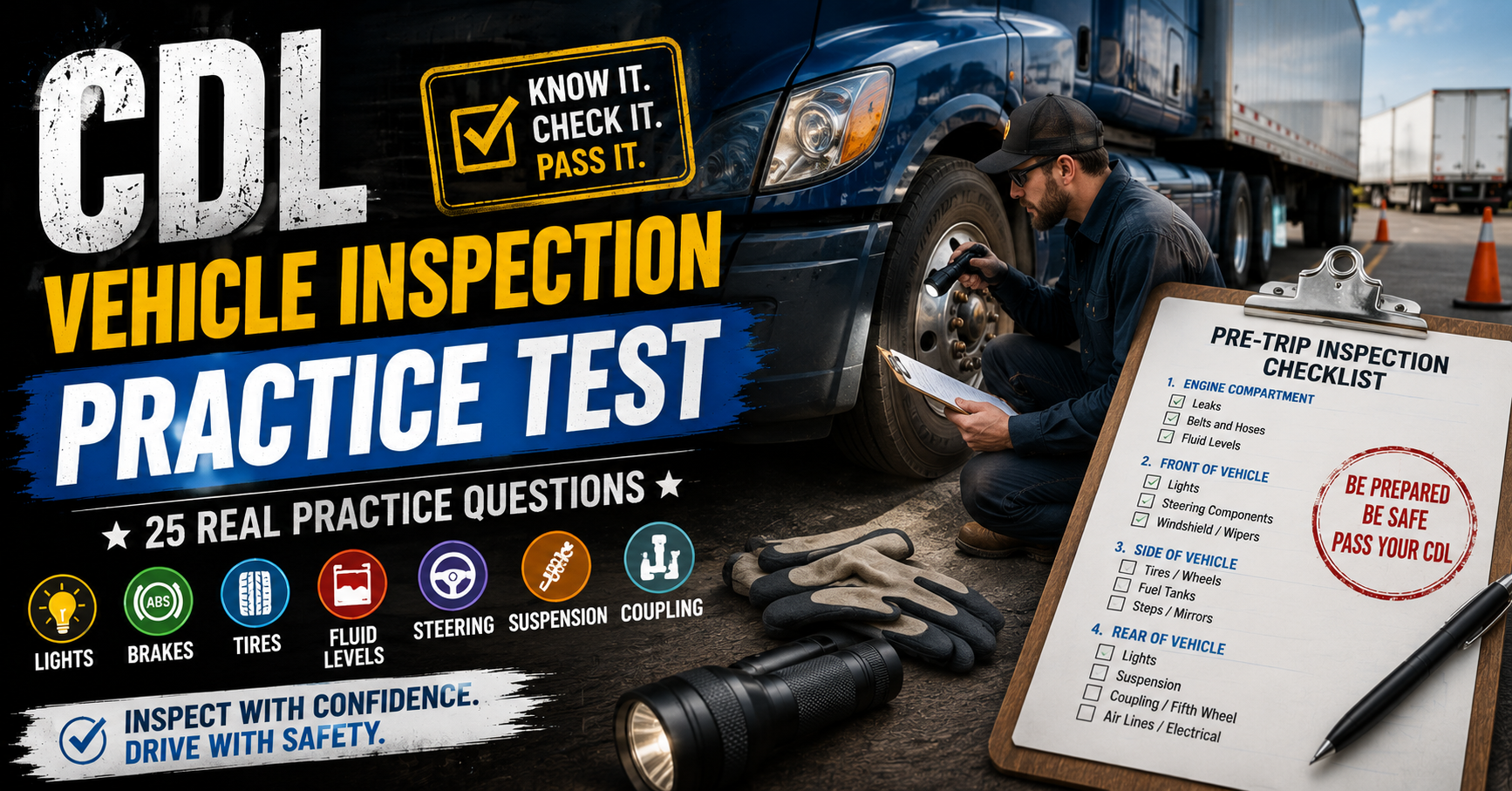
Continue sharpening your inspection skills with our CDL Vehicle Inspection Practice Test. Strong pre-trip inspection habits often prevent many of the emergency situations covered throughout this simulator.
Build Confidence Before Test Day
Confidence doesn’t come from guessing.
It comes from repeated practice and understanding why each answer is correct.
Every time you complete another randomized exam, you’ll strengthen your ability to recognize common CDL concepts without relying on memorization.
Many successful CDL students complete dozens of practice exams before taking their official permit test because every attempt reinforces safe driving principles.
If you don’t earn the score you hoped for on your first try, don’t get discouraged.
Simply review the explanations, identify your weaker subjects, and take another randomized exam.
Many applicants miss questions because they focus on memorizing answers instead of understanding the safety concepts behind them.
Some of the most common mistakes include:
Skipping pre-trip inspection questions.
Forgetting proper following distances.
Misjudging stopping distance.
Ignoring cargo securement rules.
Rushing through weather-related questions.
Overlooking railroad crossing procedures.
Not recognizing fatigue warning signs.
Failing to review incorrect answers.
Avoiding these mistakes will improve both your test scores and your future driving habits.
Why Random Questions Improve Learning
Seeing the same questions repeatedly can create a false sense of confidence.
Eventually you begin remembering the answer instead of understanding the concept.
Randomized testing forces you to slow down and think through each situation independently.
That process strengthens long-term memory while improving your ability to solve unfamiliar problems during the real CDL exam.
Professional truck drivers face different situations every day, and this simulator reflects that reality far better than a fixed practice test.
Study Until Safe Driving Becomes Automatic
The best commercial drivers don’t have to stop and think about every safety decision.
Good habits become second nature through repetition.
As you continue working through this simulator, you’ll naturally become better at:
Recognizing developing hazards.
Choosing safe following distances.
Planning escape routes.
Inspecting your vehicle.
Responding to emergencies.
Managing cargo safely.
Adjusting for weather conditions.
Thinking several seconds ahead.
These habits will help you long after you’ve passed your written permit exam.
Frequently Asked Questions
How many questions are in the CDL Permit Test Simulator?
The simulator contains a master bank of 125 questions. Each time you begin a new attempt, you’ll receive 50 randomized questions, making every practice session different.
Will I get the same questions every time?
No. The simulator randomly selects questions from the larger question bank, so every attempt presents a different combination of CDL topics.
Is this similar to the real CDL permit exam?
Yes. The simulator is designed to present realistic General Knowledge questions covering the major subjects found on CDL permit exams, helping you become comfortable answering a wide variety of question types.
Should I take the individual practice tests first?
Yes. Most students benefit from completing the topic-specific practice tests before attempting this comprehensive simulator. Building a strong foundation in each subject makes the mixed-question format much easier.
How many times should I use the simulator?
Take it as many times as necessary until you’re consistently scoring 90% or higher while understanding the explanations for every question. Because the questions are randomized, each attempt continues to challenge your knowledge.
Does the simulator explain every answer?
Yes. Every question provides an explanation after you answer, allowing you to understand the correct response and learn from any mistakes you make.
Planning Beyond Your CDL Test
Preparing for your CDL exam is important, but it’s only the beginning of your trucking career. Once you pass, you’ll move into CDL school, company orientation, driver training, and eventually your first solo loads.
Passing the CDL permit exam isn’t about memorizing answers. It’s about understanding the safety principles that professional truck drivers rely on every day. This simulator is designed to measure your overall readiness while exposing you to a wide variety of realistic driving situations.
After mastering the simulator, continue reviewing our complete collection of free CDL practice tests covering inspections, braking, weather, cargo securement, emergency procedures, railroad crossings, night driving, and other important General Knowledge topics. The more you practice, the more confident you’ll become on exam day and throughout your trucking career.