(function(){“use strict”;/* QUESTION BANK: Edit or replace only this array for future tests. Each item is [question,correct answer,[three wrong answers],explanation]. */var QUESTION_BANK=[[“Before starting the engine, why should the parking brake be set and the transmission be in neutral or park?”,”To prevent unintended vehicle movement when the engine starts”,[“To make the horn louder”,”To increase tire pressure”,”To test the cargo doors”],”A commercial vehicle can move unexpectedly if it starts in gear or if controls are disturbed. Securing the vehicle before startup protects the driver, nearby workers, and surrounding property.”],[“What is the safest way to park a commercial vehicle on a grade?”,”Set the parking brake, select the proper gear or park position, and use wheel chocks when needed”,[“Leave the transmission in neutral with no brake applied”,”Point the wheels toward traffic”,”Rely only on engine compression”],”A parked truck needs more than one layer of protection against rolling. Proper brake application, transmission position, wheel direction, and chocks where appropriate help keep it secure.”],[“Why must a driver be able to stop within the distance visible ahead?”,”A hazard beyond the visible area may leave no room to stop safely”,[“It guarantees other drivers will yield”,”It eliminates the need for mirrors”,”It allows the truck to exceed the speed limit”],”Speed must match sight distance. Darkness, hills, curves, fog, and glare can hide a stopped vehicle or obstruction, so the driver must slow enough to stop within the clear path.”],[“How does placing too much cargo weight near the rear affect vehicle handling?”,”It can lighten the steering axle and reduce steering control”,[“It always improves front-tire traction”,”It makes the vehicle immune to crosswinds”,”It shortens the vehicle’s wheelbase”],”Cargo distribution affects axle loading and control. Too little weight on the steering axle can reduce traction and steering response, while overloaded axles can damage components and violate weight limits.”],[“Why can an empty truck require extra care on rough or slippery roads?”,”It may have less tire traction and can bounce more because of its stiff suspension”,[“An empty truck always stops faster on every surface”,”Its center of gravity disappears”,”Its brakes stop functioning without cargo”],”Commercial suspensions are designed to carry weight. When empty, the vehicle may ride harshly, bounce, and have reduced traction, so speed and following distance still need careful adjustment.”],[“After driving through deep water, what should a driver do to check the brakes?”,”Apply them lightly at a slow speed to test and help dry them”,[“Park immediately with the brakes tightly applied”,”Accelerate to highway speed before testing”,”Assume disc and drum brakes cannot get wet”],”Water can reduce friction and cause uneven braking. At a safe slow speed, gentle application can test response and generate enough heat to dry the components before normal driving resumes.”],[“Excessive steering-wheel play may indicate what problem?”,”Worn or loose steering-system components”,[“The fuel tanks are full”,”The headlights are misaligned”,”The cargo is too clean”],”Loose steering parts can delay wheel response and make lane control difficult. Steering play beyond acceptable limits needs inspection and correction before the vehicle is operated.”],[“Why should headlights be used from dusk through dawn and whenever visibility is poor?”,”They help the driver see and make the vehicle easier for others to detect”,[“They reduce the vehicle’s gross weight”,”They replace clearance lights”,”They prevent all glare”],”Lights serve two purposes: illuminating the road and communicating the vehicle’s presence. Clean, properly aimed lights are essential, but speed must still be reduced when visibility is limited.”],[“When should a turn signal normally be activated before a turn?”,”Early enough to give other road users clear advance notice”,[“Only after entering the intersection”,”After the turn is complete”,”Only when another vehicle honks”],”A signal is useful only when provided in advance. Signal early, continue checking mirrors, and cancel the signal after the maneuver if it does not cancel automatically.”],[“If a vehicle ahead stops suddenly, why is steering around it often more dangerous for a truck than controlled braking?”,”A sudden swerve can cause a collision, skid, or rollover in an unseen lane”,[“Truck brakes work only below 20 mph”,”Steering always increases stopping distance by law”,”A truck cannot change lanes”],”Emergency steering should be used only when a clear escape path exists. Heavy vehicles are vulnerable to rollover and take up significant space, so a blind swerve may exchange one hazard for several others.”],[“What should a driver do before entering an unfamiliar tunnel or underpass?”,”Confirm vehicle height and any restrictions before proceeding”,[“Sound the horn and assume there is clearance”,”Move to the center of the roadway”,”Increase speed to spend less time inside”],”Tunnels may restrict height, width, hazardous materials, or vehicle types. Route planning and posted signs must be checked before entry because turning around may become impossible.”],[“Why is it important to keep cab floors and pedals free of loose objects?”,”Objects can roll under a pedal and interfere with braking or acceleration”,[“Loose objects improve traction for the driver’s shoes”,”They help absorb engine noise”,”They make emergency exits easier to find”],”Bottles, tools, and trash can jam pedals or distract the driver. A clean, organized cab keeps controls and exits accessible and reduces preventable hazards.”],[“A large animal enters the road ahead. What is usually the safest response?”,”Brake firmly while maintaining control and avoid a violent swerve”,[“Swerve into oncoming traffic”,”Accelerate to pass before it moves”,”Turn off the headlights”],”A sudden swerve in a heavy vehicle can cause a head-on crash or rollover. Reduce speed with controlled braking, sound the horn if useful, and steer only when a verified safe escape path exists.”],[“Why should engine oil pressure be checked soon after startup?”,”Low or absent pressure can quickly cause severe engine damage”,[“Oil pressure controls the trailer doors”,”The gauge measures tire tread depth”,”High pressure confirms the brakes are adjusted”],”Oil must circulate promptly to protect moving engine parts. If pressure does not rise to the normal range, shut down and investigate rather than continuing to run the engine.”],[“What is the safest action when a low-clearance warning appears on a route you planned to use?”,”Stop before the obstruction and take a verified alternate route”,[“Proceed slowly and listen for contact”,”Drive on the sidewalk around it”,”Assume navigation software is more accurate than the sign”],”Posted clearance warnings must be taken seriously. Never test an uncertain opening with the vehicle; stop safely and use a route whose clearances and restrictions have been confirmed.”],[“Why should tire pressure be checked when tires are cold?”,”Driving heat raises pressure and can hide an underinflated condition”,[“Cold air makes every tire exactly the same pressure”,”Warm tires have no measurable pressure”,”Cold checks permanently prevent punctures”],”Manufacturers’ pressure specifications generally refer to cold tires. Heat generated during travel increases pressure, so releasing air from a warm tire may leave it dangerously low after cooling.”],[“What can happen when tires on the same axle have significantly different pressures?”,”The vehicle may handle unevenly and the tires may wear or overheat differently”,[“The axle automatically balances all pressure”,”Fuel consumption always drops”,”The lower tire becomes stronger”],”Unequal inflation changes tire size, load sharing, heat buildup, and traction. Correct pressures support predictable steering, braking, tire life, and load capacity.”],[“During hot-weather driving, why should tires be inspected more often?”,”Heat increases pressure and can worsen damage or underinflation-related heat buildup”,[“Hot pavement adds new tread to tires”,”Tire defects become harmless above 80 degrees”,”Air pressure always falls as tires heat”],”High ambient and road temperatures add to flexing heat. Underinflation, overload, or existing damage can then lead to rapid failure, so pressure and tire condition deserve extra attention.”],[“What is the safest response if the vehicle begins pulling strongly to one side during braking?”,”Stop safely and have the braking or tire problem inspected”,[“Compensate permanently by steering the other way”,”Increase speed so the pull disappears”,”Disable the brakes on the opposite side”],”A strong pull can signal uneven brake force, contamination, tire failure, or another serious defect. Continuing may cause loss of control, especially during an emergency stop.”],[“Why should a driver scan well ahead instead of watching only the vehicle directly in front?”,”Early hazard detection provides more time for smooth speed and lane adjustments”,[“It removes the need to check mirrors”,”It makes road signs larger”,”It prevents vehicles from entering blind spots”],”Looking far ahead reveals traffic slowdowns, signals, work zones, curves, and escape options sooner. Early information lets a heavy vehicle respond gradually rather than through abrupt braking or steering.”],[“When approaching a stale green traffic light, what should a driver anticipate?”,”The light may change, so be prepared to stop safely”,[“The light is guaranteed to remain green”,”Cross traffic must stay stopped after it changes”,”Speed should be increased above the limit”],”A light that has been green for some time may change before a heavy vehicle reaches it. Covering the possibility and controlling speed reduces hard stops and red-light entries.”],[“Why is it unsafe to coast toward a stop with the transmission in neutral?”,”It reduces vehicle control and removes engine braking”,[“It makes the steering wheel legally unusable”,”It automatically turns off brake lights”,”It increases tire tread depth”],”Remaining in an appropriate gear keeps power available and allows the engine to assist with speed control. Coasting can also make it harder to respond promptly to changing traffic.”],[“What should a driver verify after coupling or attaching any towed equipment?”,”Connections are locked, safety devices are attached, and lights and brakes work”,[“Only the paint colors match”,”The towed unit’s radio is turned off”,”The rear doors are open”],”A secure mechanical connection is only part of the check. Safety chains or other devices, air or electrical lines, lights, brakes, and clearance all must be verified before movement.”],[“Why should a driver avoid stopping on a highway shoulder unless necessary?”,”The vehicle remains close to fast traffic and may be struck”,[“Shoulders always have stronger pavement”,”Stopping there improves traffic flow”,”Commercial vehicles become invisible when parked”],”A shoulder provides limited separation from moving traffic and may be soft, narrow, or obstructed. If a stop is unavoidable, move as far from traffic as safely possible and use required warnings.”],[“Before leaving the cab during a roadside inspection, what should the driver do?”,”Secure the vehicle and watch carefully for passing traffic”,[“Leave the engine in gear with no parking brake”,”Step directly into the traffic lane”,”Turn off all warning lights”],”Roadside work exposes a driver to moving vehicles. Park and secure the truck, use appropriate warning equipment, exit away from traffic when possible, and remain alert to approaching vehicles.”]];/* END QUESTION BANK */var S={qs:[],i:0,score:0},$=function(x){return document.getElementById(x)},E={quiz:$(‘quiz’),results:$(‘results’),reviewScreen:$(‘reviewScreen’),qcount:$(‘qcount’),score:$(‘score’),progress:$(‘progress’),bar:$(‘bar’),question:$(‘question’),answers:$(‘answers’),feedback:$(‘feedback’),prev:$(‘prev’),next:$(‘next’),review:$(‘review’),reviewList:$(‘reviewList’)};function sh(a){a=a.slice();for(var i=a.length-1;i;i–){var j=Math.floor(Math.random()*(i+1)),t=a[i];a[i]=a[j];a[j]=t}return a}function esc(s){var d=document.createElement(‘div’);d.textContent=s;return d.innerHTML}function top(){$(‘tr-cdl-app’).scrollIntoView({behavior:’smooth’,block:’start’})}function start(){S.qs=sh(QUESTION_BANK).map(function(x){return{q:x[0],a:sh([{t:x[1],ok:true}].concat(x[2].map(function(w){return{t:w,ok:false}}))),ex:x[3],pick:null}});S.i=0;S.score=0;E.quiz.hidden=false;E.results.hidden=true;E.reviewScreen.hidden=true;render();top()}function render(){var q=S.qs[S.i],done=q.pick!==null,n=S.qs.filter(function(x){return x.pick!==null}).length;E.qcount.textContent=’Question ‘+(S.i+1)+’ of ‘+S.qs.length;E.score.textContent=S.score;E.bar.style.width=n/S.qs.length*100+’%’;E.progress.setAttribute(‘aria-valuenow’,n);E.question.textContent=q.q;E.answers.innerHTML=”;q.a.forEach(function(a,i){var b=document.createElement(‘button’);b.type=’button’;b.className=’answer’+(done&&a.ok?’ good’:”)+(done&&i===q.pick&&!a.ok?’ bad’:”);b.textContent=a.t;b.disabled=done;b.onclick=function(){choose(i)};E.answers.appendChild(b)});E.prev.disabled=S.i===0;E.next.disabled=!done;E.next.textContent=S.i===S.qs.length-1?’View Results’:’Next Question’;if(done)feed(q);else E.feedback.hidden=true}function choose(i){var q=S.qs[S.i];if(q.pick!==null)return;q.pick=i;if(q.a[i].ok)S.score++;render()}function feed(q){var a=q.a[q.pick],c=q.a.filter(function(x){return x.ok})[0];E.feedback.className=’feedback ‘+(a.ok?’good’:’bad’);E.feedback.innerHTML=’‘+(a.ok?’ Correct!’:’ Incorrect’)+’‘+(!a.ok?’
Correct answer: ‘+esc(c.t)+’
Why your answer is incorrect: It does not follow the safe procedure or principle being tested.
‘:”)+’
Explanation: ‘+esc(q.ex)+’
‘;E.feedback.hidden=false}function done(){var total=S.qs.length,bad=total-S.score,p=Math.round(S.score/total*100);E.quiz.hidden=true;E.reviewScreen.hidden=true;E.results.hidden=false;$(‘percent’).textContent=p+’%’;$(‘final’).textContent=S.score+’/’+total;$(‘correct’).textContent=S.score;$(‘incorrect’).textContent=bad;$(‘message’).textContent=p>=90?’Outstanding! You\’re well prepared for the CDL permit exam.’:p>=80?’Great job! Review the missed questions and you\’ll be in excellent shape.’:p>=70?’Good progress. Keep practicing before taking the real exam.’:’More studying is recommended before taking your CDL permit test.’;E.review.disabled=!bad;top()}function review(){E.reviewList.innerHTML=”;S.qs.filter(function(q){return!q.a[q.pick].ok}).forEach(function(q,i){var c=q.a.filter(function(a){return a.ok})[0],d=document.createElement(‘article’);d.className=’review-item’;d.innerHTML=’
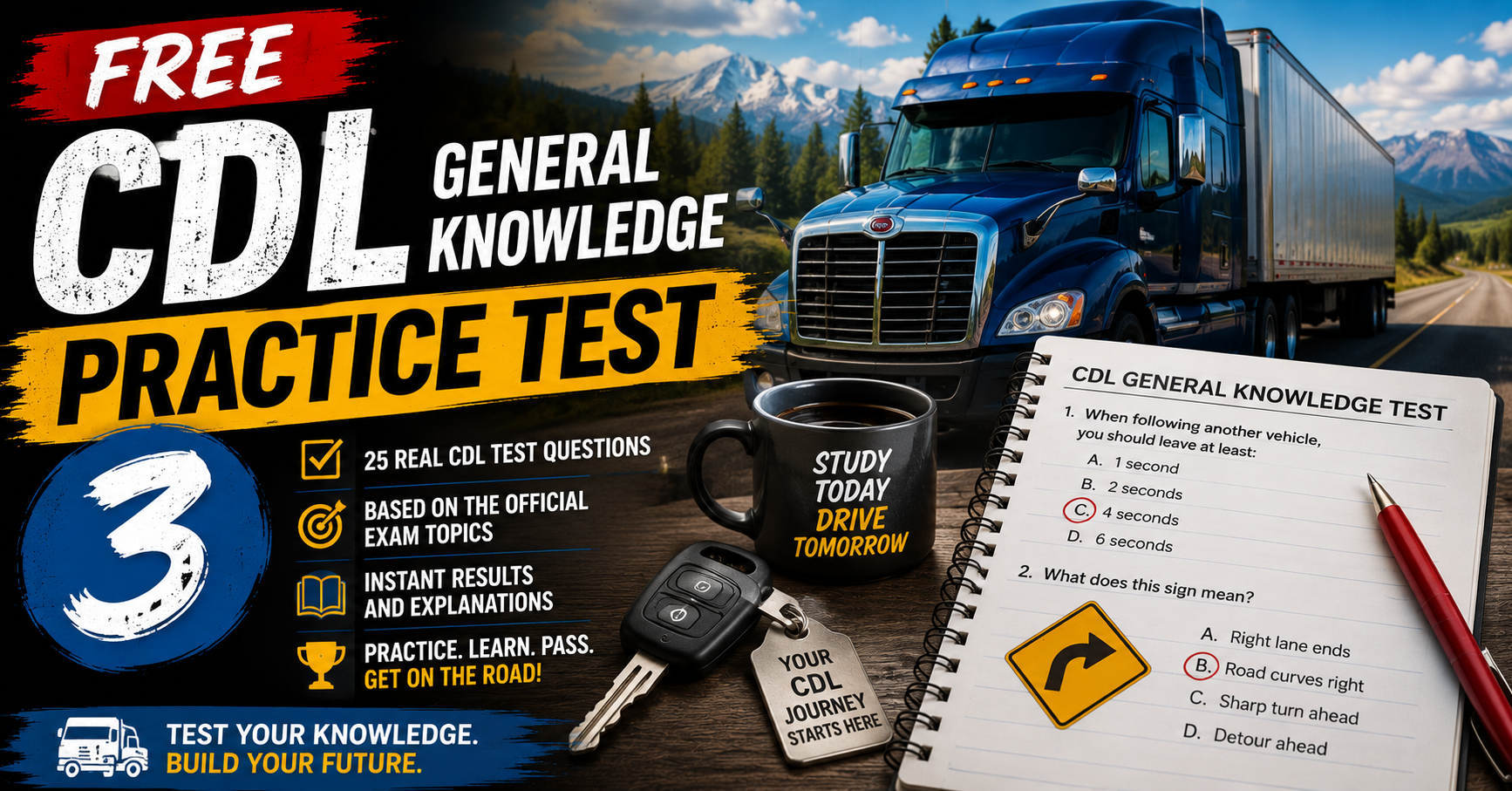
Congratulations on making it to CDL General Knowledge Practice Test #3. If you’ve already completed the first two practice tests, you’re building the kind of experience that can make a real difference when it’s time to take your CDL permit exam.
This practice test includes 25 brand-new multiple-choice questions covering many of the same safety topics you’ll study in your state’s CDL manual. Every question includes an explanation after you answer, helping you understand why the correct answer is right instead of simply memorizing it.
Every CDL practice test covers different situations, wording, and safety concepts.
The actual CDL General Knowledge exam isn’t made up of the same 25 questions over and over. That’s why taking several practice tests gives you a much better understanding of the material and exposes you to a wider variety of commercial driving scenarios.
Each additional quiz helps reinforce safe driving habits while improving your confidence before test day.
This practice test focuses on many of the topics every commercial driver should understand, including:
Vehicle inspections
Safe driving habits
Braking techniques
Defensive driving
Cargo safety
Steering control
Parking procedures
Vehicle maintenance
Driver awareness
Highway safety
Emergency situations
Commercial vehicle regulations
These questions are designed to help you think through real-world situations that professional truck drivers encounter every day.
Learn From Every Question
One of the best ways to prepare for your CDL permit exam is by understanding your mistakes.
Each question on this practice test includes an explanation after you answer. If you miss a question, take a few moments to read the explanation carefully before moving on.
You’ll often remember the reasoning much longer than simply memorizing the correct letter.
The more quality practice tests you complete, the more comfortable you’ll become with CDL testing.
Many successful CDL students don’t stop after one or two quizzes. They continue practicing until they’re consistently scoring 90% or higher across multiple practice exams.
Doing that helps reduce stress and increases confidence when it’s time to take the real CDL General Knowledge test.
Continue Your CDL Training
After completing this practice test, keep building your knowledge by reviewing our previous practice exams.
We’ll continue publishing new CDL practice tests covering General Knowledge, Air Brakes, Combination Vehicles, Hazmat, Tanker, Passenger, School Bus, Doubles & Triples, and more to help you prepare for every part of earning your Commercial Driver’s License.