(function(){“use strict”;/* QUESTION BANK — replace only this array for future tests. */var Q=[[“Before entering a railroad crossing, what must a long-vehicle driver confirm?”,”There is enough room beyond the tracks for the entire vehicle”,[“Traffic behind is ready to follow”,”The transmission can be shifted on the tracks”,”The warning lights have been off five seconds”],”Never enter unless the whole vehicle can clear without stopping. Congestion or a nearby traffic signal can trap a long vehicle on the rails.”],[“Why should shifting gears be avoided while crossing railroad tracks?”,”A missed shift or stall could leave the vehicle on the tracks”,[“Shifting makes trains travel faster”,”The rails lock the clutch”,”Gear changes turn off crossing signals”],”Choose a gear before crossing that will carry the vehicle completely across. Maintain steady motion without unnecessary drivetrain changes.”],[“If warning lights activate after the truck begins crossing, what should the driver do?”,”Continue moving and clear the tracks immediately”,[“Stop on the tracks and look”,”Back up without checking”,”Exit the cab while still moving”],”Once committed, the priority is to clear every track. Stopping exposes the vehicle to the approaching train.”],[“What should a driver do if the vehicle becomes stuck on railroad tracks?”,”Evacuate away from the tracks, call emergency services and the posted crossing number”,[“Remain in the cab and wait”,”Walk along the tracks toward the train”,”Try to flag the train from between the rails”],”Get everyone out immediately. Move away at an angle toward the direction from which a train may approach so debris is less likely to be driven toward you.”],[“Why must a driver look and listen even when crossing gates are raised?”,”Signals can fail and a train may approach on another track”,[“Raised gates always mean a train is hidden”,”Listening changes the signal timing”,”Trains are required to stop for trucks”],”Active devices add protection but do not replace observation. Slow appropriately, scan both directions, and never assume all tracks are clear.”],[“What is a passive railroad crossing?”,”A crossing without active gates or flashing-light signals”,[“A crossing used only at night”,”A track where trains have no right of way”,”A crossing inside a parking lot only”],”Passive crossings rely on signs, markings, and the driver’s observation. Approach slowly enough to see and hear clearly before proceeding.”],[“Why are multiple-track crossings especially hazardous?”,”A second train may be hidden by the first”,[“Every track carries trains in one direction”,”Trucks can stop safely between all tracks”,”Signals control only passenger cars”],”Do not move as soon as one train passes. Check every track in both directions and wait until the entire crossing is clearly safe.”],[“How should a driver approach a work-zone flagger?”,”Slow early and obey the flagger’s directions”,[“Follow signals only if police are present”,”Maintain speed until beside the flagger”,”Use the shoulder to pass”],”Flaggers have an exposed, critical traffic-control role. Watch for instructions well in advance and be prepared to stop.”],[“Why is following distance especially important in work zones?”,”Traffic may stop suddenly and lanes may narrow or shift”,[“Construction vehicles never enter traffic”,”Workers guarantee constant speed”,”Barriers shorten stopping distance”],”Queues and abrupt pattern changes are common. Extra space gives the truck time to stop smoothly without striking traffic or roadside workers.”],[“What should a driver do when temporary and permanent lane markings conflict?”,”Follow current work-zone signs, channelizing devices, and authorized directions”,[“Always follow the older markings”,”Drive between both sets of lines”,”Stop and wait in the lane”],”Temporary traffic control governs the active pattern. Reduce speed so cones, barriers, signs, and flaggers can be interpreted safely.”],[“Why are concrete barriers dangerous to large vehicles in narrow work-zone lanes?”,”There is little recovery space if the vehicle drifts or off-tracks”,[“Barriers attract the steering wheel”,”They increase tire pressure”,”They make the vehicle legally narrower”],”Maintain centered lane position, reduce speed, and avoid driving side by side with another large vehicle when space is tight.”],[“Before taking a detour, what should a commercial driver verify?”,”The route can handle the vehicle’s height, weight, length, width, and restrictions”,[“The route is shortest on a passenger-car app”,”Every local road allows trucks”,”The detour has the most traffic lights”],”A detour suitable for cars may include low bridges, weak roads, tight turns, or truck prohibitions. Verify a commercial-vehicle route.”],[“Why should a driver know the vehicle’s exact height?”,”Posted clearances must be compared with the actual vehicle and load”,[“Height determines brake pressure”,”The truck gets shorter at speed”,”Every bridge has extra clearance”],”Load height can change each trip. Pavement resurfacing, snow, suspension position, and approach angle can reduce effective clearance.”],[“What should be done when clearance is uncertain?”,”Stop before the obstruction and use a verified alternate route”,[“Creep forward until the roof touches”,”Accelerate to lower the vehicle”,”Rely on another driver’s guess”],”Never test a low opening with the truck. A safe stop and reroute prevent structural damage, injury, and traffic disruption.”],[“Why must bridge weight-limit signs be obeyed?”,”An overweight vehicle can damage or collapse the structure”,[“The sign applies only to empty trucks”,”Speed cancels the weight restriction”,”Axle weight never matters on bridges”],”Bridge limits may apply to total weight, axle groups, or vehicle configuration. Plan around structures that cannot safely carry the load.”],[“What is the danger of using passenger-car navigation as the only route source?”,”It may direct a truck onto restricted, low-clearance, or weight-limited roads”,[“It always chooses routes that are too wide”,”It disables turn signals”,”It changes cargo weight”],”Use truck-appropriate route information and verify signs. Navigation is an aid, not permission to ignore physical or legal restrictions.”],[“Before a trip, why should fuel stops be planned for a large vehicle?”,”Not every station has safe access, clearance, or turning space”,[“Fuel expands only at planned stops”,”Trucks may fuel only at night”,”Planning eliminates all traffic”],”A suitable stop needs room to enter, maneuver, park, and exit without striking structures or blocking traffic.”],[“Why should legal truck restrictions be checked before entering an urban area?”,”Some streets restrict commercial vehicles, weight, length, or delivery times”,[“City signs apply only to buses”,”Commercial vehicles may use every road”,”Restrictions disappear during rush hour”],”Local routes can include truck bans, tight turns, low structures, and time limits. Plan an approved path before arrival.”],[“How should a driver prepare for a steep downgrade found on the planned route?”,”Review grade warnings, select a safe gear, and identify escape ramps”,[“Plan to shift into neutral”,”Ignore signs if the brakes are new”,”Increase speed before the crest”],”Advance knowledge prevents last-second decisions. Enter slowly in the correct gear and know where emergency options are located.”],[“Why should parking locations be planned before hours or fatigue become critical?”,”Safe legal truck parking may be limited or full”,[“Any shoulder is approved parking”,”Trip planning removes rest requirements”,”Parking is always available at customers”],”Searching while tired or out of time encourages unsafe choices. Identify primary and backup locations that can accommodate the vehicle.”],[“What should a driver verify before entering a tunnel?”,”Clearance, vehicle restrictions, lane controls, and any hazardous-material rules”,[“Only the tunnel’s paint color”,”Whether headlights may be turned off”,”That the horn echoes”],”Tunnels may restrict height, width, cargo, or vehicle type. Obey lane-control signals and use required lighting.”],[“What does a red X above a lane mean?”,”The lane is closed to traffic”,[“The lane is reserved for trucks”,”The speed limit is doubled”,”Passing is required”],”Overhead lane-control signals manage tunnels, bridges, and reversible roads. Move safely to an open lane before reaching the closure.”],[“Why should sharp turns on an unfamiliar route be reviewed in advance?”,”A long vehicle may off-track, swing wide, or lack turning room”,[“Route review changes the wheelbase”,”All mapped turns fit every truck”,”Tight turns improve cargo stability”],”Satellite views, commercial route data, and delivery instructions can reveal access problems. Never enter a space without a safe exit plan.”],[“A road-closed sign conflicts with the navigation route. Which should the driver follow?”,”The road closure and authorized traffic control”,[“The navigation route”,”The shortest visible shoulder”,”The vehicle ahead regardless of signs”],”Live signs, barriers, and officials override stored directions. Stop safely and obtain a verified alternate route.”],[“What is the best overall route-planning practice?”,”Combine commercial routing information with current signs, conditions, and driver judgment”,[“Trust one app without verification”,”Choose only the shortest mileage”,”Ignore weather and construction updates”],”No single source catches every restriction or changing condition. A professional plan includes dimensions, weight, fuel, parking, weather, construction, and backup routes.”]],S={q:[],i:0,s:0},$=function(x){return document.getElementById(x)},E={quiz:$(‘quiz’),results:$(‘results’),reviewScreen:$(‘reviewScreen’),qcount:$(‘qcount’),score:$(‘score’),progress:$(‘progress’),bar:$(‘bar’),question:$(‘question’),answers:$(‘answers’),feedback:$(‘feedback’),prev:$(‘prev’),next:$(‘next’),review:$(‘review’),reviewList:$(‘reviewList’)};function sh(a){a=a.slice();for(var i=a.length-1;i;i–){var j=Math.floor(Math.random()*(i+1)),t=a[i];a[i]=a[j];a[j]=t}return a}function esc(s){var d=document.createElement(‘div’);d.textContent=s;return d.innerHTML}function top(){$(‘tr-cdl-app’).scrollIntoView({behavior:’smooth’,block:’start’})}function start(){S.q=sh(Q).map(function(x){return{t:x[0],a:sh([{t:x[1],ok:true}].concat(x[2].map(function(w){return{t:w,ok:false}}))),e:x[3],p:null}});S.i=0;S.s=0;E.quiz.hidden=false;E.results.hidden=true;E.reviewScreen.hidden=true;render();top()}function render(){var q=S.q[S.i],done=q.p!==null,n=S.q.filter(function(x){return x.p!==null}).length;E.qcount.textContent=’Question ‘+(S.i+1)+’ of ‘+S.q.length;E.score.textContent=S.s;E.bar.style.width=n/S.q.length*100+’%’;E.progress.setAttribute(‘aria-valuenow’,n);E.question.textContent=q.t;E.answers.innerHTML=”;q.a.forEach(function(a,i){var b=document.createElement(‘button’);b.type=’button’;b.className=’answer’+(done&&a.ok?’ good’:”)+(done&&i===q.p&&!a.ok?’ bad’:”);b.textContent=a.t;b.disabled=done;b.onclick=function(){pick(i)};E.answers.appendChild(b)});E.prev.disabled=S.i===0;E.next.disabled=!done;E.next.textContent=S.i===S.q.length-1?’View Results’:’Next Question’;if(done)feed(q);else E.feedback.hidden=true}function pick(i){var q=S.q[S.i];if(q.p!==null)return;q.p=i;if(q.a[i].ok)S.s++;render()}function feed(q){var a=q.a[q.p],c=q.a.filter(function(x){return x.ok})[0];E.feedback.className=’feedback ‘+(a.ok?’good’:’bad’);E.feedback.innerHTML=’‘+(a.ok?’ Correct!’:’ Incorrect’)+’‘+(!a.ok?’
Correct answer: ‘+esc(c.t)+’
Why yours is incorrect: It does not follow the crossing, work-zone, or route-planning principle being tested.
‘:”)+’
Explanation: ‘+esc(q.e)+’
‘;E.feedback.hidden=false}function finish(){var n=S.q.length,b=n-S.s,p=Math.round(S.s/n*100);E.quiz.hidden=true;E.reviewScreen.hidden=true;E.results.hidden=false;$(‘percent’).textContent=p+’%’;$(‘final’).textContent=S.s+’/’+n;$(‘correct’).textContent=S.s;$(‘incorrect’).textContent=b;$(‘message’).textContent=p>=90?’Outstanding! You are well prepared on crossings and commercial route planning.’:p>=80?’Great job! Review the missed route and crossing questions.’:p>=70?’Good progress. Keep practicing this section.’:’More railroad, work-zone, and route-planning study is recommended.’;E.review.disabled=!b;top()}function review(){E.reviewList.innerHTML=”;S.q.filter(function(q){return!q.a[q.p].ok}).forEach(function(q,i){var c=q.a.filter(function(a){return a.ok})[0],d=document.createElement(‘article’);d.className=’review-item’;d.innerHTML=’
Safe commercial driving begins long before you turn the key. Professional truck drivers don’t simply climb into the cab and start driving. They plan their routes, verify clearances, identify potential hazards, and understand how to safely navigate railroad crossings, work zones, bridges, tunnels, and restricted roads.
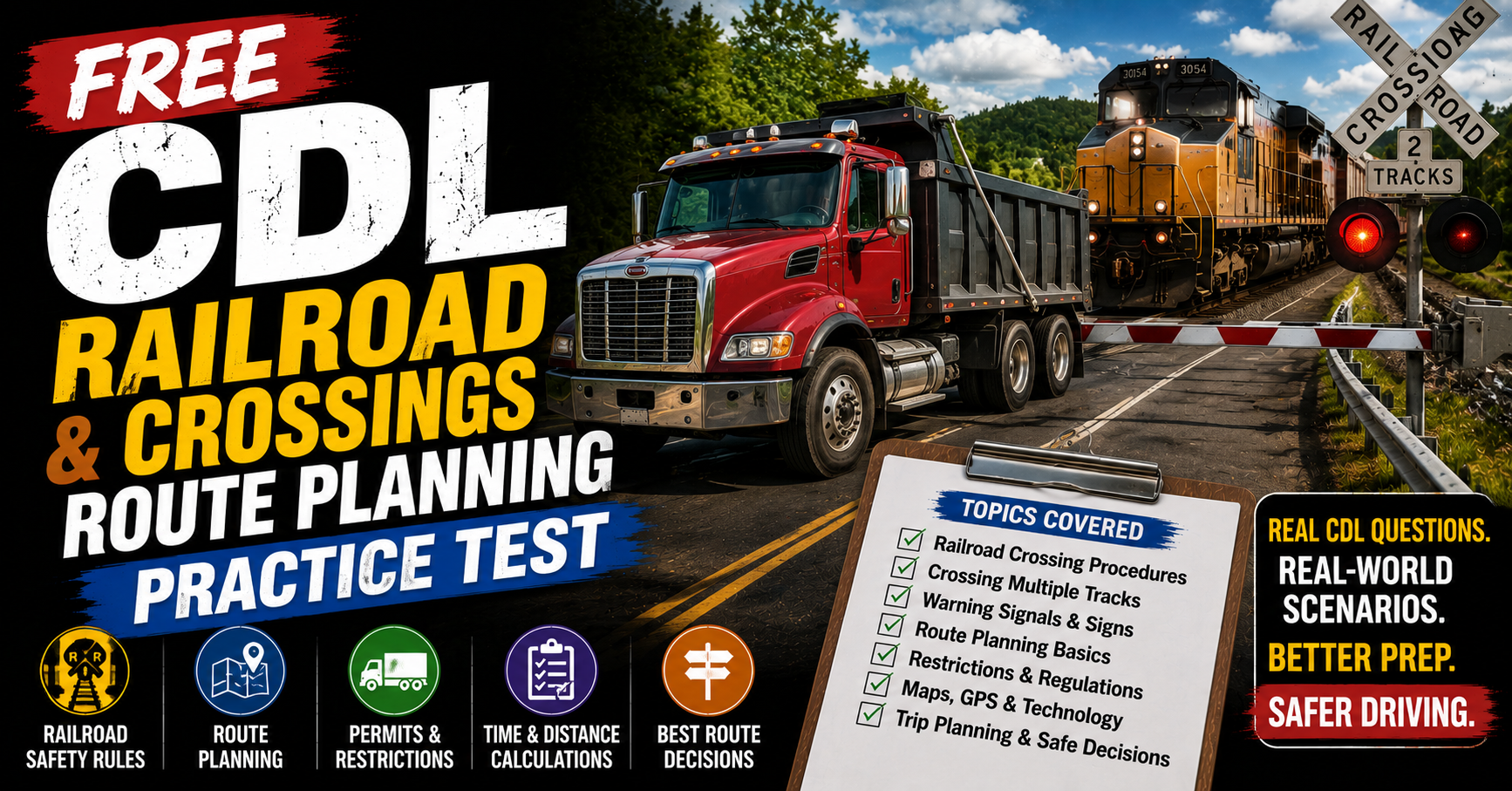
Our Free CDL Railroad Crossings & Route Planning Practice Test helps prepare you for these important topics with 25 realistic multiple-choice questions covering railroad crossing safety, trip planning, bridge clearances, work zones, truck routes, tunnels, detours, and commercial vehicle restrictions. Every question includes a detailed explanation so you understand the safest response and the reasoning behind it.
If you’re just beginning your CDL preparation, we recommend starting with our Free CDL General Knowledge Practice Test #1 before moving into specialized topics like railroad safety and commercial route planning.
Professional truck drivers spend much of their time thinking ahead.
Good route planning helps drivers avoid unnecessary delays while reducing the chance of encountering roads that aren’t suitable for large commercial vehicles.
Planning before leaving allows you to prepare for:
Low bridges
Weight restrictions
Sharp curves
Construction zones
Mountain grades
Tunnel restrictions
Railroad crossings
Heavy traffic
Truck parking
Fuel stops
The better your route is planned, the fewer surprises you’ll face during the trip.
What You’ll Learn on This Practice Test
This CDL practice test focuses on many of the route planning and railroad crossing topics found in CDL manuals across the United States.
Topics include:
Railroad crossings
Work zones
Bridge clearances
Tunnel safety
Height restrictions
Weight limits
Commercial truck routes
Detours
Lane restrictions
Route planning
Parking planning
Safe trip preparation
These questions help prepare you for both your CDL permit exam and real-world commercial driving.
Construction zones constantly change road conditions.
Temporary lane shifts, narrowed lanes, construction equipment, workers near traffic, and reduced speed limits all require commercial drivers to slow down and stay alert.
Professional drivers should:
Reduce speed early.
Watch for flaggers.
Follow temporary traffic signs.
Leave extra following distance.
Avoid unnecessary lane changes.
Patience helps protect road workers while reducing the chance of collisions.
Know Your Vehicle’s Height
Every commercial driver should know the exact height of both the vehicle and its load.
Bridge strikes happen every year because drivers assume they’ll have enough clearance without checking.
Before beginning any trip:
Verify total vehicle height.
Review the planned route.
Watch for posted clearance signs.
Avoid questionable underpasses.
Stop if clearance is uncertain.
Never guess whether your truck will fit beneath a bridge.
Even if your truck appears capable of crossing safely, exceeding a posted weight limit can damage infrastructure while creating unnecessary danger.
Commercial drivers should understand:
Gross vehicle weight.
Axle weight limits.
Bridge restrictions.
Local truck routes.
Seasonal weight limits where applicable.
Route planning helps avoid expensive citations and dangerous situations before they occur.
Commercial Navigation Is Better Than Passenger GPS
Many passenger vehicle navigation apps aren’t designed for commercial trucks.
They may route drivers onto roads with:
Low bridges.
Sharp turns.
Truck restrictions.
Weight limits.
Narrow streets.
Residential neighborhoods.
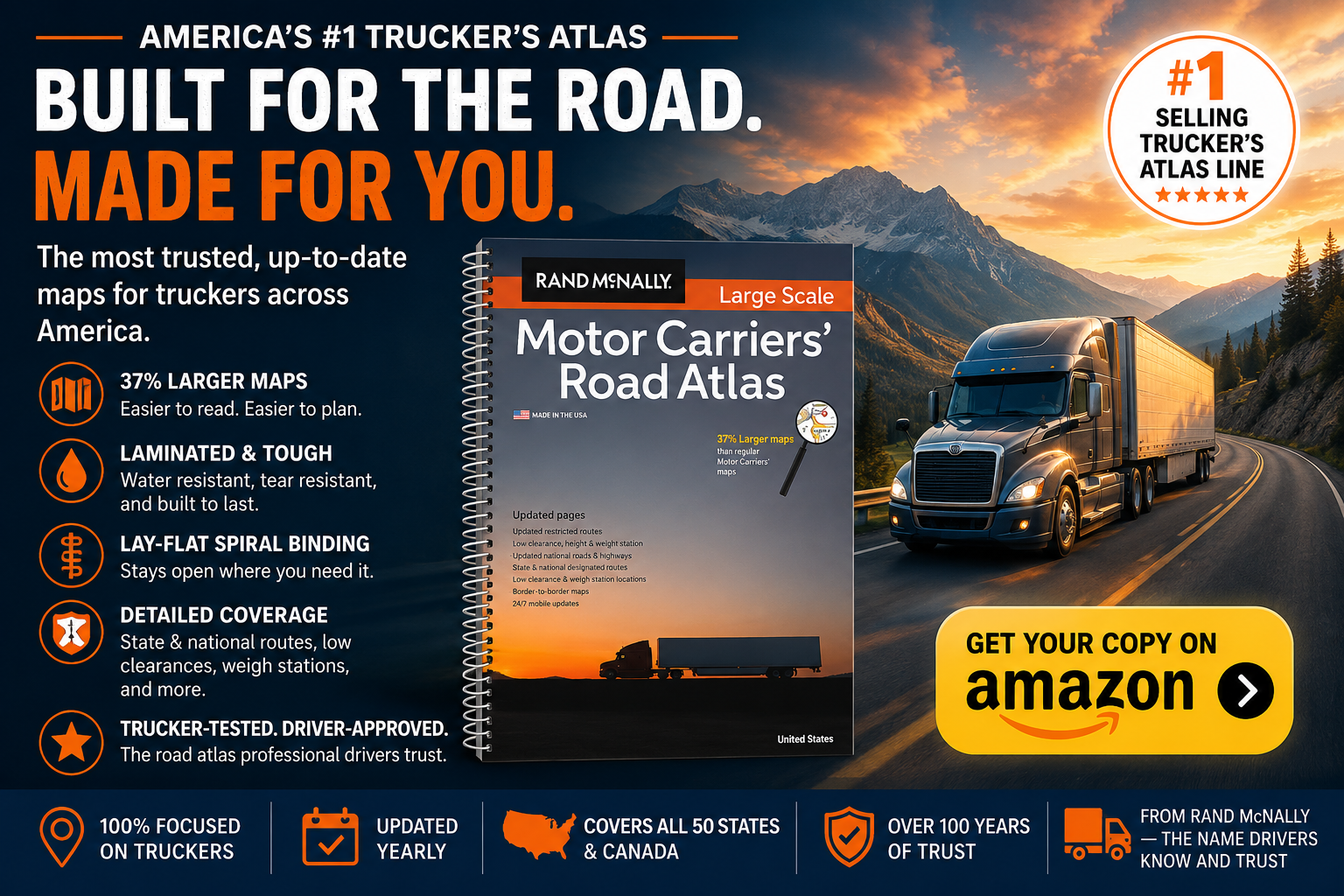
Professional drivers should use commercial route planning tools while still paying close attention to roadside signs. A Rand McNally motor carriers' road atlas can provide a paper reference alongside truck-specific route planning tools when drivers review a trip.
Road signs always take priority over electronic navigation.
Plan Fuel Stops Before You Leave
Finding fuel isn’t usually difficult.
Finding fuel that’s easily accessible to a large commercial vehicle is another story.
Professional drivers often plan their fuel stops before beginning long trips.
Doing so helps avoid:
Tight parking lots.
Low canopies.
Difficult turns.
Heavy city traffic.
Running low on fuel.
Planning ahead reduces stress while making each trip more efficient.
Prepare for Weather Along Your Route
Good route planning includes checking weather forecasts before departure.
Rain, snow, ice, flooding, high winds, and extreme temperatures may all affect your travel plans.
Many tunnels have restrictions that apply specifically to commercial vehicles.
Some prohibit hazardous materials, while others have limits on vehicle height, width, weight, or lane usage.
Before entering any tunnel, drivers should verify:
Vehicle height.
Cargo restrictions.
Posted speed limits.
Lane control signals.
Ventilation restrictions.
Hazardous material requirements.
Entering a restricted tunnel without proper authorization can create serious safety risks and result in costly penalties.
Be Prepared for Unexpected Detours
Road construction, accidents, flooding, and severe weather can force drivers to leave their planned route.
Before following any detour, consider whether the alternate route is suitable for a commercial vehicle.
Look for potential problems such as:
Low bridges.
Weight-restricted roads.
Narrow streets.
Tight intersections.
Sharp curves.
Local truck restrictions.
A detour that’s perfectly safe for a passenger car may be completely unsuitable for a tractor trailer or dump truck.
Plan Your Parking Before You Need It
One of the biggest mistakes new truck drivers make is waiting until they’re almost out of driving hours before searching for parking.
Truck parking fills quickly, especially during evenings and along busy freight corridors.
Before beginning your trip:
Identify primary parking locations.
Have backup parking options.
Monitor your available driving hours.
Avoid waiting until the last minute.
Good planning reduces stress while helping you stay compliant with Hours of Service regulations.
Railroad Emergencies Require Immediate Action
Although rare, vehicles occasionally become stuck on railroad tracks.
If this happens:
Get everyone out of the vehicle immediately.
Move away from the tracks.
Call 911.
Use the emergency crossing number posted at the crossing if available.
Never remain inside the vehicle waiting for a train to stop.
Trains require tremendous distances to stop and cannot steer around obstacles.
Knowing what to do ahead of time can save lives.
Common Route Planning Mistakes
Many commercial driving problems begin before the trip even starts.
Some of the most common planning mistakes include:
Depending only on passenger vehicle GPS.
Ignoring posted truck restrictions.
Forgetting to verify bridge clearances.
Failing to plan fuel stops.
Not checking weather forecasts.
Entering construction zones unprepared.
Assuming every detour is truck-friendly.
Waiting too long to find parking.
Careful preparation helps eliminate many of these avoidable problems before they affect your trip.
Frequently Asked Questions
How many questions are on this CDL Railroad Crossings & Route Planning Practice Test?
This practice test contains 25 multiple-choice questions covering railroad crossings, work zones, bridges, tunnels, route planning, truck restrictions, and other important commercial driving topics.
Why should I avoid shifting gears while crossing railroad tracks?
A missed shift or engine stall could leave your truck stranded on the tracks. Selecting the proper gear before entering the crossing helps ensure you clear the tracks safely.
Why is knowing my truck’s height important?
Commercial drivers must know their vehicle’s exact height to avoid striking low bridges, parking garages, tunnels, tree limbs, or other overhead obstacles.
Should I trust my car’s GPS while driving a truck?
Passenger vehicle navigation systems often don’t account for commercial vehicle restrictions. Always use truck-specific routing whenever possible and obey all posted road signs.
Why is trip planning important for CDL drivers?
Good trip planning helps drivers avoid low bridges, weight restrictions, construction zones, unsafe roads, traffic delays, and parking problems while making each trip safer and more efficient.
What should I do if road signs conflict with my GPS?
Always follow official road signs and traffic control devices. Navigation systems can contain outdated information, but posted restrictions and closures take priority.
Continue Building Your CDL Knowledge
Safe commercial driving begins long before your truck starts moving. Careful route planning, proper railroad crossing procedures, and understanding vehicle restrictions all help prevent accidents while making every trip more efficient.
Continue working through our growing collection of free CDL practice tests to strengthen your knowledge in every major subject covered on the CDL permit exam. The more you study, the better prepared you’ll be to pass your test and build safe driving habits that will serve you throughout your trucking career.