
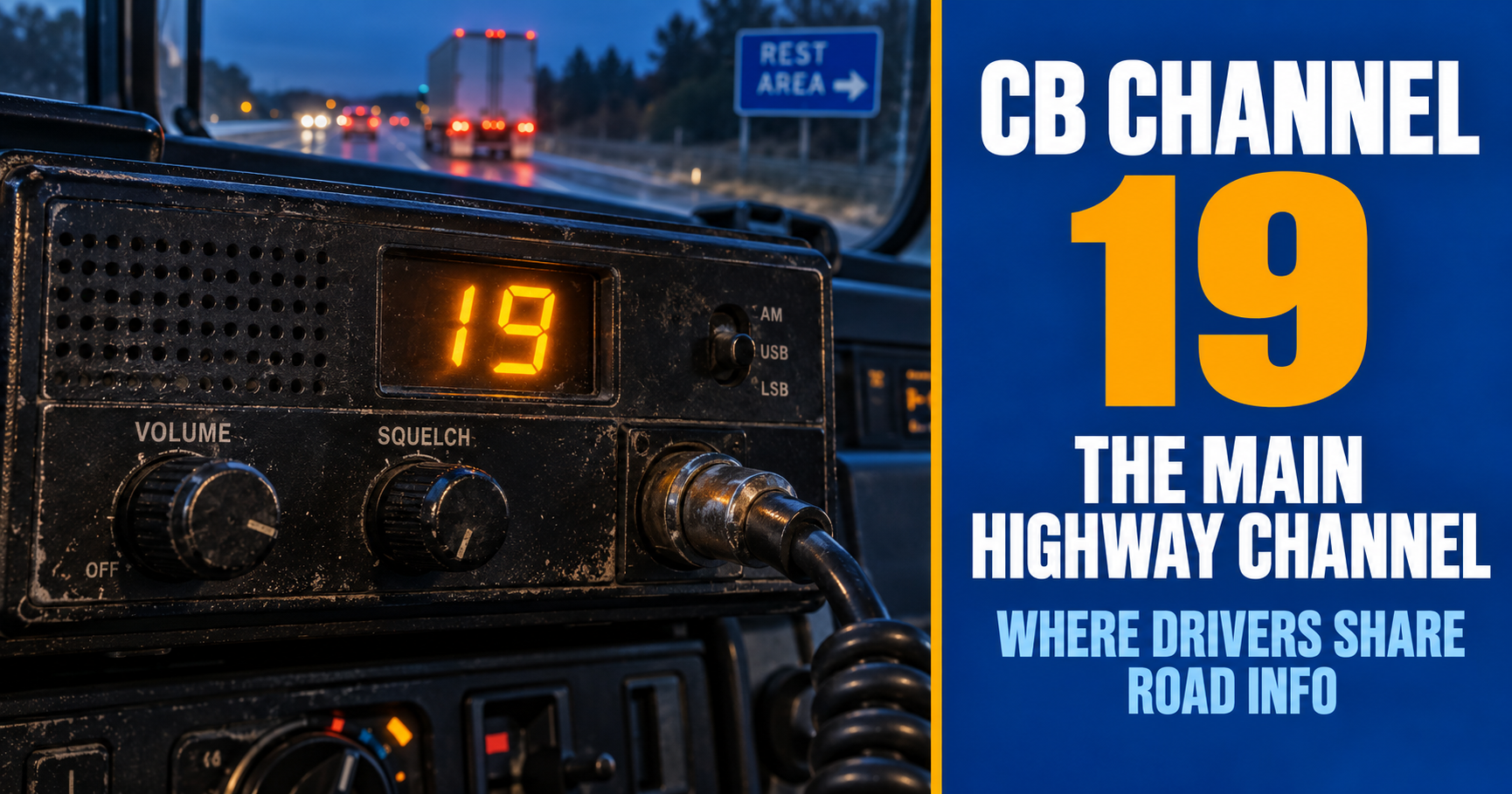
Turn on a CB radio in a truck and you’ve got 40 channels to choose from.
So where are the truck drivers?
In most of the United States, Channel 19 is still the first place to try.
CB Channel 19 operates on 27.185 MHz, and it’s been associated with truckers and highway communication for decades. There are exceptions depending on the area and type of work being done, but if you’re driving down the interstate and want to hear nearby truck traffic, 19 is the channel I’d start with.
That doesn’t mean it’s constantly busy anymore.
CB use isn’t what it was before cell phones, GPS navigation, and traffic apps became normal. You might drive quite a while without hearing much at all. Then you hit stopped traffic, road construction, bad weather, or an accident and suddenly Channel 19 becomes useful again.
Why Do Truck Drivers Use Channel 19?
There’s nothing about the radio itself that makes Channel 19 work better for trucks than the other CB channels.
It became useful because everybody agreed to meet in the same place.
Think about what would happen if one driver monitored Channel 4, another used 12, somebody else listened to 27, and another driver stayed on 35.
They could all be within a mile of each other and never communicate.
Having a commonly used highway channel solved that problem.
A driver could turn to Channel 19 and have a reasonable chance of reaching other CB-equipped drivers nearby.
That tradition stuck.
Is Channel 19 Officially the Trucker Channel?
No.
The FCC doesn’t reserve Channel 19 exclusively for commercial truck drivers.
Other CB users can legally use it too.
It’s simply the channel that became widely associated with highway and trucking communication.
That’s an important distinction because occasionally people talk about Channel 19 as though truck drivers own it.
They don’t.
It’s part of the regular Citizens Band Radio Service.

What Frequency Is CB Channel 19?
Channel 19 operates at:
27.185 MHz
You normally don’t have to think about the actual frequency when using an ordinary CB radio.
Select Channel 19 and the radio handles the rest.
Still, you’ll see 27.185 MHz mentioned frequently when researching CB antennas, scanners, radio specifications, and frequency charts, so it’s useful to know what the number represents.
What Do Truckers Talk About on Channel 19?
Pretty much whatever is happening around them.
But the useful conversations usually involve the road.
You might hear drivers talking about:
- An accident ahead.
- Stopped traffic.
- A lane closure.
- Road debris.
- Construction.
- Weather conditions.
- A disabled vehicle.
- A truck trying to merge or maneuver.
- Something happening at a nearby facility or jobsite.
And yes, you’ll hear plenty of conversations that aren’t useful at all.
That’s part of CB.
The important thing is that when somebody nearby has information every driver behind them needs, Channel 19 provides a way to get that message out immediately.


Why Use CB When We Have Traffic Apps?
This is probably the best argument against CB today.
Google Maps, Waze, truck GPS units, state DOT apps, and other services already tell us about traffic.
And they’re incredibly useful.
But there’s a difference between an app knowing something happened and a driver physically looking at it right now.
Imagine traffic suddenly stops around a blind curve.
A driver ahead can grab the microphone and warn everyone listening behind them immediately.
No report has to be submitted.
No server has to process anything.
No map has to update.
It’s simply one driver talking directly to another.
That’s one of the reasons CB has survived even though technology replaced many of its original uses.
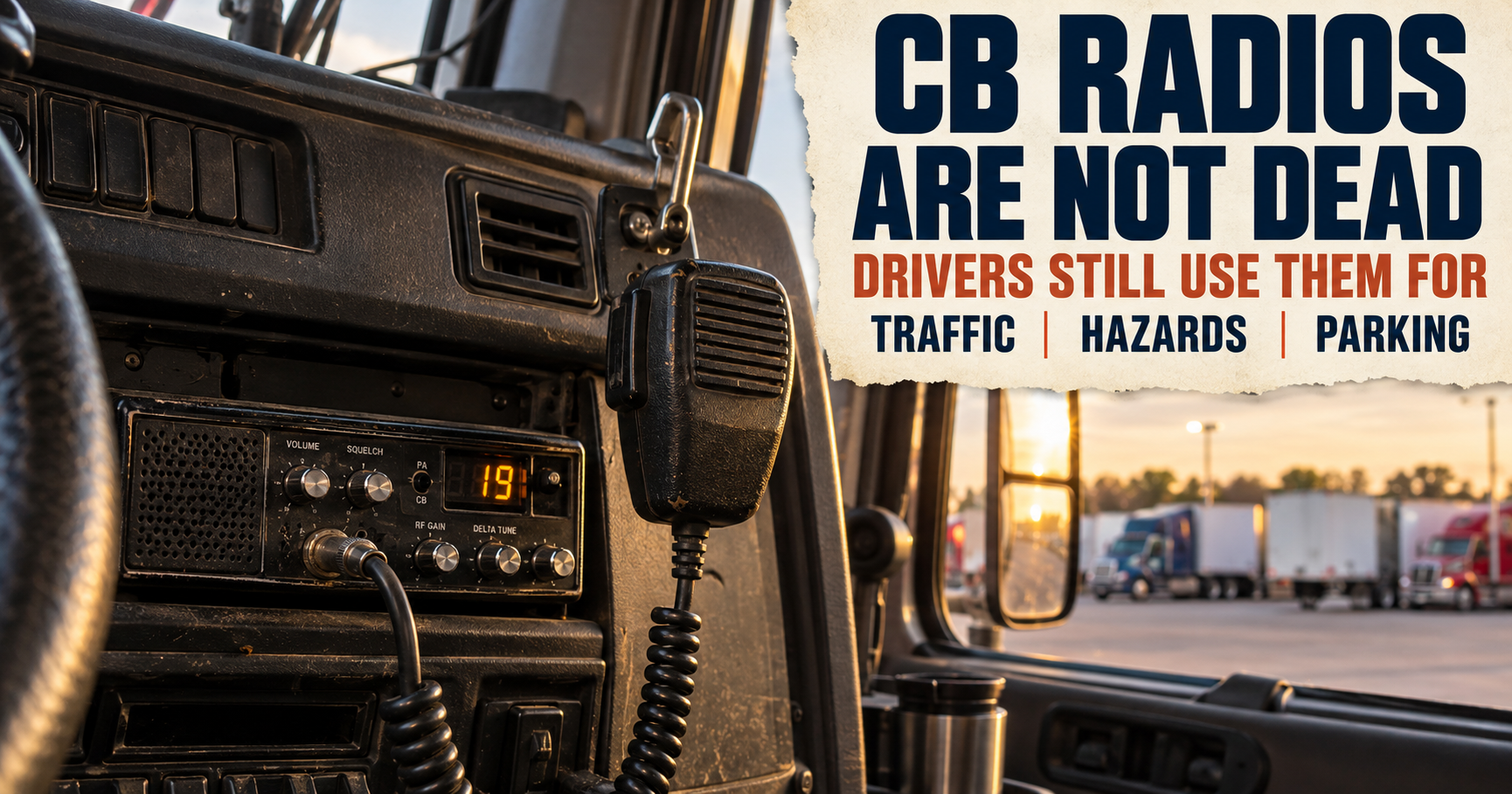
If you’re wondering whether drivers still bother carrying radios at all, I go much deeper into that in Do Truck Drivers Still Use CB Radios? What They’re Used For Today.
Channel 19 Can Be Especially Useful in Rural Areas
Interstate traffic isn’t the only place CB can help.
Commercial trucks operate all over the country in places where cellular coverage isn’t perfect.
Grain trucks.
Dump trucks.
Construction trucks.
Heavy haul.
Logging operations.
Farm trucks.
Local commercial vehicles.
A traditional CB doesn’t need a cellular tower to communicate with another CB radio that’s within range.
That’s a meaningful difference from phone-based communication.



Do Dump Truck Drivers Use Channel 19?
Some do, but local operations don’t always follow the same habits as interstate trucking.
A group of dump trucks working the same job may use another CB channel to keep their conversations away from general highway traffic.
The company might also use business-band radios, cellular push-to-talk equipment, phones, or another communication system instead.
So if you’re working for somebody, don’t assume Channel 19 is automatically the work channel.
Ask what the operation uses.
For general highway communication, though, Channel 19 remains the obvious starting point.
Do Grain Truck Drivers Use CB Radios?
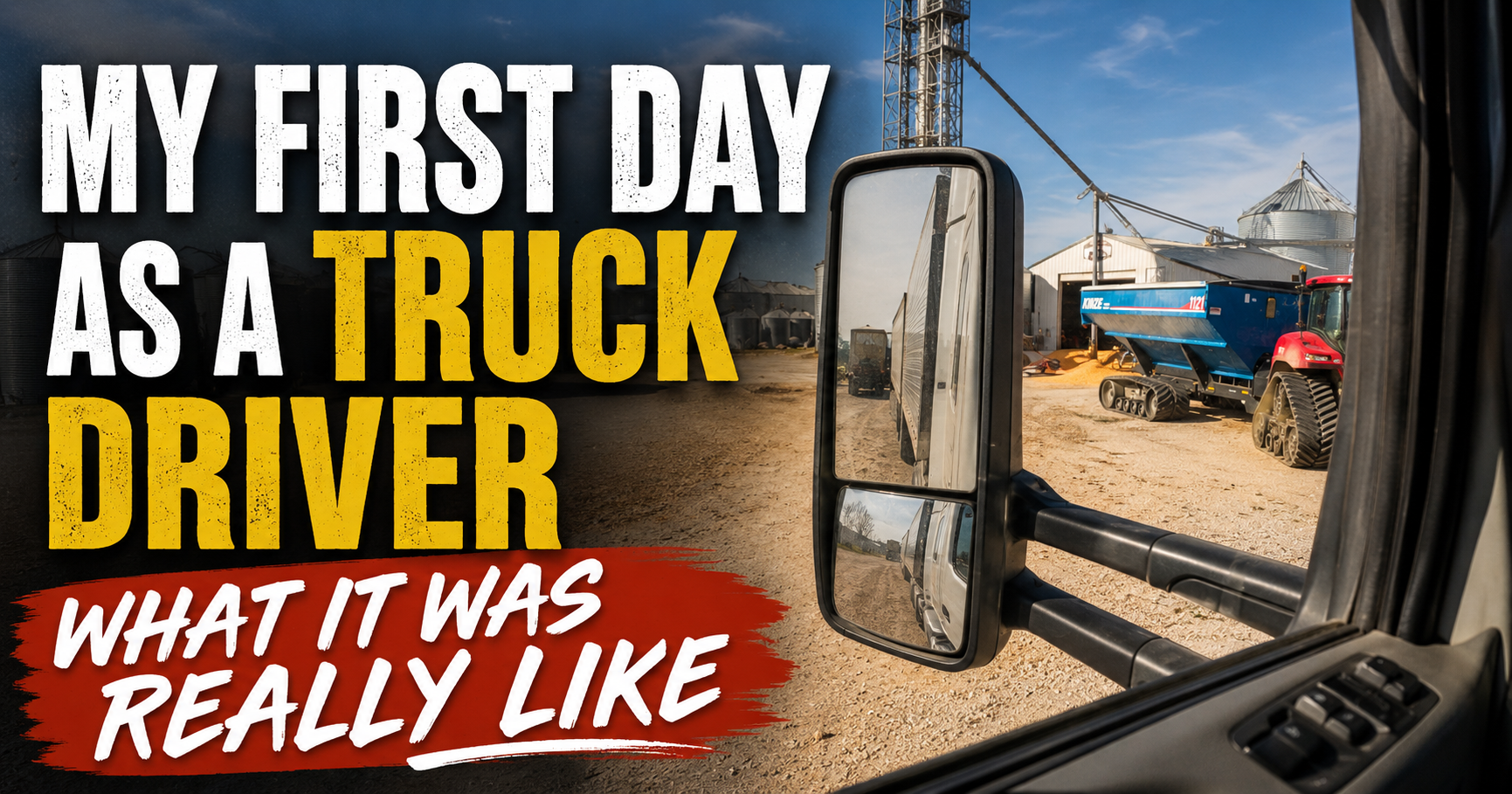
They certainly can! We do in ours!
Grain hauling creates several situations where short-range communication between drivers can be useful.
Trucks may be traveling between the same fields and bins.
Several drivers may be waiting in the same area.
Equipment may be moving around narrow rural roads.
Someone may encounter traffic, farm machinery, or another problem that the trucks behind them should know about.
Whether CB is actually used depends on the farm and trucking operation.
Some rely almost entirely on cell phones now.
Others still keep radios in the trucks because they’re simple and immediate. The farm I work for uses CB as well as Bluetooth headsets on their phones!


What About Channel 17?
Channel 17 has historically been used by truckers in some parts of the country, particularly along certain north-south routes and on the West Coast.
That’s a good reminder that CB habits aren’t identical everywhere.
Channel 19 is the national default most people associate with truckers, but local customs can differ.
If you aren’t hearing anybody on 19, that doesn’t necessarily mean nobody around you has a CB.
They may simply be somewhere else on the band.
Should You Leave Your CB on Channel 19 All Day?
You can.
Plenty of drivers who use CB primarily for road information simply monitor Channel 19 while driving.
That doesn’t mean you need the volume cranked up listening to every conversation.
Set the squelch properly, keep the volume comfortable, and let the radio sit in the background.
When somebody nearby transmits a strong enough signal, you’ll hear it.
If Channel 19 gets annoying or you’re trying to communicate privately with another truck in your group, you can always agree to move to another channel.
What Does Squelch Do?
Squelch is one of the controls that makes CB much more pleasant to use.
Without enough squelch, you’ll hear static and weak noise constantly.
Turn the squelch up and the radio blocks weaker signals and background noise.
Turn it too far and you can also block transmissions you actually wanted to hear.
The trick is finding the point where the background static disappears without unnecessarily killing useful signals.
Once you set it correctly, monitoring Channel 19 becomes much easier.
Should You Use AM or FM on Channel 19?
This has become a more interesting question because modern U.S. CB radios can support both AM and FM.
Traditional American trucking CB communication has overwhelmingly been associated with AM.
FM is now permitted and can offer different audio characteristics, but both radios need to be operating in the same mode to communicate properly.
If your goal is simply hearing the largest number of traditional truckers on Channel 19, AM is still the obvious mode to monitor first.
A radio that supports both gives you flexibility.
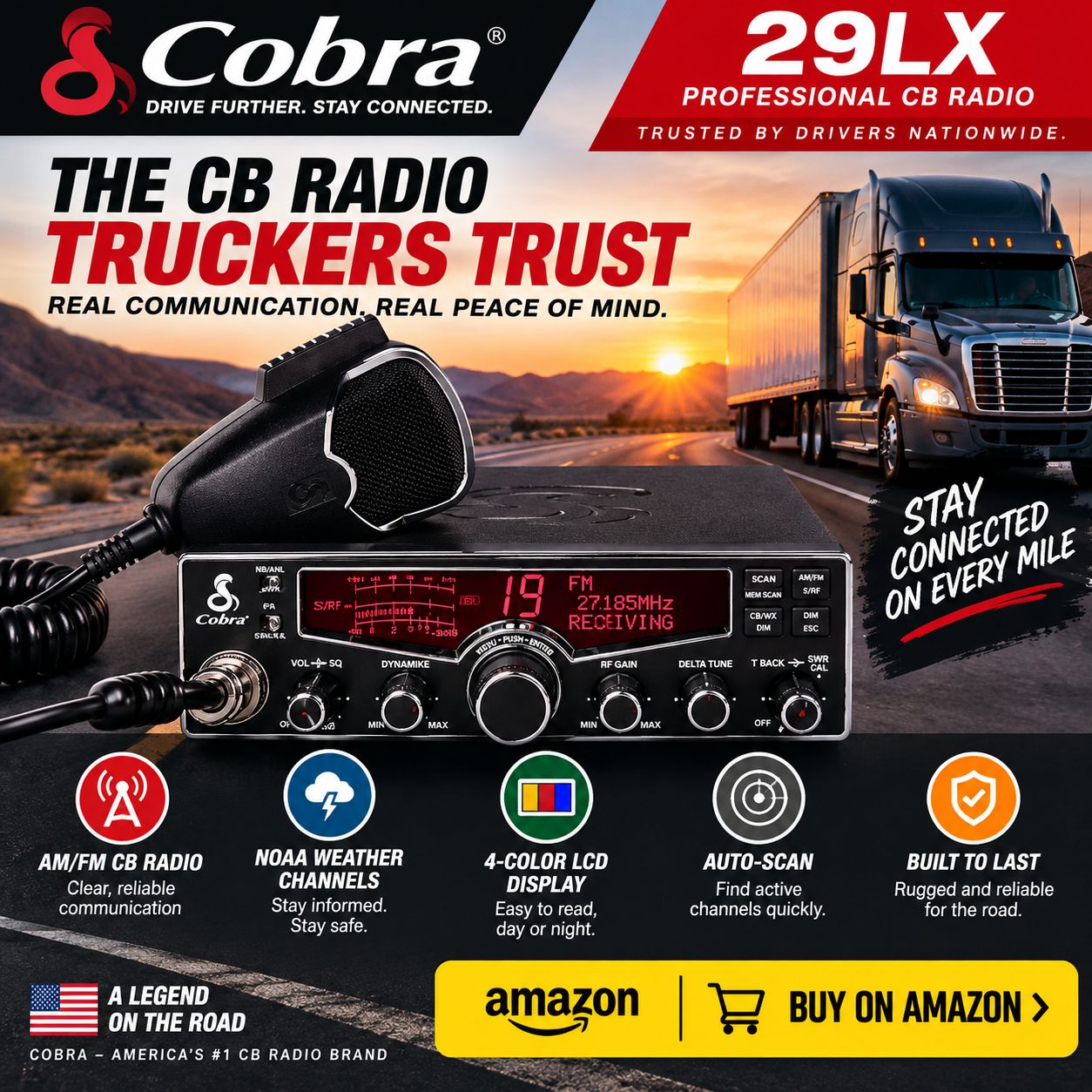
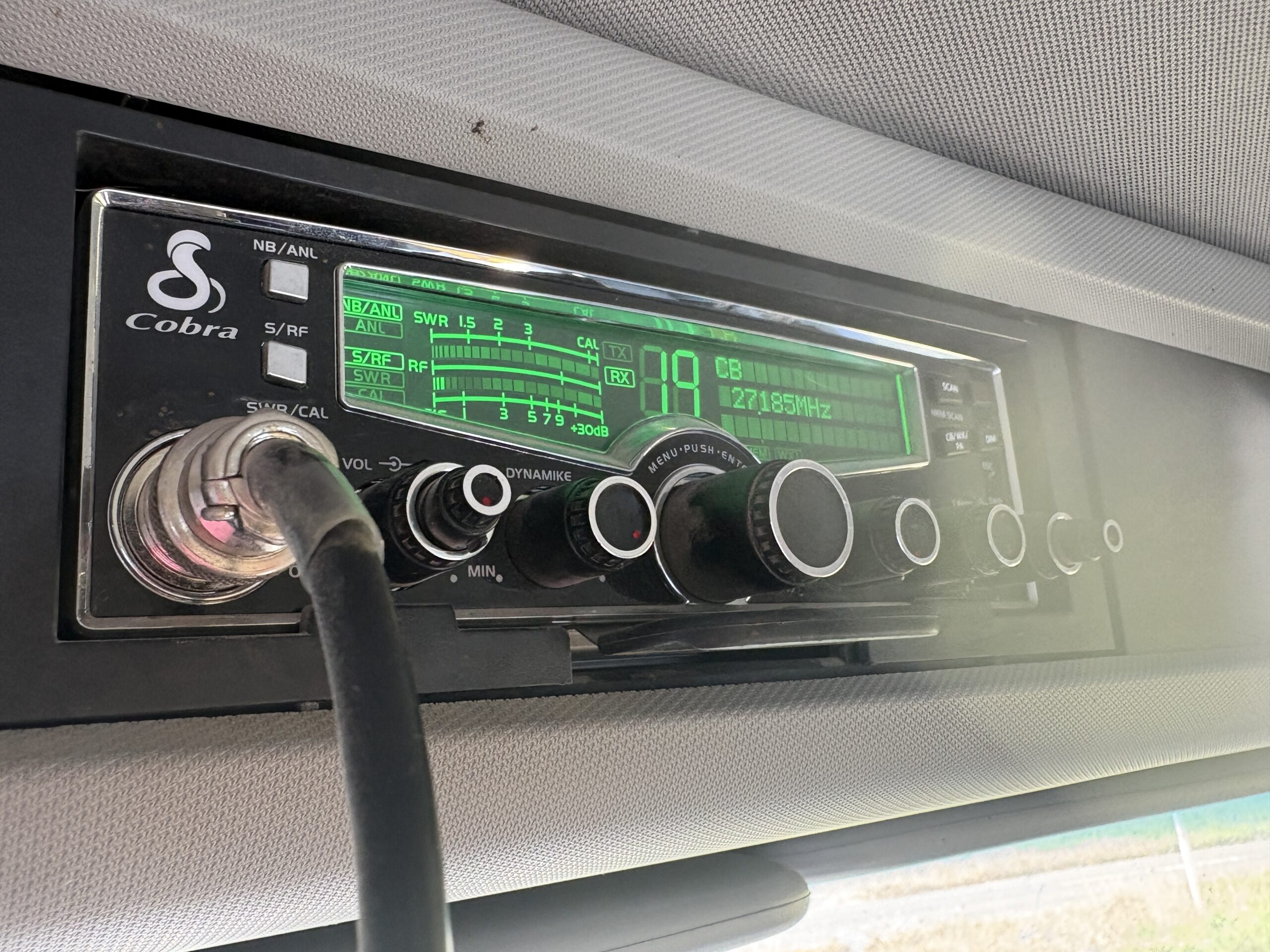
That’s one reason I like the Cobra 29LX AM/FM Professional CB Radio for a working truck. You retain normal AM CB operation while also having FM capability, NOAA weather channels, emergency alerts, channel scanning, and useful radio diagnostics.
For somebody actually mounting a CB in a semi or dump truck instead of buying one as a novelty, those extra features make sense.
CB Etiquette Still Matters
You don’t need a rulebook taped to the dashboard to use Channel 19.
A little common sense goes a long way.
Listen before transmitting.
Keep useful road information reasonably short.
Don’t hold the channel forever when other drivers may need it.
Don’t intentionally interfere with conversations.
And remember that everyone nearby can hear you.
If two drivers want to have a long conversation, moving to another channel leaves 19 available for highway traffic.
What Does “Breaker 19” Mean?
This is one of those phrases almost everybody has heard in movies.
“Breaker 19” is basically a way of asking to break into the channel and get people’s attention.
You don’t need to talk like a 1970s trucking movie to use a CB today.
If there’s stopped traffic ahead, saying something clear like:
“Westbound, traffic is stopped around the next curve.”
is a lot more useful than trying to sound like you’ve memorized every piece of old CB slang.
Clear communication beats sounding cool.
Can You Call for Emergency Help on Channel 19?
You can certainly use CB to tell nearby users about an emergency, and another driver may be able to help or call emergency services.
But a CB should not replace 911 when cellular or another reliable emergency communication method is available.
Historically, Channel 9 was associated with emergency and traveler assistance communications, but modern emergency response shouldn’t depend on somebody happening to monitor a CB channel.
If you’ve got phone service and there’s a genuine emergency, call 911.
How Far Away Can Drivers Hear You on Channel 19?
Channel choice doesn’t magically determine range.
Channel 19 doesn’t travel farther simply because truckers use it.
Your practical range depends much more on:
- Antenna quality.
- Antenna placement.
- SWR.
- Terrain.
- Buildings.
- Interference.
- Coax condition.
- The other station’s equipment.
The FCC has described typical direct CB communication as roughly five to fifteen miles under suitable conditions, but real-world mobile range can vary substantially.
We’re going to cover CB range in a semi truck separately because the antenna setup deserves far more attention than most beginners realize.
Your Antenna Matters More Than Most Beginners Expect
It’s easy to spend all your money on the radio because that’s the part with the buttons, screen, and microphone.
But a CB is only as useful as the antenna system connected to it.
A poorly installed antenna can make an expensive radio perform terribly.
A properly installed and tuned antenna can make a more modest radio surprisingly useful.
That’s why antenna placement and SWR deserve to be treated as part of the radio installation rather than an afterthought.
CB vs Nationwide Push-to-Talk
If your goal is communicating with a specific crew that’s spread across a huge area, CB isn’t necessarily the best tool.
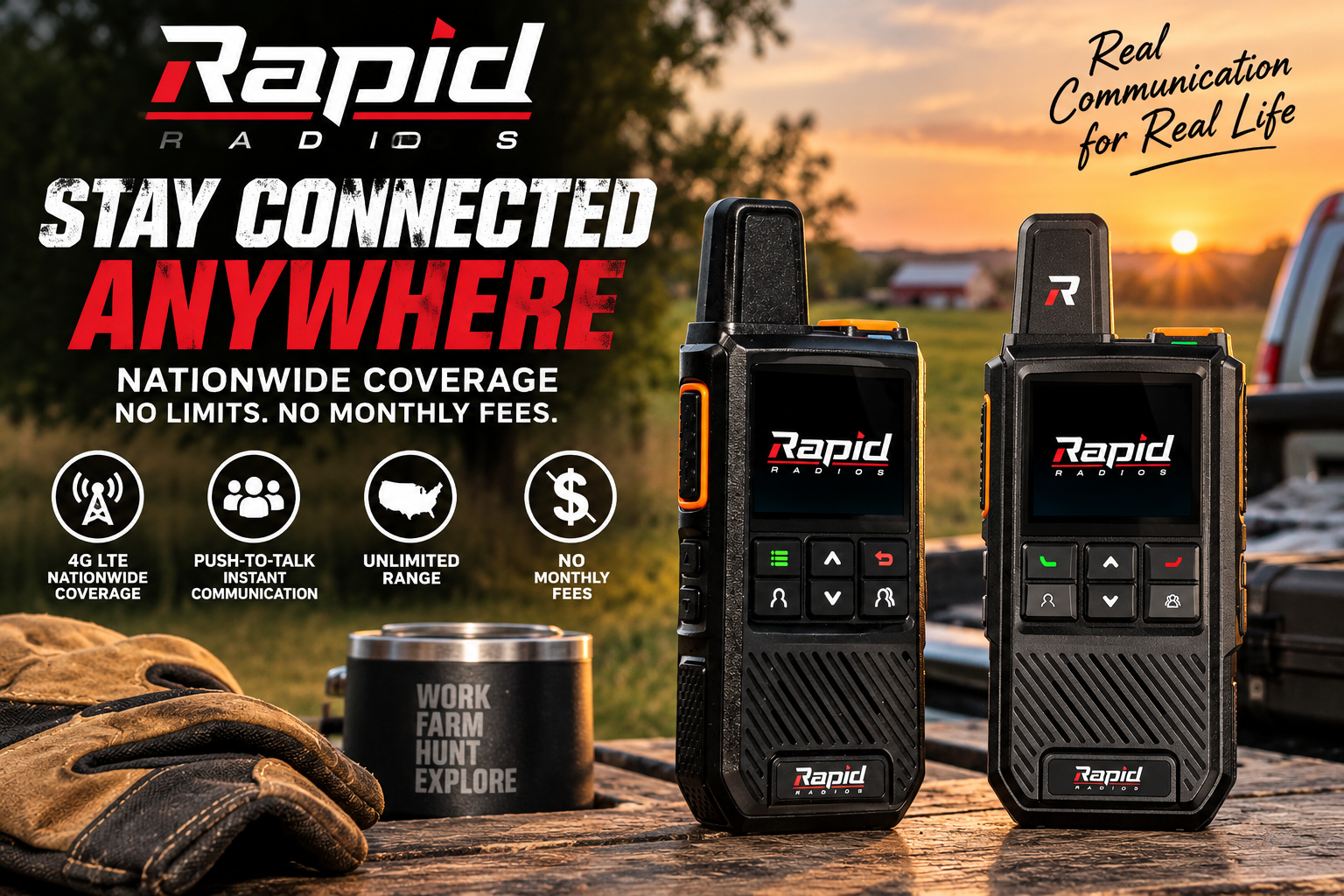
That’s where something like the Rapid Radios G1 Nationwide LTE Push-to-Talk Radios becomes interesting.
Those use cellular networks rather than traditional CB frequencies, so they’re designed for communication over far greater distances wherever the required network service is available.
But there’s a tradeoff.
An LTE radio doesn’t give you the same open local highway community that Channel 19 does.
If an unknown trucker two miles ahead wants to warn everybody about stopped traffic, traditional CB is built for exactly that kind of communication.
Frequently Asked Questions
What CB channel do most truck drivers use?
Channel 19 is the channel most commonly associated with truckers and highway communication in the United States.
What frequency is CB Channel 19?
27.185 MHz.
Is Channel 19 only for truck drivers?
No. Channel 19 isn’t exclusively reserved for truckers. It simply became the commonly used highway channel.
Do truckers still monitor Channel 19?
Some do. CB use is less universal than it once was, but Channel 19 remains the traditional place to find trucking-related CB traffic.
Do dump truck drivers use Channel 19?
They can, especially while traveling public roads. Local crews may use another channel or a completely different communication system for jobsite communication.
What mode should I use on Channel 19, AM or FM?
AM remains the traditional mode for U.S. trucking CB communication. Modern radios may also support FM, but both users need compatible operating modes.
What is Channel 9 used for?
Channel 9 has historically been associated with emergency and traveler assistance communications. For an actual emergency today, use 911 whenever reliable phone service is available.
Is Channel 19 better than the other CB channels?
Not technically. Its advantage comes from the number of truckers who traditionally monitor it, not because the radio signal itself is inherently better.
Channel 19 Works Because Drivers Know Where to Meet
That’s really the whole story.
There’s nothing magical about 19.
It became valuable because truck drivers collectively knew where to listen.
That common meeting place allowed a driver who had never met another driver to warn them about something happening ahead.
Modern technology replaced a lot of what CB once did.
But it never completely replaced that simple idea.
Turn to one channel.
Listen to the drivers around you.
And when you’ve got something important they need to know, press the microphone button and tell them.
Author: Tyler Grant
Tyler Grant writes about commercial truck equipment, driver communication, and everyday life behind the wheel for TruckingResource.com. His guides focus on practical equipment and traditions that still have a place in modern trucking.