(function(){“use strict”;/* QUESTION BANK — replace only this array for future tests. */var Q=[[“Why are combination vehicles more rollover-prone?”,”They are long, heavy, and may carry weight high above the road”,[“Trailers eliminate gravity”,”Their tires cannot grip”,”Tractors have no suspension”],”High centers of gravity and trailer motion amplify sudden steering. Slow before curves and keep cargo low and centered.”],[“What is the crack-the-whip effect?”,”A quick tractor movement becomes stronger toward the rear trailer”,[“A brake hose breaking”,”The fifth wheel unlocking”,”Cargo moving forward”],”Rearward amplification can roll the last trailer even when the tractor stays upright. Steer smoothly.”],[“What is off-tracking?”,”Trailer wheels follow a path inside the tractor’s path during turns”,[“The trailer moves outside every turn”,”The tractor loses air pressure”,”The kingpin slides upward”],”Long combinations need extra turn room because rear wheels cut inside the tractor’s path.”],[“Why should cargo be kept low and centered?”,”It lowers rollover risk and prevents side-to-side imbalance”,[“It shortens the trailer”,”It increases brake lag”,”It unlocks the fifth wheel”],”High or off-center cargo raises overturning leverage and can make the trailer lean.”],[“When backing a trailer, which way is the steering wheel initially turned?”,”Opposite the direction you want the trailer to move”,[“Always straight”,”The same direction throughout”,”Toward the nearest mirror”],”Once the trailer begins turning, steer back to follow it. Back slowly and use small corrections.”],[“Which backing setup is usually safest?”,”Position to back toward the driver’s side when possible”,[“Blind-side backing”,”Backing from the roadway”,”Backing without checking the path”],”Driver-side backing offers better visibility. Get out and look, use both mirrors, and pull forward when needed.”],[“What is the trailer hand valve mainly used for?”,”Testing trailer service brakes”,[“Parking the combination”,”Routine highway stopping”,”Releasing spring brakes”],”Using only trailer brakes while driving can skid the trailer. The foot pedal normally applies all service brakes.”],[“Why should the trailer hand valve not be used for parking?”,”Service air may leak away and release the brakes”,[“It locks the kingpin”,”It drains tractor fuel”,”It lowers landing gear”],”Use spring parking brakes and chocks when needed; a temporary air application is not reliable parking restraint.”],[“What does the tractor protection valve do?”,”Protects tractor air if the trailer breaks away or has a major leak”,[“Locks the fifth wheel”,”Adjusts trailer height”,”Controls turn signals”],”The valve closes the trailer supply and preserves tractor air during a severe trailer-side loss.”],[“What does the red trailer-air-supply control do?”,”Supplies or shuts off emergency-line air to the trailer”,[“Operates only the service line”,”Slides the fifth wheel”,”Raises landing gear”],”Pushing it in supplies air; pulling it out shuts supply and applies trailer emergency brakes.”],[“What is the service air line for?”,”Carrying the brake-application signal to trailer service brakes”,[“Filling trailer fuel tanks”,”Holding the parking brakes off”,”Powering trailer lights”],”Pressure varies with pedal or hand-valve input and operates relay valves for trailer braking.”],[“What are the emergency line’s two jobs?”,”Supply trailer tanks and control emergency brakes”,[“Power lights and ABS only”,”Operate landing gear”,”Control cargo doors”],”Loss of emergency-line pressure applies trailer emergency brakes and closes tractor protection.”],[“Which colors commonly identify trailer air lines?”,”Blue for service and red for emergency”,[“Red for service and green for emergency”,”Both yellow”,”Color has no use”],”Colors and tags help prevent crossed connections, but always verify line function.”],[“What can happen if service and emergency lines are crossed?”,”Trailer tanks may not charge and spring brakes may not release”,[“The fifth wheel locks tighter”,”Trailer lights become brighter”,”Landing gear rises”],”Supply air sent into the service line cannot properly charge the trailer system.”],[“Why clean glad hands and seals before connecting?”,”Dirt or damage can cause leaks and poor sealing”,[“It increases cargo capacity”,”It adjusts brake pressure”,”It lowers the trailer”],”Connect the correct lines securely and inspect seals so the system holds air.”],[“How much space should be visible between upper and lower fifth-wheel plates after coupling?”,”No visible space”,[“About six inches”,”Enough for a hand”,”Any gap is acceptable”],”A gap can mean the kingpin is not properly seated and the trailer may be high-coupled.”],[“Where should fifth-wheel locking jaws close?”,”Around the kingpin shank”,[“Around the kingpin head”,”Around the landing gear”,”Around an air line”],”Jaws around the head indicate improper coupling. Inspect from behind the fifth wheel.”],[“Why perform a tug test after coupling?”,”To confirm the fifth-wheel jaws hold the kingpin”,[“To test headlights”,”To drain air tanks”,”To weigh cargo”],”With trailer brakes applied, gently pull forward before raising landing gear fully.”],[“What risk comes from a trailer that is too high before coupling?”,”The tractor may miss proper contact and high-couple”,[“The trailer brakes overheat”,”The air lines reverse”,”The cargo becomes lighter”],”The trailer should be low enough for the tractor to lift it slightly as it backs under.”],[“What must be done with landing gear before driving?”,”Raise it fully and secure the crank handle”,[“Leave it one inch above pavement”,”Remove it”,”Lower it for stability”],”Partly lowered gear can strike the roadway and destabilize or damage the trailer.”],[“Why must air and electrical lines have enough slack?”,”They need room for turns without pulling apart”,[“Slack applies the brakes”,”It lowers cargo weight”,”It locks the fifth wheel”],”Lines should be secure and clear of rubbing, but long enough for the combination’s full turning range.”],[“What should sliding fifth-wheel locking pins look like before travel?”,”Fully engaged with no missing or damaged parts”,[“Retracted for easier turning”,”Held by air pressure only”,”Covered by cargo”],”Unlocked slides can shift suddenly and change axle loading or cause loss of control.”],[“How are trailer emergency brakes tested?”,”Pull out trailer air supply and gently tug against the trailer”,[“Use only the foot brake at highway speed”,”Disconnect both lines”,”Lower landing gear while moving”],”With the system charged, closing supply should apply trailer emergency brakes; a gentle tug confirms holding.”],[“How are trailer service brakes checked?”,”Move slowly and apply the trailer hand control for the test”,[“Park with the hand valve overnight”,”Pull the supply knob at speed”,”Disconnect the blue line”],”The low-speed test confirms connection and response; normal driving uses the foot pedal.”],[“What must be inspected around the coupling before every trip?”,”Fifth wheel, jaws, kingpin, release arm, safety latch, lines, and landing gear”,[“Only trailer paint”,”Only tractor tires”,”Only the license plate”],”Combination safety depends on a complete mechanical, air, electrical, and visual coupling inspection.”]],S={q:[],i:0,s:0},$=function(x){return document.getElementById(x)},E={quiz:$(‘quiz’),results:$(‘results’),reviewScreen:$(‘reviewScreen’),qcount:$(‘qcount’),score:$(‘score’),progress:$(‘progress’),bar:$(‘bar’),question:$(‘question’),answers:$(‘answers’),feedback:$(‘feedback’),prev:$(‘prev’),next:$(‘next’),review:$(‘review’),reviewList:$(‘reviewList’)};function sh(a){a=a.slice();for(var i=a.length-1;i;i–){var j=Math.floor(Math.random()*(i+1)),t=a[i];a[i]=a[j];a[j]=t}return a}function esc(s){var d=document.createElement(‘div’);d.textContent=s;return d.innerHTML}function top(){$(‘tr-cdl-app’).scrollIntoView({behavior:’smooth’,block:’start’})}function start(){S.q=sh(Q).map(function(x){return{t:x[0],a:sh([{t:x[1],ok:true}].concat(x[2].map(function(w){return{t:w,ok:false}}))),e:x[3],p:null}});S.i=0;S.s=0;E.quiz.hidden=false;E.results.hidden=true;E.reviewScreen.hidden=true;render();top()}function render(){var q=S.q[S.i],done=q.p!==null,n=S.q.filter(function(x){return x.p!==null}).length;E.qcount.textContent=’Question ‘+(S.i+1)+’ of ‘+S.q.length;E.score.textContent=S.s;E.bar.style.width=n/S.q.length*100+’%’;E.progress.setAttribute(‘aria-valuenow’,n);E.question.textContent=q.t;E.answers.innerHTML=”;q.a.forEach(function(a,i){var b=document.createElement(‘button’);b.type=’button’;b.className=’answer’+(done&&a.ok?’ good’:”)+(done&&i===q.p&&!a.ok?’ bad’:”);b.textContent=a.t;b.disabled=done;b.onclick=function(){pick(i)};E.answers.appendChild(b)});E.prev.disabled=S.i===0;E.next.disabled=!done;E.next.textContent=S.i===S.q.length-1?’View Results’:’Next Question’;if(done)feed(q);else E.feedback.hidden=true}function pick(i){var q=S.q[S.i];if(q.p!==null)return;q.p=i;if(q.a[i].ok)S.s++;render()}function feed(q){var a=q.a[q.p],c=q.a.filter(function(x){return x.ok})[0];E.feedback.className=’feedback ‘+(a.ok?’good’:’bad’);E.feedback.innerHTML=’‘+(a.ok?’✔ Correct!’:’✘ Incorrect’)+’‘+(!a.ok?’
Correct answer: ‘+esc(c.t)+’
Why yours is incorrect: It does not correctly apply the CDL safety principles in this scenario.
‘:”)+’
Explanation: ‘+esc(q.e)+’
‘;E.feedback.hidden=false}function finish(){var n=S.q.length,b=n-S.s,p=Math.round(S.s/n*100);E.quiz.hidden=true;E.reviewScreen.hidden=true;E.results.hidden=false;$(‘percent’).textContent=p+’%’;$(‘final’).textContent=S.s+’/’+n;$(‘correct’).textContent=S.s;$(‘incorrect’).textContent=b;$(‘message’).textContent=p>=90?’Outstanding! You have a strong grasp of combination-vehicle fundamentals.’:p>=80?’Great job! Review the missed Combination Vehicles questions.’:p>=70?’Good progress. Keep practicing this section.’:’More Combination Vehicles review is recommended before testing.’;E.review.disabled=!b;top()}function review(){E.reviewList.innerHTML=”;S.q.filter(function(q){return!q.a[q.p].ok}).forEach(function(q,i){var c=q.a.filter(function(a){return a.ok})[0],d=document.createElement(‘article’);d.className=’review-item’;d.innerHTML=’
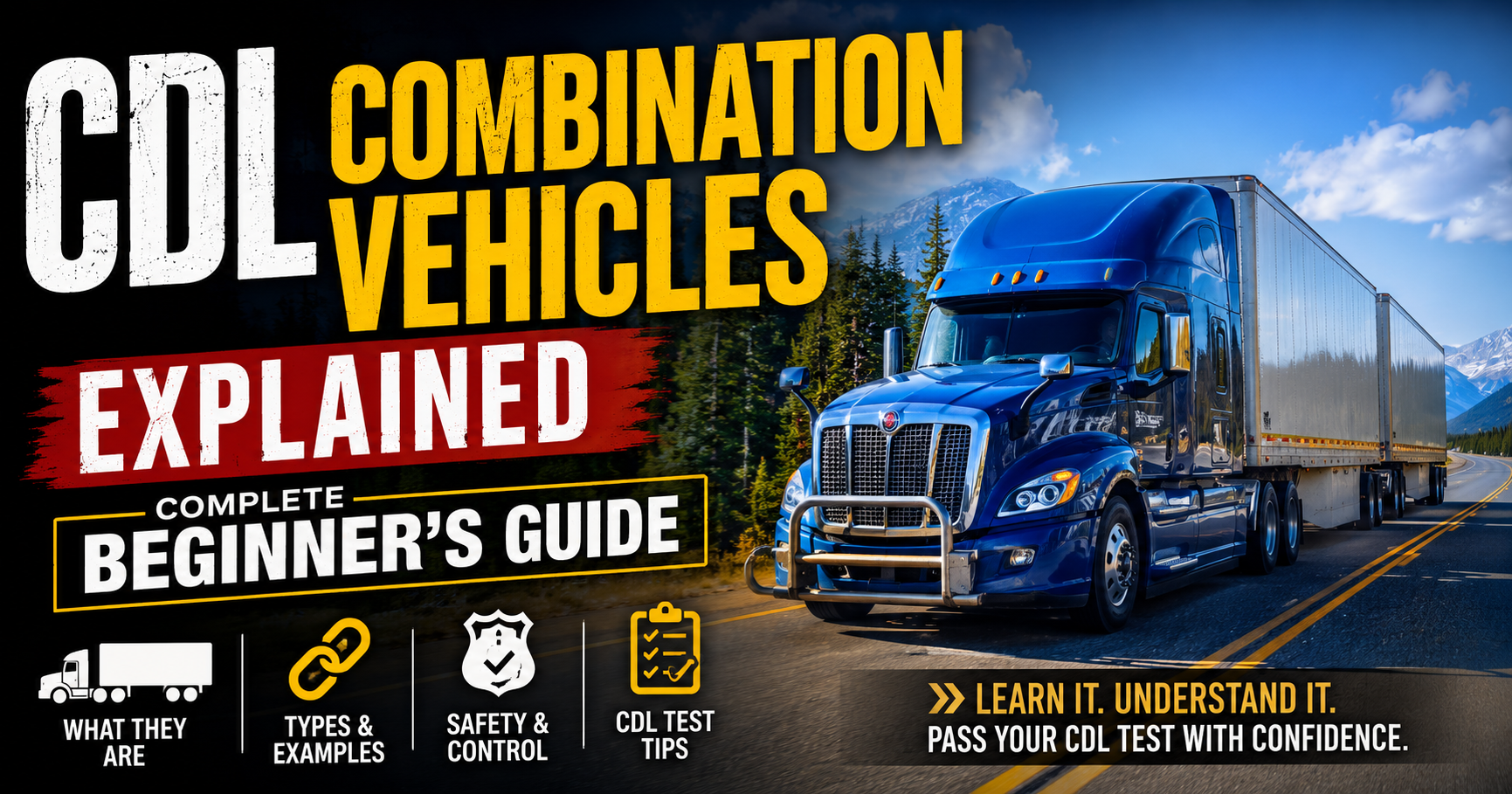
Driving a combination vehicle requires additional knowledge and skills beyond operating a single commercial truck. Tractor trailers are longer, heavier, and respond differently during turns, lane changes, braking, and backing. Understanding how the tractor and trailer work together is essential for passing your CDL Combination Vehicles knowledge exam and for operating safely on public roads. Review the fundamentals in this CDL Combination Vehicles Explained: Complete Beginner’s Guide before working through the practice questions.
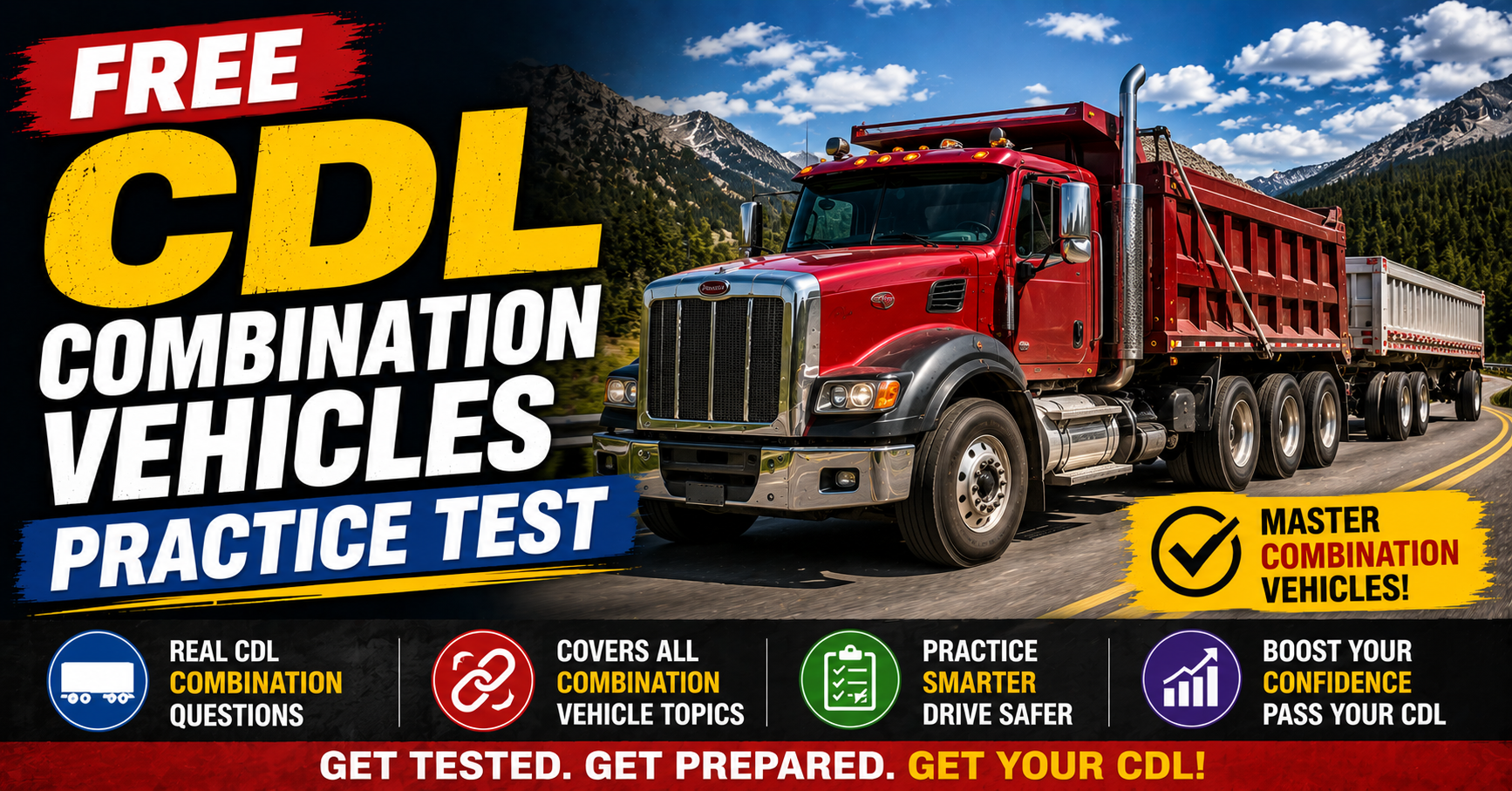
Our Free CDL Combination Vehicles Practice Test includes 25 realistic multiple-choice questions covering coupling, uncoupling, trailer air systems, fifth wheels, glad hands, backing, off-tracking, inspections, and safe handling. Every question includes a detailed explanation so you understand why the correct answer is right instead of simply memorizing it.
If you’re still preparing for your CDL permit, begin with our Free CDL General Knowledge Practice Test #1 before moving into endorsement-specific topics like combination vehicles.
Why Combination Vehicles Require Extra Training
A tractor trailer doesn’t handle like a straight truck.
The trailer adds significant weight, changes stopping distance, increases turning space, and creates unique driving challenges that don’t exist with single-unit commercial vehicles.
Drivers must understand how trailers react during:
Turns.
Backing.
Braking.
Lane changes.
Mountain driving.
Emergency maneuvers.
Learning these concepts before getting behind the wheel helps prevent accidents while building confidence as a professional driver.
What You’ll Learn on This Practice Test
This practice test covers many of the major subjects found on the CDL Combination Vehicles endorsement exam.
Topics include:
Coupling procedures.
Uncoupling procedures.
Fifth wheels.
Kingpins.
Glad hands.
Air lines.
Trailer inspections.
Trailer brakes.
Backing.
Off-tracking.
Rollover prevention.
Trailer safety.
Each question prepares you for both your written CDL exam and real-world commercial driving.
The glad hands connect the tractor and trailer air brake systems.
Before connecting them, drivers should inspect for:
Damaged seals.
Dirt.
Cracks.
Loose fittings.
Air leaks.
Air lines should also have enough slack to allow full turning movement without becoming stretched or rubbing against moving components.
Small problems discovered during inspection can prevent much larger problems later.
Perform a Tug Test Every Time
One of the simplest but most important safety checks is the tug test.
After coupling the trailer and connecting the air lines, drivers should gently pull against the trailer brakes to verify the locking jaws have securely captured the kingpin.
A successful tug test helps confirm the trailer is properly connected before raising the landing gear and beginning the trip.
Professional drivers never skip this step.
Back Slowly and Patiently
Backing a tractor trailer is one of the most challenging skills new drivers learn.
Small steering movements create large trailer movements.
Successful backing requires:
Slow speed.
Frequent mirror checks.
Small steering corrections.
Patience.
Getting out to look whenever necessary.
Whenever possible, backing toward the driver’s side provides much better visibility than blind-side backing.
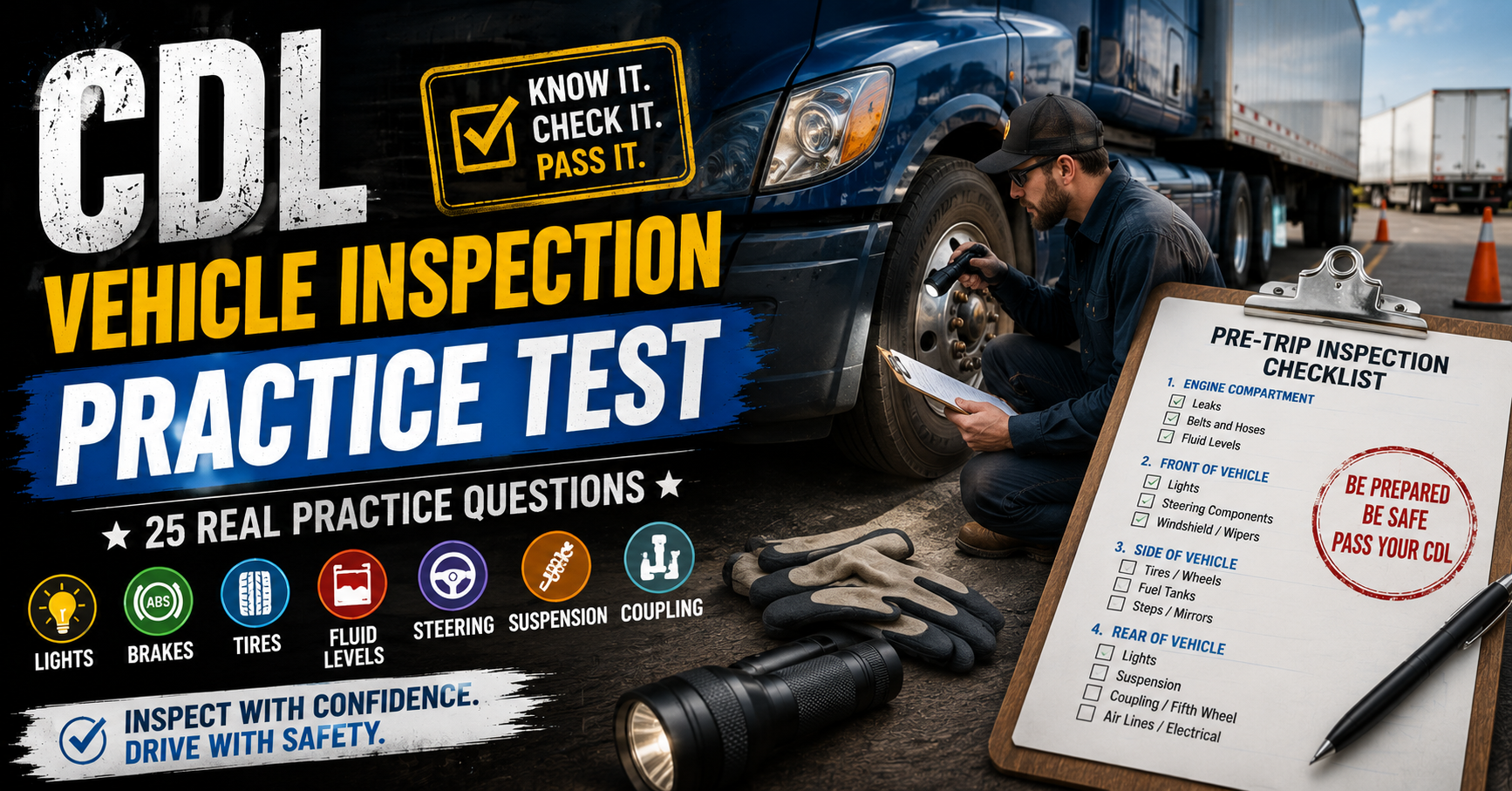
Continue strengthening your inspection skills by taking our CDL Vehicle Inspection Practice Test. Many coupling components inspected during combination vehicle checks are also covered during the CDL pre-trip inspection.
Understanding the Trailer Air Brake System
Combination vehicles rely on two separate air lines connecting the tractor and trailer.
These include:
The emergency air line.
The service air line.
The emergency line supplies air to the trailer’s air tanks and helps control the trailer’s emergency braking system.
The service line carries the brake application signal whenever you press the brake pedal.
Drivers should inspect both lines carefully before every trip to ensure they’re connected correctly and free from leaks or damage.
Knowing the purpose of each line is an important part of the CDL Combination Vehicles exam.
Fifth Wheel Inspections Matter
The fifth wheel is one of the most critical components on any tractor trailer.
Before every trip, inspect the fifth wheel for:
Proper lubrication.
Secure mounting.
Damaged locking jaws.
Cracks.
Loose bolts.
Proper kingpin engagement.
There should be no visible gap between the trailer apron and the fifth wheel after coupling.
A trailer that’s improperly coupled can separate while traveling, creating an extremely dangerous situation.
Landing Gear Must Be Fully Raised
Once you’ve confirmed the trailer is securely coupled, the landing gear should be raised completely.
Drivers should verify:
Both legs are fully retracted.
The crank handle is secured.
No parts are hanging low.
The landing gear won’t contact the roadway.
Forgetting to fully raise the landing gear can cause expensive damage and create a serious road hazard.
Always include this step in your final walk-around inspection.
Trailer Air Brakes Should Always Be Tested
Before leaving your parking area, confirm the trailer brakes are functioning properly.
Drivers commonly perform:
A trailer brake tug test.
A service brake test.
An air pressure check.
These simple tests help verify that the trailer brake system responds correctly before entering traffic.
Finding a problem in the parking lot is much safer than discovering it while traveling at highway speeds.
Combination Vehicles Require Larger Following Distances
Because of their weight and length, tractor trailers require significantly more room to stop than passenger vehicles.
Drivers should always leave enough space to account for:
Reaction time.
Brake lag.
Vehicle weight.
Road conditions.
Weather.
Traffic changes.
Following too closely reduces your available reaction time and increases the likelihood of rear-end collisions.
Professional drivers constantly adjust following distance as conditions change.
Common Combination Vehicle Mistakes
Many new CDL drivers make the same mistakes while learning to operate tractor trailers.
Some of the most common include:
Turning too sharply.
Backing too quickly.
Forgetting the tug test.
Failing to inspect glad hands.
Misunderstanding off-tracking.
Driving too fast through curves.
Forgetting to secure the landing gear.
Skipping coupling inspections.
Understanding these common mistakes will help you avoid them during both your CDL exam and your professional driving career.
Frequently Asked Questions
How many questions are on this CDL Combination Vehicles Practice Test?
This practice test contains 25 multiple-choice questions covering coupling, uncoupling, trailer air systems, fifth wheels, backing, inspections, and other Combination Vehicles topics commonly found on CDL endorsement exams.
What is off-tracking?
Off-tracking occurs because trailer wheels follow a shorter path than the tractor during turns. Drivers must allow additional space to avoid striking curbs, signs, parked vehicles, or other obstacles.
Why is a tug test important?
A tug test confirms the trailer is securely locked to the fifth wheel before beginning a trip. It helps prevent trailer separation caused by improper coupling.
What are glad hands?
Glad hands are the connectors that join the tractor and trailer air brake systems. They must be clean, securely connected, and free of leaks before every trip.
Why should cargo remain low and centered?
Keeping cargo low and evenly distributed lowers the vehicle’s center of gravity, improves stability, and reduces the risk of rollovers during turns and emergency maneuvers.
Why are combination vehicles harder to back?
Because the trailer pivots behind the tractor, small steering inputs create larger trailer movements. Backing slowly with frequent mirror checks and small corrections provides much better control.
Continue Building Your CDL Knowledge
Driving combination vehicles safely requires more than simply knowing how to pull a trailer. Professional drivers must understand proper coupling procedures, trailer inspections, braking systems, backing techniques, and the unique handling characteristics that come with pulling a loaded trailer.
Continue working through our growing collection of free CDL practice tests covering General Knowledge, Air Brakes, vehicle inspections, weather, cargo securement, emergency procedures, railroad crossings, night driving, and other important CDL subjects. Every practice test helps build the knowledge and confidence you’ll need to pass your CDL exams and become a safer professional truck driver.