(function(){“use strict”;/* QUESTION BANK — replace only this array for future tests. */var Q=[[“What supplies the energy used by an air-brake system?”,”Compressed air stored in reservoirs”,[“Engine coolant”,”Battery voltage alone”,”Fuel pressure”],”The compressor builds air pressure and the reservoirs store it until the driver or another brake control needs it.”],[“What is the normal job of the service-brake system?”,”Apply and release the brakes through the foot pedal during driving”,[“Hold the vehicle only while parked”,”Start the air compressor”,”Drain moisture from tanks”],”Air-brake vehicles have service, parking, and emergency functions. The service system handles normal pedal-controlled stopping.”],[“Why are air tanks drained?”,”To remove accumulated moisture and oil that can harm the system”,[“To increase brake lag”,”To release the spring brakes”,”To cool the tires”],”Water and compressor oil can collect in reservoirs. Moisture can freeze, corrode components, and interfere with reliable braking.”],[“What does the air-compressor governor control?”,”When the compressor loads and unloads as system pressure changes”,[“The amount of tread on each tire”,”The parking-brake spring strength”,”The steering ratio”],”The governor establishes cut-in and cut-out points so the compressor rebuilds pressure when needed without pumping continuously.”],[“What is the purpose of the safety relief valve?”,”Protect the air system from excessive pressure”,[“Apply the parking brakes at every stop”,”Measure brake-lining thickness”,”Prevent tire overinflation”],”The relief valve opens if pressure becomes abnormally high. If it releases, the underlying compressor or governor fault needs repair.”],[“What information does a supply-pressure gauge provide?”,”The amount of air pressure available in the reservoirs”,[“The pressure currently inside the tires”,”The force on the steering wheel”,”The cargo’s axle weight”],”Drivers monitor reservoir pressure to confirm that the system is charged and remains in a safe operating range.”],[“What does an application-pressure gauge show when the vehicle has one?”,”The air pressure being delivered during a brake application”,[“The compressor’s oil level”,”The parking-brake spring length”,”The engine coolant pressure”],”If progressively more application pressure is needed to hold the same speed, brakes may be fading, out of adjustment, or experiencing another problem.”],[“What should a driver do if the low-air warning activates while driving?”,”Stop and safely park as soon as possible before control is lost”,[“Pump the pedal rapidly to silence it”,”Continue until the spring brakes apply”,”Increase speed to build pressure”],”Low pressure may indicate a serious leak or compressor problem. Stop while enough braking capacity remains instead of waiting for automatic spring-brake application.”],[“Why are spring brakes held off by air pressure while driving?”,”Air pressure compresses powerful springs that apply when pressure is released”,[“Air pressure heats the springs”,”The springs power the compressor”,”Air prevents the brake pedal from moving”],”Spring force provides a mechanical parking and emergency function. Loss of air allows the springs to apply the brakes.”],[“Why should the brake pedal generally not be pressed while spring brakes are fully applied?”,”Combined spring and air forces may damage brake components”,[“It turns off the low-air warning”,”It drains engine oil”,”It releases every parking brake”],”Some systems prevent compounding, but not all do. Avoid adding a full service application on top of applied spring brakes.”],[“What is the main safety advantage of a dual air-brake system?”,”One circuit may retain partial braking if the other loses pressure”,[“It eliminates every air leak”,”It removes the need for inspections”,”It doubles the legal speed”],”Primary and secondary circuits have separate reservoirs and lines. A failure still reduces braking, so a low-pressure warning requires an immediate safe stop.”],[“Before driving a dual-air vehicle, what must the gauges show?”,”Both systems have built adequate operating pressure”,[“Only one circuit has pressure”,”Both needles remain at zero”,”Application pressure is at maximum”],”Do not move until primary and secondary systems are properly charged and warning devices have cleared according to the vehicle’s specifications.”],[“What is brake lag?”,”The delay while compressed air travels through the system before the brakes apply”,[“The time needed to see a hazard”,”A delay in engine acceleration”,”The period after spring brakes release”],”Air brakes do not respond as instantly as hydraulic systems. Brake lag adds distance beyond perception, reaction, and physical braking distance.”],[“At highway speed, why must air-brake drivers leave generous following distance?”,”Brake lag and heavy-vehicle braking distance require extra room”,[“Air brakes eliminate reaction distance”,”The compressor shortens every stop”,”Reservoir pressure increases tire grip”],”The driver must account for perception, reaction, air-system lag, and braking distance, especially on poor surfaces or with heavy loads.”],[“What does an ABS malfunction lamp that remains on indicate?”,”The antilock function may be unavailable at one or more wheels”,[“All normal braking has disappeared”,”The reservoirs are overfilled”,”The parking brake is released”],”ABS supplements normal brakes. A fault may remove wheel-lock protection, but ordinary braking usually remains; the defect still requires repair.”],[“How should a driver brake hard in an air-brake vehicle equipped with ABS?”,”Apply firm pressure and let ABS manage impending wheel lock”,[“Pump the pedal continuously”,”Release the pedal whenever ABS activates”,”Use only the parking brake”],”ABS automatically modulates pressure at wheels nearing lockup. Maintain firm control and steer only toward a verified safe path.”],[“What is controlled braking?”,”Applying maximum braking without locking the wheels while keeping steering control”,[“Using the parking brake for every stop”,”Pumping brakes at a fixed rhythm”,”Braking only with the engine”],”If wheels lock or a large steering correction is needed, release enough pressure to regain control and reapply appropriately.”],[“Why must foundation brakes be inspected for adjustment and condition?”,”Air pressure cannot produce proper stopping if mechanical brake parts cannot apply correctly”,[“Adjustment changes reservoir size”,”Foundation brakes control headlights”,”Air pressure automatically repairs wear”],”Drums or rotors, linings, chambers, pushrods, and adjusters convert air pressure into wheel braking. Mechanical defects reduce both service and spring-brake performance.”],[“During an applied leakage test on a single vehicle, what pressure loss generally indicates a problem?”,”More than 3 psi in one minute after stabilization”,[“Any movement under 1 psi”,”Exactly zero psi over ten minutes”,”A pressure increase while the engine runs”],”Current CDL inspection guidance generally allows no more than 3 psi in one minute for a single vehicle with the brake fully applied; use the rule for the vehicle and jurisdiction.”],[“For a two-vehicle air-brake combination, what is the general applied-leakage maximum?”,”4 psi in one minute after stabilization”,[“1 psi per minute”,”10 psi per second”,”No measurable pressure is required”],”A typical two-vehicle air-brake combination may lose no more than 4 psi in one minute during the applied test. Excess loss requires repair.”],[“How is the low-air warning normally tested during inspection?”,”Reduce air pressure with brake applications and confirm the warning activates before the required threshold”,[“Disconnect the warning lamp”,”Raise pressure beyond the safety-valve setting”,”Apply only the parking brake once”],”The warning must activate early enough to alert the driver while usable pressure remains. Follow the vehicle and testing procedure for the exact threshold.”],[“How is automatic spring-brake application checked?”,”Fan down air pressure and confirm the parking control pops out near the specified low-pressure range”,[“Build pressure until the safety valve opens”,”Hold the accelerator down”,”Drain only the wet tank with the engine running”],”As pressure falls, the parking or protection controls should close and spring brakes apply, commonly in the 20–45 psi range or as specified.”],[“Why should unnecessary brake-pedal pumping be avoided?”,”Each application and release uses stored air faster than the compressor may replace it”,[“It permanently increases pressure”,”It strengthens brake linings”,”It disables the governor”],”Repeated applications can reduce reservoir pressure toward the low-air warning and spring-brake application range.”],[“On a long downgrade, what role should service brakes play?”,”Supplement engine braking through proper intermittent applications”,[“Hold the vehicle continuously without a low gear”,”Replace all engine braking”,”Remain fully released regardless of speed”],”Choose the correct low gear first. Apply enough brake for a definite slowdown, release to permit cooling, and repeat at the planned safe speed.”],[“What does steadily increasing pedal pressure to maintain downgrade speed suggest?”,”Brake fade or another loss of braking effectiveness”,[“The brakes are cooling normally”,”Reservoir pressure is unnecessary”,”ABS is increasing engine power”],”Needing more pressure for the same result is a warning. Reduce speed, use a lower gear if safely possible, and use an escape ramp if control is deteriorating.”]],S={q:[],i:0,s:0},$=function(x){return document.getElementById(x)},E={quiz:$(‘quiz’),results:$(‘results’),reviewScreen:$(‘reviewScreen’),qcount:$(‘qcount’),score:$(‘score’),progress:$(‘progress’),bar:$(‘bar’),question:$(‘question’),answers:$(‘answers’),feedback:$(‘feedback’),prev:$(‘prev’),next:$(‘next’),review:$(‘review’),reviewList:$(‘reviewList’)};function sh(a){a=a.slice();for(var i=a.length-1;i;i–){var j=Math.floor(Math.random()*(i+1)),t=a[i];a[i]=a[j];a[j]=t}return a}function esc(s){var d=document.createElement(‘div’);d.textContent=s;return d.innerHTML}function top(){$(‘tr-cdl-app’).scrollIntoView({behavior:’smooth’,block:’start’})}function start(){S.q=sh(Q).map(function(x){return{t:x[0],a:sh([{t:x[1],ok:true}].concat(x[2].map(function(w){return{t:w,ok:false}}))),e:x[3],p:null}});S.i=0;S.s=0;E.quiz.hidden=false;E.results.hidden=true;E.reviewScreen.hidden=true;render();top()}function render(){var q=S.q[S.i],done=q.p!==null,n=S.q.filter(function(x){return x.p!==null}).length;E.qcount.textContent=’Question ‘+(S.i+1)+’ of ‘+S.q.length;E.score.textContent=S.s;E.bar.style.width=n/S.q.length*100+’%’;E.progress.setAttribute(‘aria-valuenow’,n);E.question.textContent=q.t;E.answers.innerHTML=”;q.a.forEach(function(a,i){var b=document.createElement(‘button’);b.type=’button’;b.className=’answer’+(done&&a.ok?’ good’:”)+(done&&i===q.p&&!a.ok?’ bad’:”);b.textContent=a.t;b.disabled=done;b.onclick=function(){pick(i)};E.answers.appendChild(b)});E.prev.disabled=S.i===0;E.next.disabled=!done;E.next.textContent=S.i===S.q.length-1?’View Results’:’Next Question’;if(done)feed(q);else E.feedback.hidden=true}function pick(i){var q=S.q[S.i];if(q.p!==null)return;q.p=i;if(q.a[i].ok)S.s++;render()}function feed(q){var a=q.a[q.p],c=q.a.filter(function(x){return x.ok})[0];E.feedback.className=’feedback ‘+(a.ok?’good’:’bad’);E.feedback.innerHTML=’‘+(a.ok?’ Correct!’:’ Incorrect’)+’‘+(!a.ok?’
Correct answer: ‘+esc(c.t)+’
Why yours is incorrect: It does not correctly apply the CDL safety principles in this scenario.
‘:”)+’
Explanation: ‘+esc(q.e)+’
‘;E.feedback.hidden=false}function finish(){var n=S.q.length,b=n-S.s,p=Math.round(S.s/n*100);E.quiz.hidden=true;E.reviewScreen.hidden=true;E.results.hidden=false;$(‘percent’).textContent=p+’%’;$(‘final’).textContent=S.s+’/’+n;$(‘correct’).textContent=S.s;$(‘incorrect’).textContent=b;$(‘message’).textContent=p>=90?’Outstanding! You have a strong grasp of air-brake fundamentals.’:p>=80?’Great job! Review the missed Air Brakes questions.’:p>=70?’Good progress. Keep practicing this section.’:’More Air Brakes review is recommended before testing.’;E.review.disabled=!b;top()}function review(){E.reviewList.innerHTML=”;S.q.filter(function(q){return!q.a[q.p].ok}).forEach(function(q,i){var c=q.a.filter(function(a){return a.ok})[0],d=document.createElement(‘article’);d.className=’review-item’;d.innerHTML=’
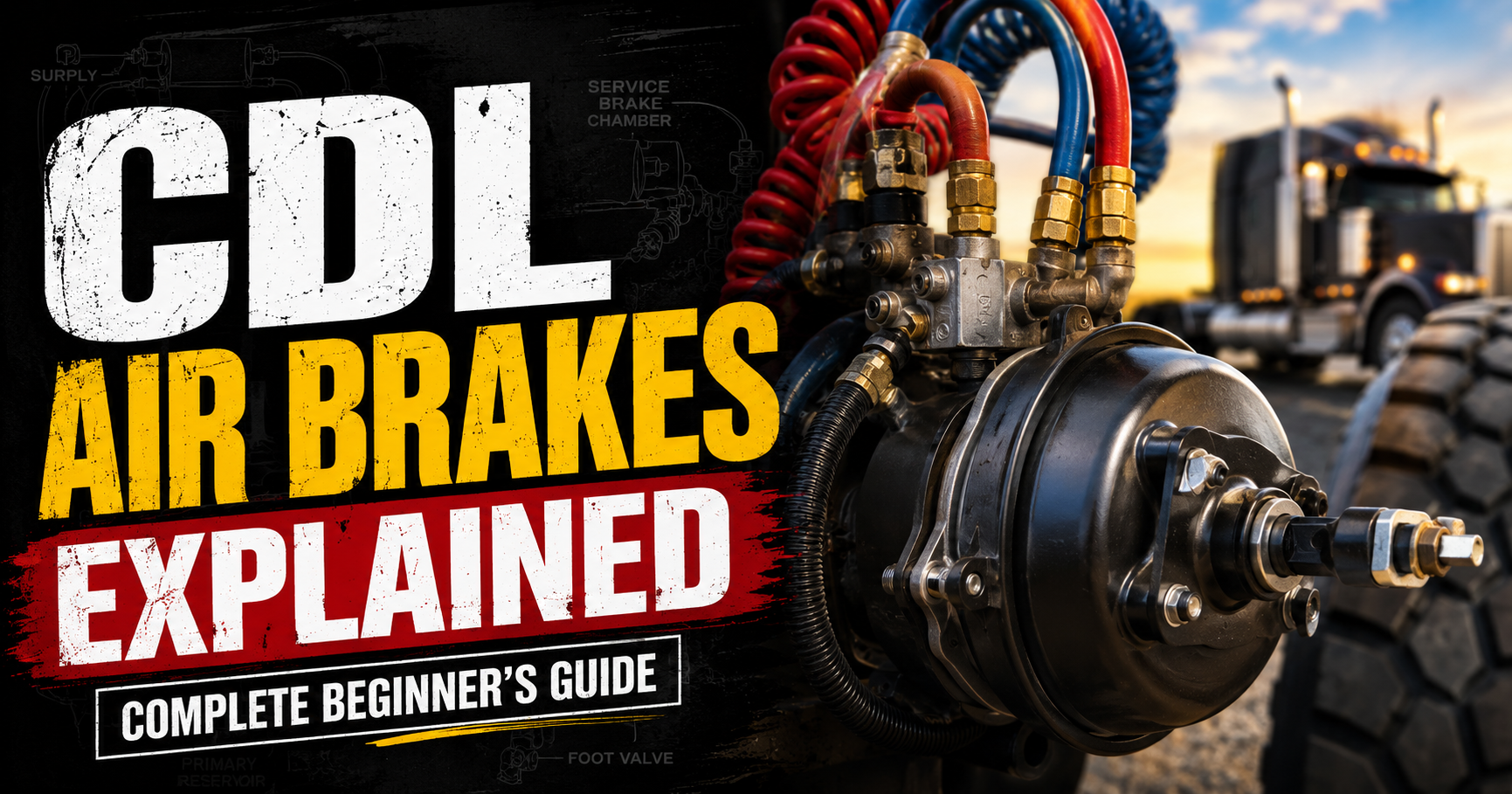
Air brakes are one of the most important systems you’ll learn about while earning your Commercial Driver’s License. Unlike the hydraulic brakes found on most passenger vehicles, commercial trucks use compressed air to apply the brakes safely and reliably. Understanding how the system works isn’t just necessary for passing your CDL exam. It’s also essential for safely operating large commercial vehicles every day. Build a clearer foundation with this CDL Air Brakes Explained: Complete Beginner’s Guide before tackling more detailed practice questions.
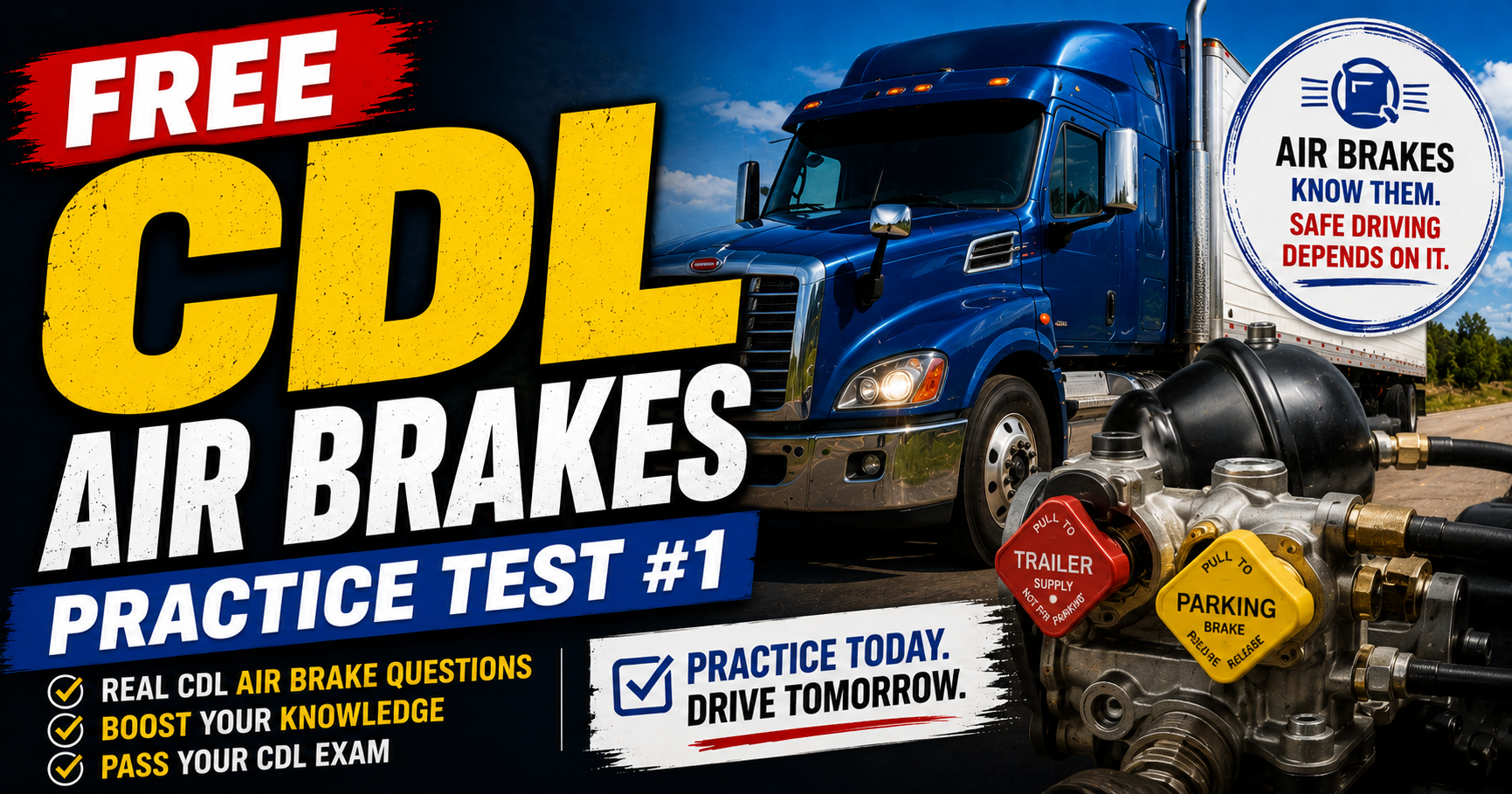
Our Free CDL Air Brakes Practice Test #1 features 25 realistic multiple-choice questions covering compressors, air tanks, governors, brake chambers, spring brakes, ABS, brake inspections, brake lag, and emergency braking procedures. Every question includes an explanation to help you understand the correct answer instead of simply memorizing it.
Commercial vehicles include warning systems that alert drivers when air pressure becomes dangerously low.
These warnings may include:
Warning lights.
Buzzers.
Audible alarms.
If a low-air warning activates while driving, the safest response is finding a safe place to stop as soon as possible.
Continuing to drive with low air pressure increases the risk of losing braking performance and may eventually allow the spring brakes to apply automatically.
Professional drivers never ignore these warnings.
Spring Brakes Provide Important Protection
Spring brakes serve two important purposes.
They hold the vehicle when it’s parked and help stop the vehicle if air pressure becomes critically low.
Unlike service brakes, spring brakes are applied mechanically by large springs.
Compressed air keeps those springs compressed while you’re driving.
If sufficient air pressure is lost, the springs automatically apply the brakes.
This design provides an important backup safety feature that every CDL driver must understand.
Brake Lag Is Normal
One difference between air brakes and hydraulic brakes is brake lag.
Brake lag is the short delay that occurs while compressed air travels through the braking system after the brake pedal is pressed.
Although the delay is brief, it becomes important at highway speeds.
Professional drivers compensate by:
Looking farther ahead.
Maintaining greater following distances.
Anticipating stops earlier.
Braking smoothly.
Understanding brake lag helps explain why commercial vehicles require more stopping distance than passenger cars.
Daily Air Brake Inspections Save Lives
Routine inspections help identify small problems before they become major repairs.
Drivers should inspect:
Air pressure.
Warning devices.
Brake hoses.
Air leaks.
Brake adjustment.
Drain valves.
Brake chambers.
Slack adjusters.
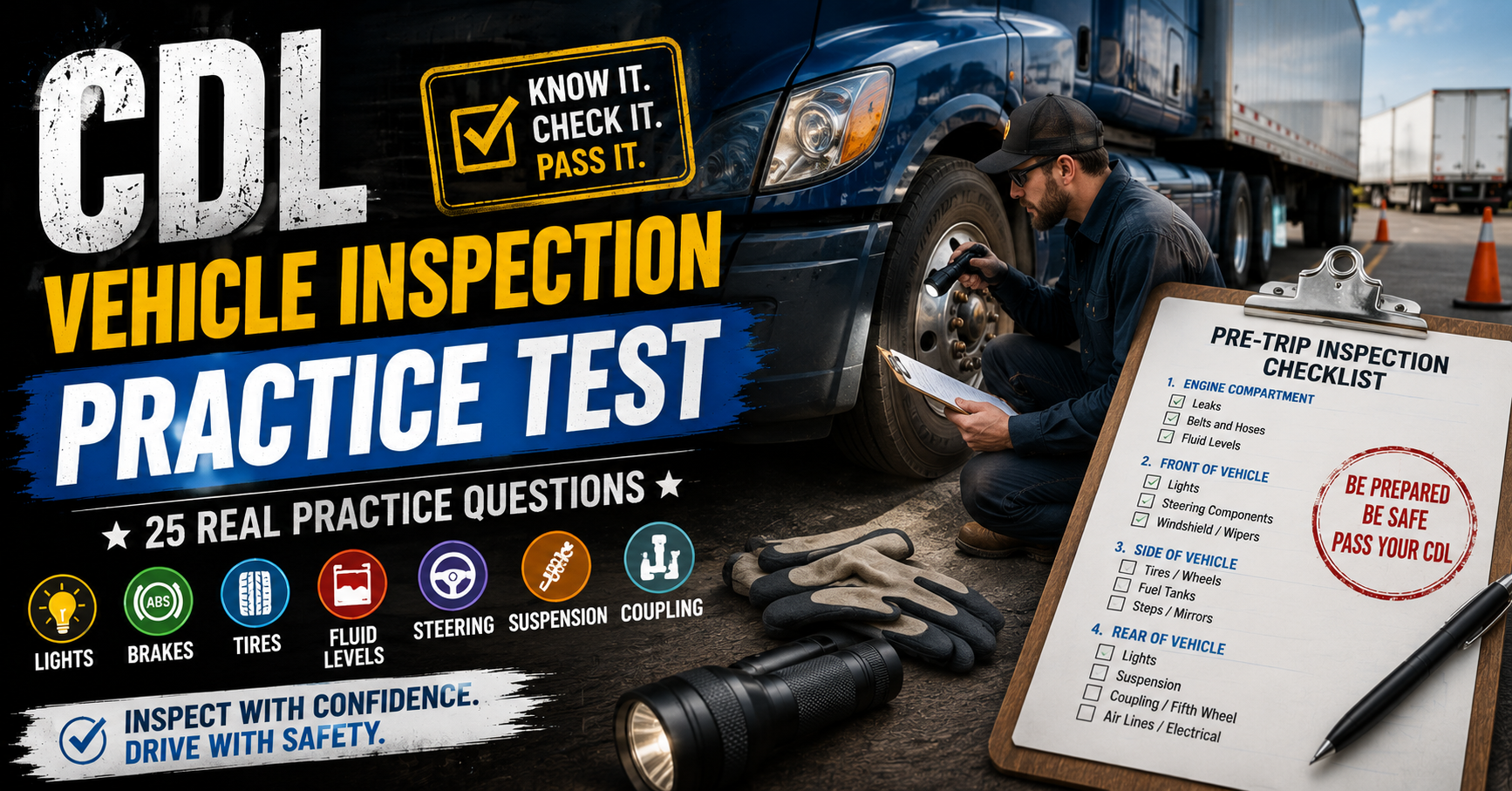
Continue strengthening your inspection knowledge by taking our CDL Vehicle Inspection Practice Test. Understanding how to inspect your air brake system is one of the most important skills you’ll develop as a commercial driver.
Brake Lag Increases Stopping Distance
Many new CDL students are surprised to learn that air brakes don’t apply instantly.
After you press the brake pedal, compressed air must travel through the system before the brake chambers begin applying pressure to the wheels.
This short delay is known as brake lag.
Although brake lag only lasts a fraction of a second, a fully loaded tractor trailer traveling at highway speed can cover many feet before the brakes even begin slowing the vehicle.
That’s one reason professional truck drivers maintain larger following distances than passenger vehicles.
Planning ahead gives you enough space to account for:
Perception time.
Reaction time.
Brake lag.
Actual braking distance.
Understanding all four stages of stopping is essential for safe commercial driving.
Anti-Lock Braking Systems (ABS)
Most modern commercial vehicles are equipped with Anti-Lock Braking Systems, commonly called ABS.
ABS helps prevent wheel lockup during hard braking.
Instead of allowing the wheels to stop rotating completely, the system rapidly adjusts braking pressure so the tires continue gripping the road.
ABS helps drivers:
Maintain steering control.
Reduce skidding.
Improve stability.
Control the vehicle during emergency stops.
If the ABS warning light remains illuminated after startup, the anti-lock system may require service.
Normal braking usually remains available, but the ABS system should be repaired as soon as possible.
Brake Fade Can Become Dangerous
Brakes generate tremendous heat while slowing heavy commercial vehicles.
If brakes become excessively hot, they may begin losing effectiveness.
This condition is known as brake fade.
Brake fade often occurs when drivers:
Ride the brakes on long downgrades.
Descend mountains too fast.
Fail to select the proper gear.
Depend entirely on service brakes.
Professional drivers reduce the chance of brake fade by selecting an appropriate gear before beginning a downgrade and allowing engine braking to help control speed.
Air Leaks Should Never Be Ignored
Even a small air leak deserves attention.
Over time, leaking air reduces the pressure available for braking and forces the compressor to work harder.
Common leak locations include:
Air hoses.
Brake chambers.
Air fittings.
Valves.
Connectors.
During your pre-trip inspection, you’ll perform leak tests to verify the system maintains pressure within acceptable limits. For low-light checks, a rechargeable inspection headlamp can help illuminate components around the vehicle.
If excessive leakage is found, the vehicle should be repaired before returning to service.
Proper Air Pressure Is Critical
Commercial drivers constantly monitor their air pressure gauges while driving.
Pressure that drops unexpectedly may indicate:
A damaged air line.
Compressor problems.
Valve failure.
A significant leak.
Driving with insufficient air pressure can eventually activate low-air warnings and, if ignored, cause the spring brakes to apply automatically.
Monitoring the gauges throughout your trip helps identify problems before they become emergencies.
Common Air Brake Mistakes
Many CDL students make similar mistakes while learning about air brake systems.
Some of the most common include:
Confusing service brakes with spring brakes.
Forgetting what the governor controls.
Ignoring brake lag.
Misunderstanding low-air warnings.
Not knowing why reservoirs are drained.
Forgetting the purpose of ABS.
Riding the brakes on downgrades.
Skipping air leak inspections.
Understanding these topics thoroughly will make both the written exam and future vehicle inspections much easier.
Frequently Asked Questions
How many questions are on this CDL Air Brakes Practice Test?
This practice test contains 25 multiple-choice questions covering compressors, governors, reservoirs, brake lag, ABS, spring brakes, inspections, and other Air Brakes knowledge commonly found on CDL exams.
What is brake lag?
Brake lag is the brief delay between pressing the brake pedal and the brakes actually applying. It occurs because compressed air must travel through the braking system before reaching the brake chambers.
Why are air tanks drained?
Air tanks are drained to remove moisture and oil that naturally collect inside the system. Removing moisture helps prevent corrosion and freezing during cold weather.
What happens if air pressure becomes too low?
A low-air warning will activate. If pressure continues dropping, the spring brakes may eventually apply automatically, making it unsafe to continue driving.
What does the governor do?
The governor controls when the air compressor begins building pressure and when it stops, helping maintain the proper operating pressure inside the air brake system.
Does ABS replace good driving habits?
No. ABS is designed to help prevent wheel lockup during hard braking, but drivers must still maintain safe speeds, proper following distances, and good defensive driving habits.
Continue Building Your CDL Knowledge
Understanding air brakes is one of the biggest steps toward becoming a safe and confident commercial driver. The more familiar you become with compressors, governors, reservoirs, brake inspections, and emergency procedures, the better prepared you’ll be for both your CDL permit exam and real-world driving.
After completing this practice test, continue working through our growing collection of free CDL practice tests covering General Knowledge, vehicle inspections, weather, cargo securement, emergency procedures, railroad crossings, night driving, braking, and other essential CDL topics. Every practice session strengthens your understanding and brings you one step closer to earning your Commercial Driver’s License.