TruckingResource.com
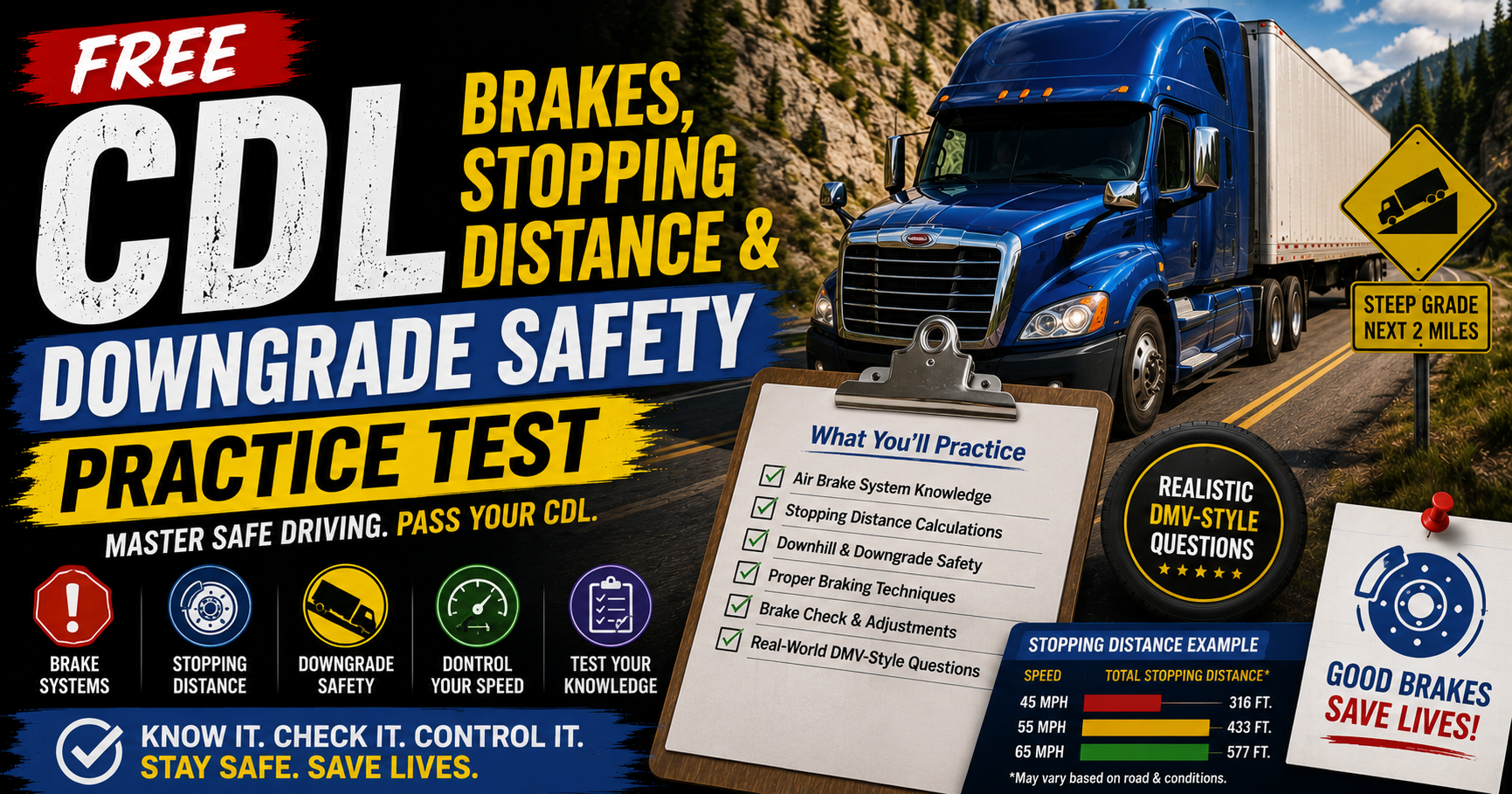
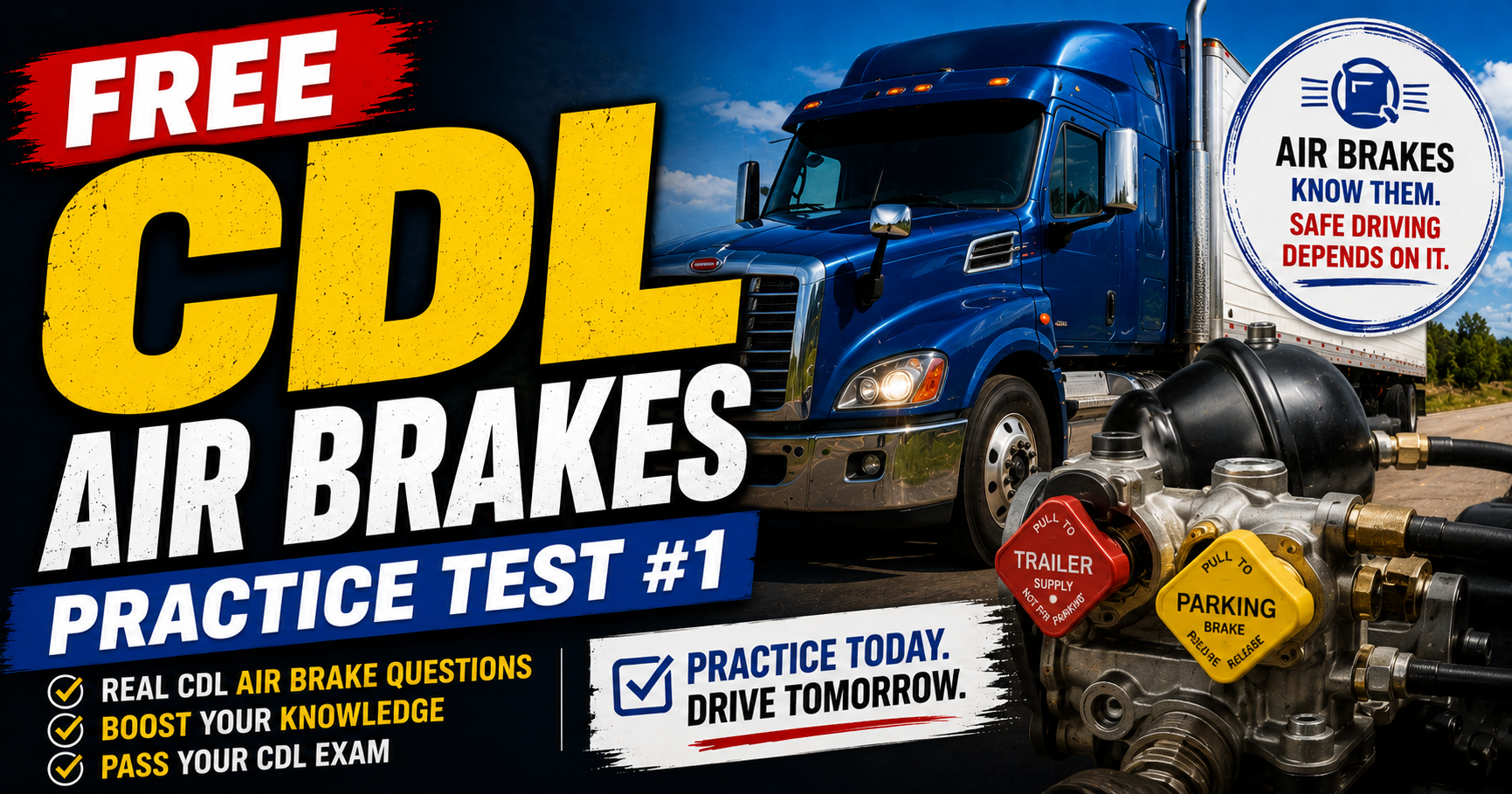
CDL Brakes, Stopping Distance & Downgrade Safety
25 focused questions on brake control, stopping physics, skids, and mountain driving.
Final Score
Missed Question Review
Continue Practicing CDL Tests
Ready for another challenge? Keep building your knowledge by taking more free CDL practice tests below.
Braking is one of the most important skills every commercial driver must master. Whether you're driving an empty straight truck, a fully loaded tractor trailer, or a dump truck carrying heavy material, understanding how your brakes work can make the difference between avoiding an accident and becoming part of one.
Our Free CDL Brakes, Stopping Distance & Downgrade Safety Practice Test includes 25 realistic multiple-choice questions covering many of the braking and safety topics found on CDL permit exams across the United States. Every question includes an explanation so you can understand the reasoning behind the correct answer instead of simply memorizing it.
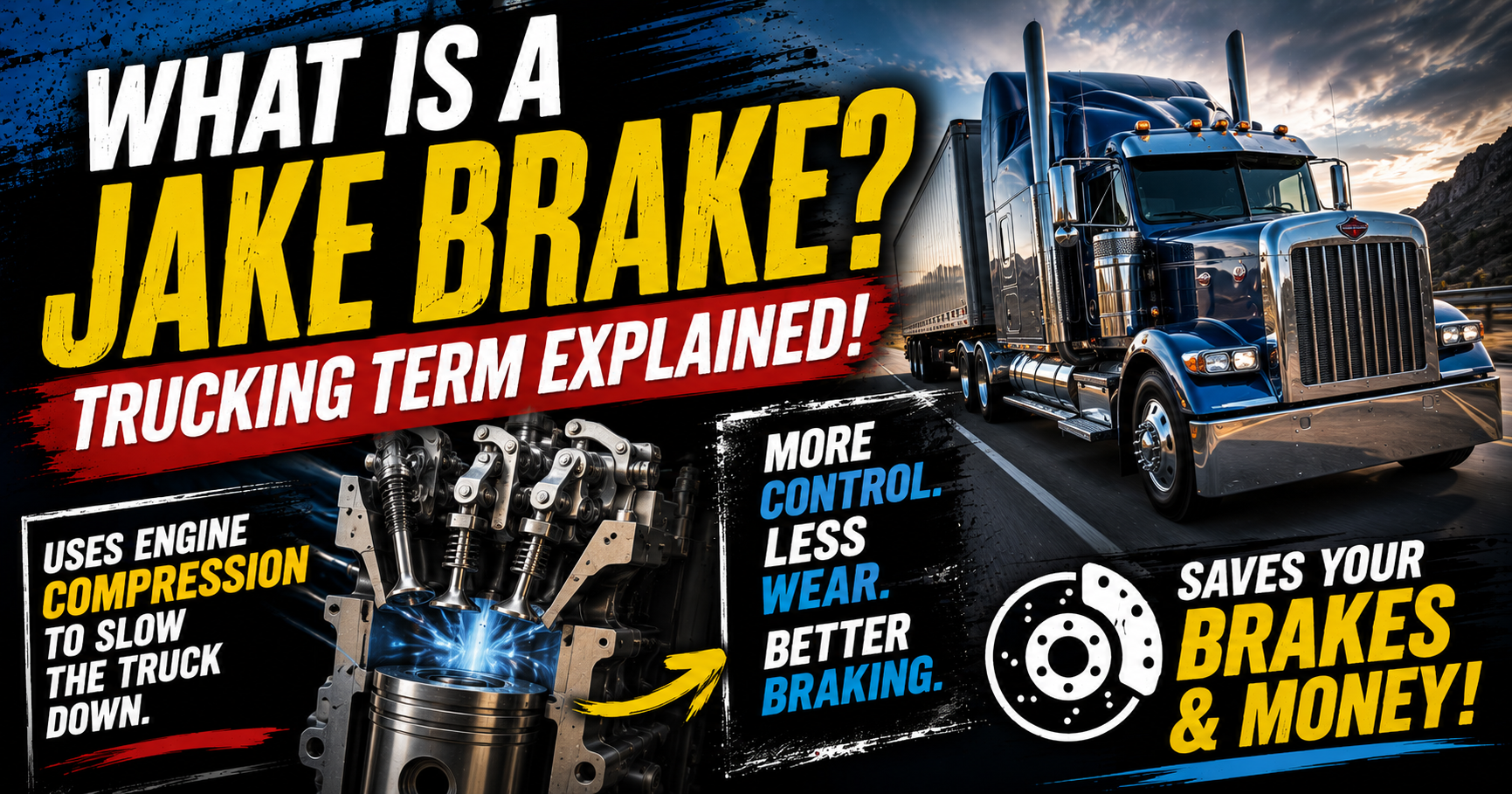
The topics covered in this quiz closely match many of the braking concepts found in CDL study materials, including stopping distance, brake fade, emergency braking, skids, mountain driving, and safe speed management. The mountain-driving section also connects with the engine-braking concepts explained in What Is a Jake Brake? Trucking Term Explained.
If you're still working through the basics of commercial driving, start by completing our Free CDL General Knowledge Practice Test #1 before moving into more advanced topics like braking systems and downhill driving.
Why Braking Knowledge Is So Important
Commercial vehicles weigh far more than passenger cars.
A fully loaded tractor trailer can legally weigh up to 80,000 pounds in many situations. Even medium-duty commercial vehicles carry much more momentum than the average automobile.
That extra weight means drivers must think much farther ahead.
Stopping safely depends on much more than simply pressing the brake pedal.
Professional drivers constantly consider:
- Vehicle weight
- Road conditions
- Weather
- Speed
- Following distance
- Brake condition
- Tire traction
- Visibility
Every one of these factors changes how quickly a commercial vehicle can stop.
Learning how they work together helps prepare you for both the CDL exam and real-world driving.
Understanding Total Stopping Distance
One of the first concepts CDL students learn is total stopping distance.
Many people assume a vehicle begins stopping the instant the brake pedal is pressed.
In reality, stopping happens in several stages.
First, you must recognize a hazard.
Next, your brain processes what you've seen and tells your foot to move toward the brake pedal.
Only then do the brakes begin slowing the vehicle.
As your speed increases, every part of that process requires more distance.
That's why professional truck drivers always leave themselves enough space to react safely.
Why Speed Has Such a Big Impact
Many new CDL students underestimate just how much speed affects stopping distance.
Driving just a little faster can dramatically increase the amount of road needed to stop.
That's because momentum increases rapidly as speed increases.
A commercial truck traveling at highway speeds requires significantly more stopping distance than one traveling through a residential area.
This is why experienced truck drivers rarely drive right at the maximum posted speed during poor weather, heavy traffic, or unfamiliar road conditions.
Safe drivers adjust their speed based on conditions instead of relying only on speed limit signs.
Heavy Loads Change Everything
Weight plays a major role in braking performance.
A loaded dump truck behaves much differently than an empty one.
Likewise, a fully loaded tractor trailer requires considerably more stopping distance than an empty trailer.
Heavy loads generate more momentum.
That momentum must be overcome by the braking system every time you slow down or stop.
Drivers should always remember that cargo weight affects:
- Stopping distance
- Acceleration
- Hill climbing
- Downhill control
- Cornering
- Overall handling
Understanding how weight changes vehicle behavior helps you make better driving decisions.
Brake Fade Can Become Extremely Dangerous
One of the most important topics covered during CDL training is brake fade.
Brake fade happens when brakes become overheated.
As brake temperatures increase, braking effectiveness begins to decrease.
Many cases of brake fade occur while descending long mountain grades.
Drivers who ride their brakes continuously instead of selecting the proper gear may eventually discover that pressing the brake pedal no longer slows the vehicle effectively.
That's why professional drivers rely on engine braking whenever possible while using service brakes correctly.
Preventing brake fade is always easier than recovering from it.
Mountain Driving Requires Planning
Mountain driving isn't difficult when approached correctly.
Problems usually begin when drivers fail to prepare before starting downhill.
Experienced commercial drivers slow down before reaching the downgrade.
They select an appropriate gear before beginning the descent.
Once speed begins increasing on a steep hill, it becomes much harder to regain control.
Good planning allows the engine to help control speed while reducing stress on the service brakes.
This technique also helps reduce brake temperatures during long descents.
ABS Helps You Maintain Control
Many commercial vehicles are equipped with Anti-lock Braking Systems, commonly called ABS.
ABS does not magically shorten stopping distance under every condition.
Instead, its primary purpose is helping drivers maintain steering control during hard braking.
The system automatically reduces brake pressure whenever it detects wheel lockup.
This allows the wheels to continue rotating while still slowing the vehicle.
Drivers should remember that ABS cannot overcome:
- Excessive speed
- Poor following distance
- Ice
- Snow
- Bald tires
- Driver inattention
Good driving habits remain the most effective safety feature.
Skids Are Easier to Prevent Than Correct
Every CDL student learns about skids because they can quickly lead to loss of vehicle control.
Skids often result from:
- Excessive speed
- Sudden braking
- Poor road conditions
- Oversteering
- Entering curves too fast
- Locked wheels
Preventing skids begins with smooth driving.
Professional drivers avoid sudden steering movements, accelerate gradually, and brake smoothly whenever possible.
Maintaining proper following distance also gives you additional time to slow gradually instead of making emergency stops.
Road Conditions Can Change Braking Performance
Braking performance changes constantly.
Dry pavement provides much better traction than wet pavement.
Snow and ice reduce traction even further.
Loose gravel, mud, leaves, and standing water all affect how quickly a commercial vehicle can stop.
Professional drivers constantly adjust for changing road conditions.
Instead of assuming yesterday's stopping distance will work today, they increase following distance and reduce speed whenever traction becomes questionable.
This simple habit prevents many crashes every year.
Practice Until Safe Braking Becomes Automatic
Knowing the correct answer on a CDL practice test is helpful, but developing safe habits is even more valuable.
Every time you complete another practice test, you reinforce important braking concepts that you'll use throughout your trucking career.
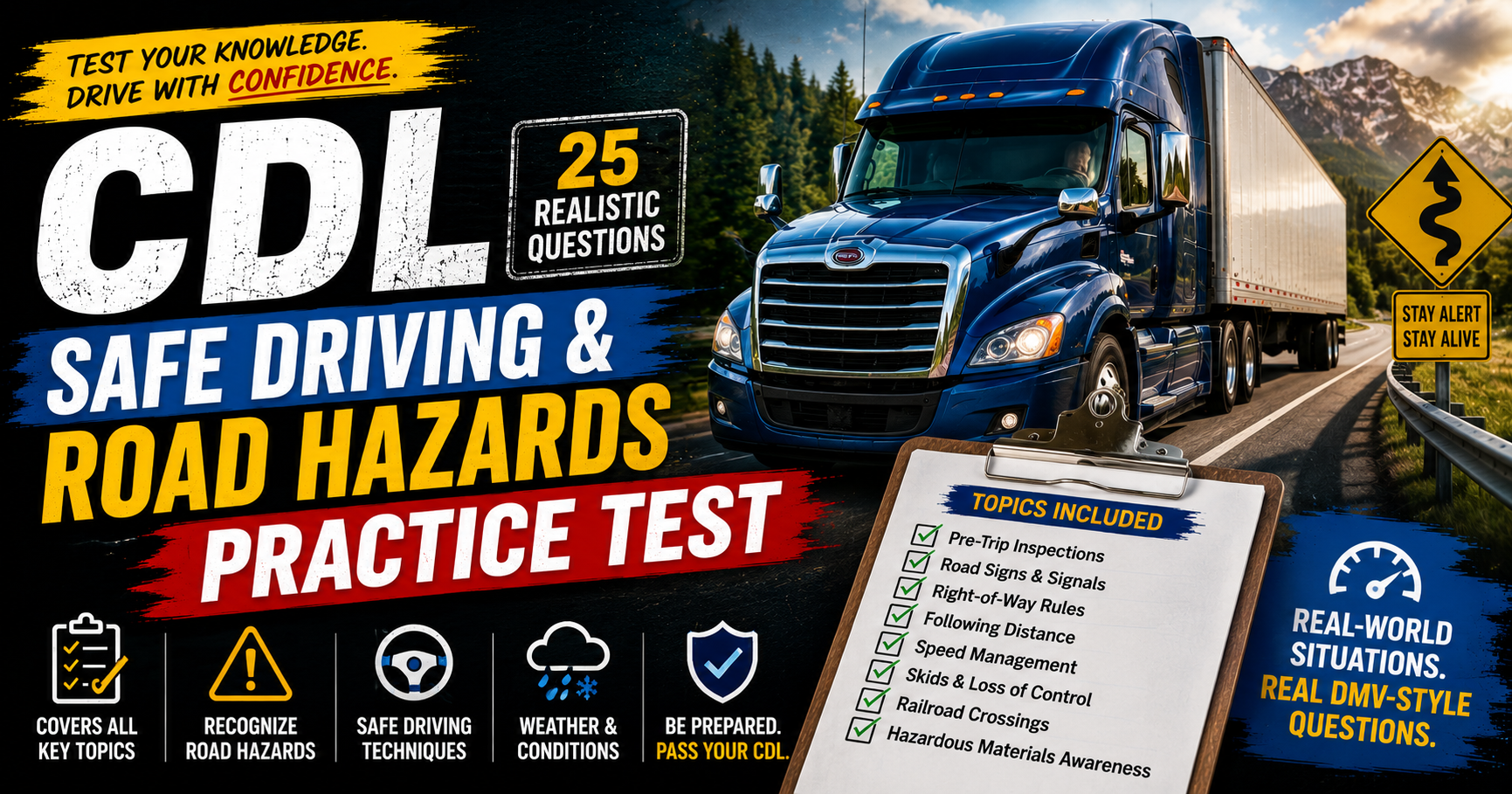
Continue building your knowledge by taking our CDL Safe Driving & Road Hazards Practice Test after finishing this quiz. Safe driving and proper braking go hand in hand, and understanding both subjects will make you a more confident and prepared commercial driver.
Why Following Distance Is Your Best Safety Tool
One of the easiest ways to prevent a collision is by maintaining a safe following distance.
Many crashes involving commercial vehicles occur because drivers simply don't have enough room to stop when traffic suddenly slows or comes to a halt.
Following distance should never remain the same in every situation.
Professional drivers increase their following distance when:
- Roads are wet or icy.
- Visibility is reduced.
- Traffic becomes congested.
- They're hauling heavy loads.
- Driving at highway speeds.
- Traveling through construction zones.
- Driving at night.
Giving yourself additional space provides valuable time to recognize hazards, react appropriately, and bring the vehicle to a controlled stop.
Emergency Braking Techniques
Even experienced truck drivers occasionally face emergency situations.
A vehicle may suddenly pull in front of you.
Traffic may stop unexpectedly.
An animal could run into the roadway.
Construction equipment might appear around a curve.
During these situations, remaining calm is critical.
Avoid jerking the steering wheel or making sudden lane changes unless absolutely necessary.
Modern commercial vehicles equipped with Anti-lock Braking Systems (ABS) should generally be braked firmly while maintaining steering control. Drivers should continue looking where they want the vehicle to travel instead of focusing on the hazard itself.
Panic rarely improves a situation.
Controlled, deliberate actions usually provide the safest outcome.
Driving Safely on Long Downgrades
Long downhill grades deserve special respect.
Gravity continually works against your braking system, causing your speed to increase if you don't control it properly.
Before beginning a steep descent:
- Reduce your speed.
- Select the appropriate gear.
- Use engine braking whenever possible.
- Avoid continuous brake application.
- Watch your speed frequently.
If your speed begins increasing beyond a safe level, address it immediately.
Waiting too long often allows brake temperatures to rise until brake fade develops.
Planning ahead is one of the most valuable habits a professional truck driver can develop.
Why Regular Brake Inspections Matter
Brakes should never be taken for granted.
Every pre-trip inspection gives you an opportunity to identify problems before they become dangerous.
Commercial drivers should look for signs of:
- Air leaks.
- Worn brake components.
- Damaged brake hoses.
- Loose mounting hardware.
- Warning lights.
- Fluid leaks.
- Excessive brake adjustment.
Small problems often become much larger if ignored.
Finding an issue during your inspection is always preferable to discovering it while traveling at highway speed.
Weather Makes Braking More Challenging
Weather conditions constantly change how commercial vehicles handle.
Rain reduces tire traction.
Snow makes stopping distances much longer.
Ice can nearly eliminate available traction altogether.
Fog reduces visibility and often requires lower speeds.
Strong winds can affect steering while you're trying to slow down.
Professional drivers constantly adapt to changing weather instead of driving exactly the same way every day.
Reducing speed and increasing following distance are two of the simplest adjustments you can make when road conditions become less than ideal.
Common Braking Mistakes New CDL Students Make
Many first-time CDL students make similar mistakes while learning about commercial braking systems.
Some of the most common include:
- Following traffic too closely.
- Driving too fast for conditions.
- Riding the brakes on long hills.
- Entering curves too quickly.
- Waiting too long to begin slowing.
- Depending entirely on service brakes.
- Forgetting that heavier loads require longer stopping distances.
- Ignoring warning lights or brake system problems.
Recognizing these common mistakes before taking your CDL exam can help you become a safer and more confident commercial driver.
Frequently Asked Questions
How many questions are on this CDL Brakes Practice Test?
This practice test contains 25 multiple-choice questions covering braking systems, stopping distance, emergency braking, brake fade, mountain driving, and other important commercial driving safety topics.
Will these questions help me pass my CDL permit exam?
Yes. This quiz focuses on many of the braking concepts commonly covered in CDL manuals and written permit exams. While every state writes its own exam, understanding these safety principles will help prepare you for test day.
Why is brake fade dangerous?
Brake fade occurs when brakes become overheated and lose effectiveness. If ignored, it can make slowing or stopping extremely difficult, especially while traveling down long mountain grades.
Should I rely on ABS to stop faster?
No. ABS is designed to help maintain steering control during hard braking by reducing wheel lockup. It does not eliminate the need for safe speeds, proper following distance, or defensive driving.
How often should I take CDL practice tests?
The more you practice, the better. Many successful CDL students complete multiple practice tests until they're consistently scoring 90% or higher while understanding the explanations behind every answer.
Continue Building Your CDL Knowledge
Every practice test you complete helps strengthen your understanding of commercial vehicle safety.
Don't stop after mastering braking concepts. Continue reviewing General Knowledge, vehicle inspections, defensive driving, road hazards, and the other subjects that make up the CDL written exam.
The more situations you study before taking your permit test, the more prepared you'll feel when it's time to earn your Commercial Driver's License and begin your trucking career.