Before I started spending time around grain handling equipment, I kept hearing people say things like:
“Hook the PTO up.”
“Start the auger.”
“We’ll run it off the tractor.”
I understood that the tractor was somehow powering the auger.
What I didn’t understand was how.
After seeing the system work up close, it turned out to be much simpler than I expected.
If you’ve watched a grain auger being used around a farm, there’s a good chance it was powered by a tractor’s Power Take-Off, usually called the PTO.
That simple connection allows the tractor’s engine to provide all the power needed to move thousands of bushels of grain every hour without the auger needing its own engine.
What Does PTO Mean?
PTO stands for Power Take-Off.
It’s a rotating shaft located at the rear of most agricultural tractors.
Instead of using that engine power only to move the tractor itself, the PTO allows the engine to power other equipment.
Depending on the attachment, a PTO may operate:
- Grain augers.
- Rotary cutters.
- Hay balers.
- Finish mowers.
- Manure spreaders.
- Feed grinders.
- Pumps.
- Many other farm implements.
It’s one of the reasons tractors are among the most versatile machines on a farm.



How Does a PTO Grain Auger Work?
The system is surprisingly straightforward.
The tractor backs up to the auger.
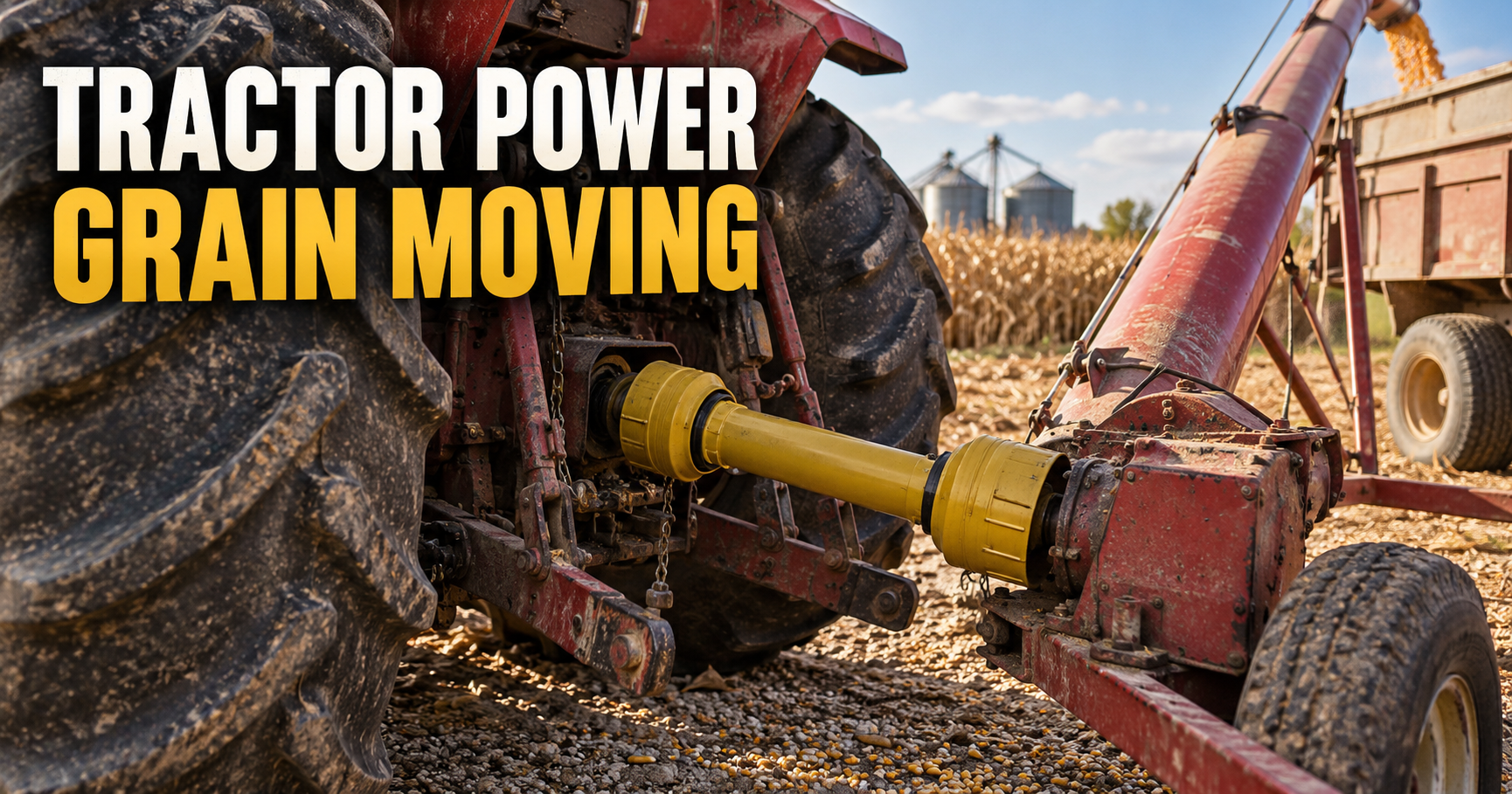
A PTO driveline connects the tractor’s PTO shaft to the auger’s gearbox.
Once everything is connected correctly, the operator engages the PTO from inside the tractor.
That rotating shaft transfers engine power directly into the auger.
Inside the auger, a long spiral called flighting begins turning.
As it rotates, the flighting carries grain from the hopper at the bottom to the discharge spout at the top.
From the outside it looks almost effortless.
Inside the tube, however, thousands of pounds of grain are being pushed uphill every hour. PTO-driven augers remain one of the most common ways farms move grain because they are simple, reliable, and can handle high volumes efficiently.

Why Use a Tractor Instead of Giving the Auger Its Own Engine?
This is probably the question I hear most.
The answer usually comes down to simplicity and cost.
Most farms already own tractors.
Instead of maintaining another gasoline or diesel engine on every portable auger, they simply use equipment that’s already available.
That offers several advantages.
- Fewer engines to maintain.
- Fewer fuel systems.
- Plenty of available horsepower.
- Easy to move from one job to another.
- Reliable operation throughout harvest.
For many farms, using a tractor as the power source simply makes the most sense.
PTO Speed Matters
One thing I didn’t realize until I started learning more about PTO equipment is that not every PTO turns at the same speed.
The two most common agricultural PTO speeds are:
- 540 RPM
- 1,000 RPM
The auger is designed for one of those speeds, and it’s important that the tractor is matched correctly.
Running equipment at the wrong PTO speed can reduce performance and may even damage the equipment.
That’s one reason operators always know which PTO speed their auger is designed to use before hooking everything together.


Hooking Up the PTO Correctly
Connecting a PTO-powered auger isn’t difficult, but it should always be done carefully.
The tractor should be completely shut off before connecting the driveline.
Once the PTO shaft is attached and properly locked into place, operators usually check that:
- The locking collar is fully engaged.
- Safety shields are in place.
- The driveline has enough clearance.
- Nothing will bind while the auger is operating.
Only after everything has been checked should the PTO be engaged.
Taking an extra minute before starting can prevent equipment damage and improve safety.
Why Many Farms Still Choose PTO Augers
Today there are electric grain augers, hydraulic systems, and larger commercial conveyors.
Even with those options, PTO-powered augers remain extremely common.
There are several reasons why.
First, almost every grain farm already owns tractors.
Second, tractors provide plenty of horsepower.
Third, the auger can easily be moved wherever it’s needed.
Instead of running electrical wiring or buying another engine, the tractor simply becomes the power source.
It’s a simple solution that’s worked well for generations.
PTO Augers Can Move a Lot of Grain
The first time I watched one working, I was honestly surprised by how quickly corn moved through it.
Thousands of bushels can be transferred in a relatively short amount of time depending on:
- Auger diameter.
- Length.
- PTO speed.
- Tractor horsepower.
- Type of grain.
- Operating conditions.
For something that looks fairly simple, it’s an incredibly productive piece of equipment.
Safety Should Always Come First
One thing I’ve learned very quickly around farm equipment is that nobody rushes around a PTO.
Experienced operators treat it with respect because they understand how powerful it is.
A few simple habits make a huge difference.
Never step across a rotating PTO shaft.
Never wear loose clothing around moving equipment.
Never try to clear a plugged auger while it’s running.
Always disengage the PTO and wait for everything to stop before working on the equipment.
Those habits become second nature for people who work around augers every day, and for good reason.
Agricultural safety organizations consistently identify PTO drivelines as one of the leading causes of serious farm equipment injuries when guards are missing or safe procedures aren’t followed. (extension.psu.edu)


Frequently Asked Questions
What does PTO stand for?
PTO stands for Power Take-Off. It’s a rotating shaft on a tractor that transfers engine power to equipment such as grain augers, mowers, balers, pumps, and many other farm implements.
Can any tractor run a grain auger?
Many can, but the tractor and auger must be compatible. PTO speed, horsepower, and the auger’s requirements all need to match for safe operation.
Why use a PTO instead of an electric motor?
Many farms already have tractors available, making a PTO-powered auger portable, reliable, and easy to use almost anywhere without requiring electrical service.
Are PTO grain augers dangerous?
Yes. Like any rotating machinery, PTO-powered equipment should always be operated with proper guards in place and with safe operating procedures. Never work around a rotating PTO shaft or attempt to clear a plugged auger while it’s still running.
Simple Equipment That Does an Incredible Amount of Work
Before I started hauling grain, I looked at a PTO-powered grain auger as just another piece of farm equipment.
Now I see it differently.
It’s one of the machines that quietly keeps the entire grain handling system moving.
Without it, loading trucks, emptying grain bins, filling storage bins, and moving grain around the farm would take far more time and labor.
It’s not the biggest machine on the farm.
It may not even be the most impressive.
But after watching one move load after load of corn, it’s easy to understand why so many farms depend on PTO-powered grain augers every single harvest season.
Author: Jake Harrison
Jake Harrison is a commercial transportation writer for TruckingResource.com who specializes in commercial trucking, agricultural transportation, CDL training, and equipment. He works with the TruckingResource.com editorial team to create detailed, beginner-friendly guides that explain the equipment and systems that keep farms and the trucking industry moving.