
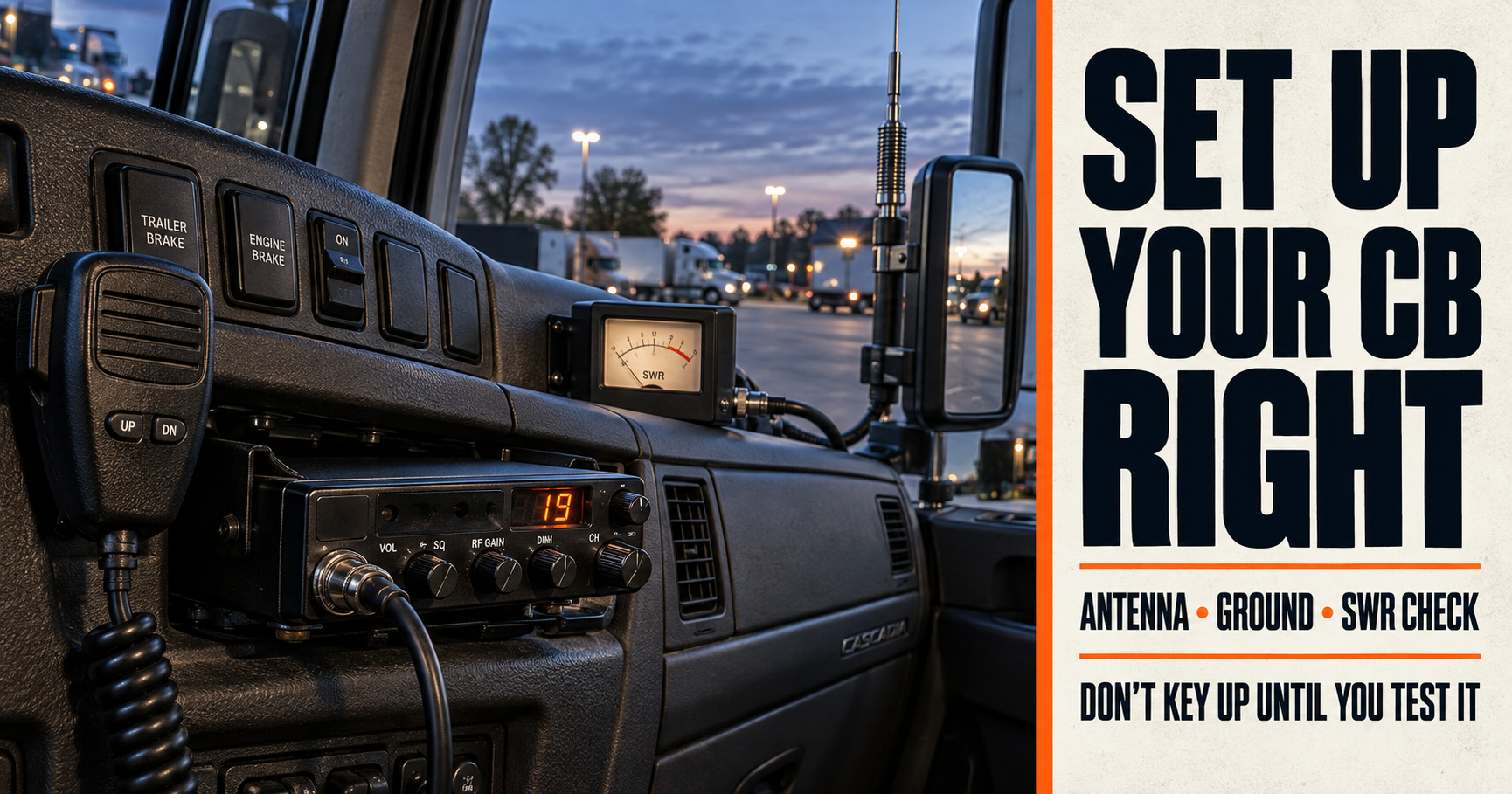
Buying a CB radio is the easy part.
Getting the whole setup to work well is where people get frustrated.
You can spend good money on a nice radio, mount it neatly in the cab, turn it on and still end up barely hearing anyone. Then it’s easy to blame the radio.
Sometimes the radio isn’t the problem at all.
A CB system includes the radio, antenna, antenna mount, coax cable, electrical power and the way everything is installed. Get one important part wrong and the entire setup can suffer.
If I were setting up a CB in a semi truck from scratch, I’d spend just as much time thinking about the antenna and installation as I would deciding which radio to buy.
Start With a CB That Makes Sense for a Truck
You don’t need the fanciest CB ever made to communicate with other drivers.
But if you’re installing one in a truck where it’s going to stay, I like having features that are actually useful on the road.
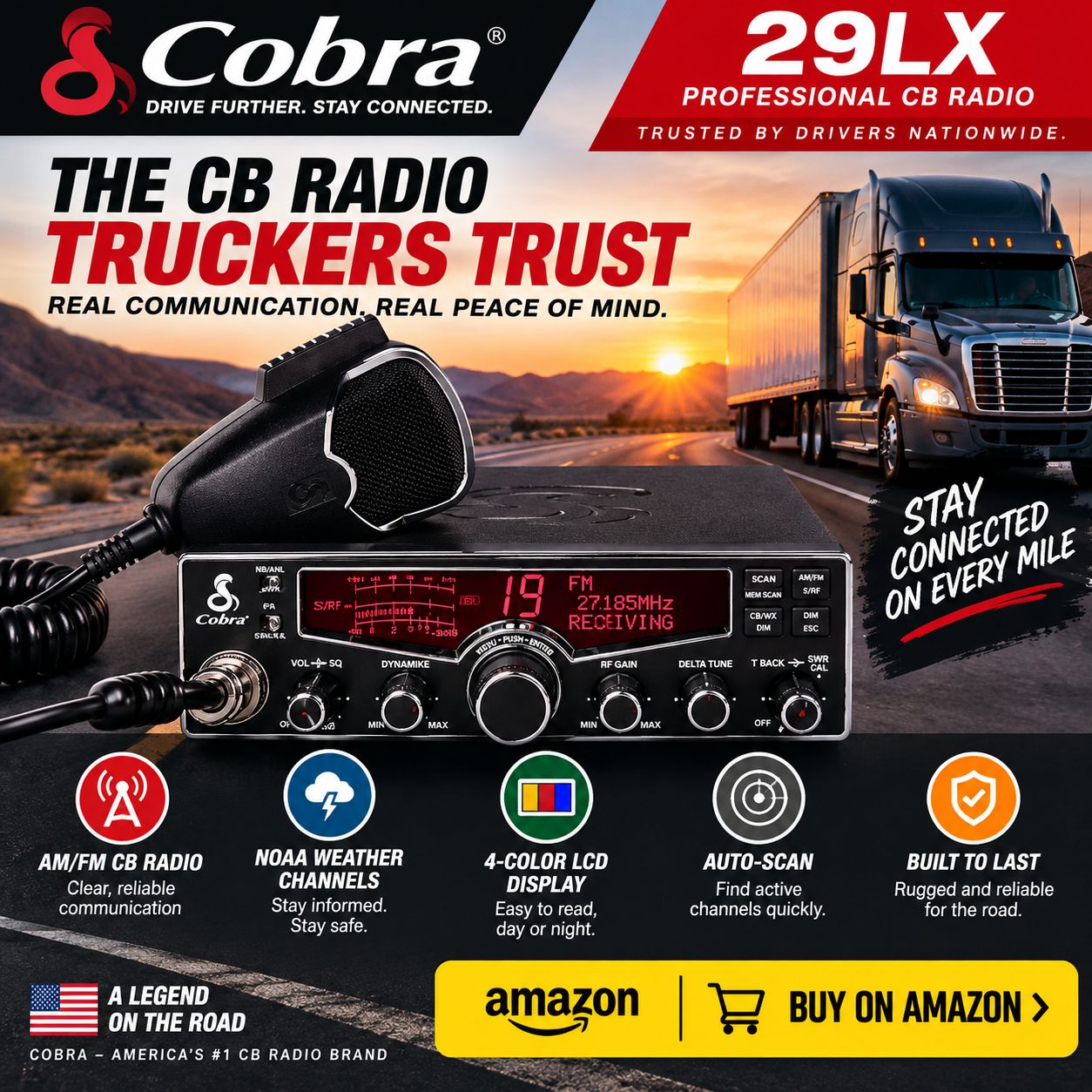
The Cobra 29LX AM/FM Professional CB Radio is a good example.
It gives you traditional AM CB operation along with FM capability, NOAA weather channels and emergency alerts, channel scanning and a large selectable four-color display.
One feature that’s particularly useful when you’re installing a radio yourself is Cobra’s built-in diagnostic capability. The 29LX can provide information related to antenna SWR, RF output and vehicle voltage.
That’s more useful in a working truck than adding a bunch of features you’ll never touch.
And because it’s an actual CB, you’re able to communicate with other CB-equipped drivers nearby instead of being limited to people using the same cellular push-to-talk service.
If you’re still wondering whether a CB is even worth installing anymore, I covered that separately in Do Truck Drivers Still Use CB Radios?.
Don’t Buy the Radio and Treat the Antenna Like an Afterthought
This is probably the biggest mistake I’d avoid.
People naturally focus on the radio because that’s the part they see.
It’s got the microphone.
The knobs.
The display.
The speaker.
But the antenna system has a huge effect on how well you’re actually going to transmit and receive.
A great CB attached to a poorly installed antenna can be disappointing.
A decent radio connected to a properly installed antenna can work surprisingly well.
So don’t spend your entire budget on the radio and then buy whatever antenna happens to be cheapest.


Antenna Location Matters
CB operates around 27 MHz, which means antenna placement matters quite a bit.
Generally, you want as much of the antenna as practical to be above surrounding metal and other obstructions.
That’s one reason mirror-mounted antennas have traditionally been common on semis.
The mirrors provide a practical mounting location outside the cab and can get the antenna away from some of the metal surrounding it.
Depending on the truck, other mounting locations can work too.
What I wouldn’t do is assume the easiest place to physically bolt an antenna is automatically the best place electrically.
The truck itself becomes part of the antenna installation.
One Antenna or Two?
You’ve probably seen semis with an antenna on each mirror.
That’s the classic dual-antenna look.
But two antennas aren’t automatically better than one.
A properly installed single antenna can work extremely well.
Dual antennas, often called a co-phased setup, require the correct coax arrangement and proper spacing to work as intended.
They’re sometimes used to shape the signal pattern more favorably along the highway, but installing two random antennas and connecting them however you want isn’t the same thing.
For someone setting up their first CB, a good single antenna installed correctly is often much simpler to get right.



Pay Attention to Antenna Height
This is another place where practicality matters.
From a radio standpoint, getting more of the antenna above the cab can help.
From a trucking standpoint, you’ve still got bridges, trees, loading areas and everything else a commercial truck encounters.
You need an installation that’s effective without creating another problem.
A flexible whip can tolerate contact better than something rigid, but the right choice depends on the truck and where you operate.
The Coax Cable Matters Too
The coax is the cable connecting the CB radio to the antenna.
It carries the radio-frequency signal between them.
Don’t treat it like an ordinary piece of wire.
Damaged coax, poor connectors, corrosion or a badly routed cable can hurt performance.
I’d inspect the entire cable while installing it.
Avoid crushing it.
Avoid routing it where doors, seats or other equipment can constantly pinch it.
Keep connections clean and secure.
And don’t assume that because the outside of the cable looks fine everything inside it must be perfect.



Don’t Cut Coax Randomly Trying to Fix SWR
This is one of those pieces of CB advice that’s been repeated so many times people assume it applies to every situation.
Don’t start hacking chunks off your coax because somebody told you that’s how you tune the antenna.
The antenna itself, mounting system, ground plane or counterpoise, coax arrangement and overall installation all affect performance.
Follow the antenna manufacturer’s installation instructions instead of randomly shortening cable until a meter gives you a number you like.
Power the Radio Correctly
The CB needs clean, reliable electrical power.
Depending on the truck, you may already have a factory CB power connection.
That’s ideal when it’s properly wired for the radio you’re installing.
Otherwise, follow the radio manufacturer’s wiring instructions.
Don’t twist wires together, wrap them with cheap tape and shove everything behind the dash.
Commercial trucks vibrate.
A lot.
A connection that seems fine sitting in the driveway can become a problem after months of bouncing down rough roads.
Use proper connections and protect the wiring from abrasion.


Why Electrical Noise Can Become Annoying
A CB is a radio receiver sitting inside a vehicle full of electrical equipment.
Alternator.
Blower motors.
LED lights.
Charging equipment.
Inverters.
Electronic modules.
Poor wiring or grounding can sometimes introduce noise into the radio.
If you hear whining that changes with engine RPM or interference that appears when a certain accessory is switched on, you may be dealing with electrical noise rather than a problem with the CB itself.
A clean installation matters.
SWR Is the Part You Shouldn’t Skip
Once the radio and antenna are installed, you need to know whether the antenna system is properly matched.
That’s where SWR, or Standing Wave Ratio, comes in.
You don’t need to become a radio engineer to understand the important part.
A good SWR means the antenna system is accepting the transmitter’s power reasonably well.
A poor SWR means more of that energy is being reflected back toward the radio instead of being efficiently radiated by the antenna.
High SWR can hurt your range and, if it’s severe enough, potentially damage the transmitter.
That’s why I wouldn’t consider a CB installation finished until the antenna system has been checked.
We’re going to cover what SWR means and how to adjust it in its own article because this is one of the most important parts of getting a CB to perform properly.
Don’t Judge Range Until the Antenna Is Set Up Correctly
This is another common mistake.
Someone installs a CB.
Talks to another driver.
Only gets a mile or two.
Then decides:
“This radio is junk.”
Maybe.
But before blaming the radio, I’d want to know:
Is the antenna mounted correctly?
Is the SWR acceptable?
Is the coax good?
Is the antenna properly grounded or otherwise installed according to its design?
How high is the antenna?
What’s the terrain like?
Is there a lot of interference?
There are too many variables to judge the radio without checking the rest of the installation.

Our guide to how far a CB radio can reach in a semi truck goes deeper into why two trucks using similar radios can get very different real-world range.
Set Your Squelch Instead of Listening to Static All Day
Once the hardware is working, it’s time to set up the controls.
Squelch determines how strong a received signal needs to be before the radio opens the speaker.
Set it too low and you’ll listen to static constantly.
Set it too high and you can block weaker transmissions you actually wanted to hear.
A simple way to set it is to turn it until the background noise just disappears.
That gives you a reasonable starting point.
You can always adjust it depending on how noisy the band is.
What Does RF Gain Do?
RF gain is another control beginners sometimes confuse with volume.
It controls the sensitivity of the receiver.
In many situations, you’ll leave RF gain relatively high so you can hear weaker stations.
In very noisy environments with strong nearby signals, reducing it can sometimes make listening more comfortable.
It doesn’t make the transmitter more powerful.
That’s an important distinction.
Start With Channel 19 for Highway Trucking
Once everything works, you need somewhere to listen.
For general U.S. highway trucking communication, Channel 19 remains the obvious starting point.
That’s where you’re most likely to hear truck-related road information from nearby CB users.
It isn’t legally reserved for truck drivers, and local practices vary, but decades of trucking tradition made 19 the highway channel.
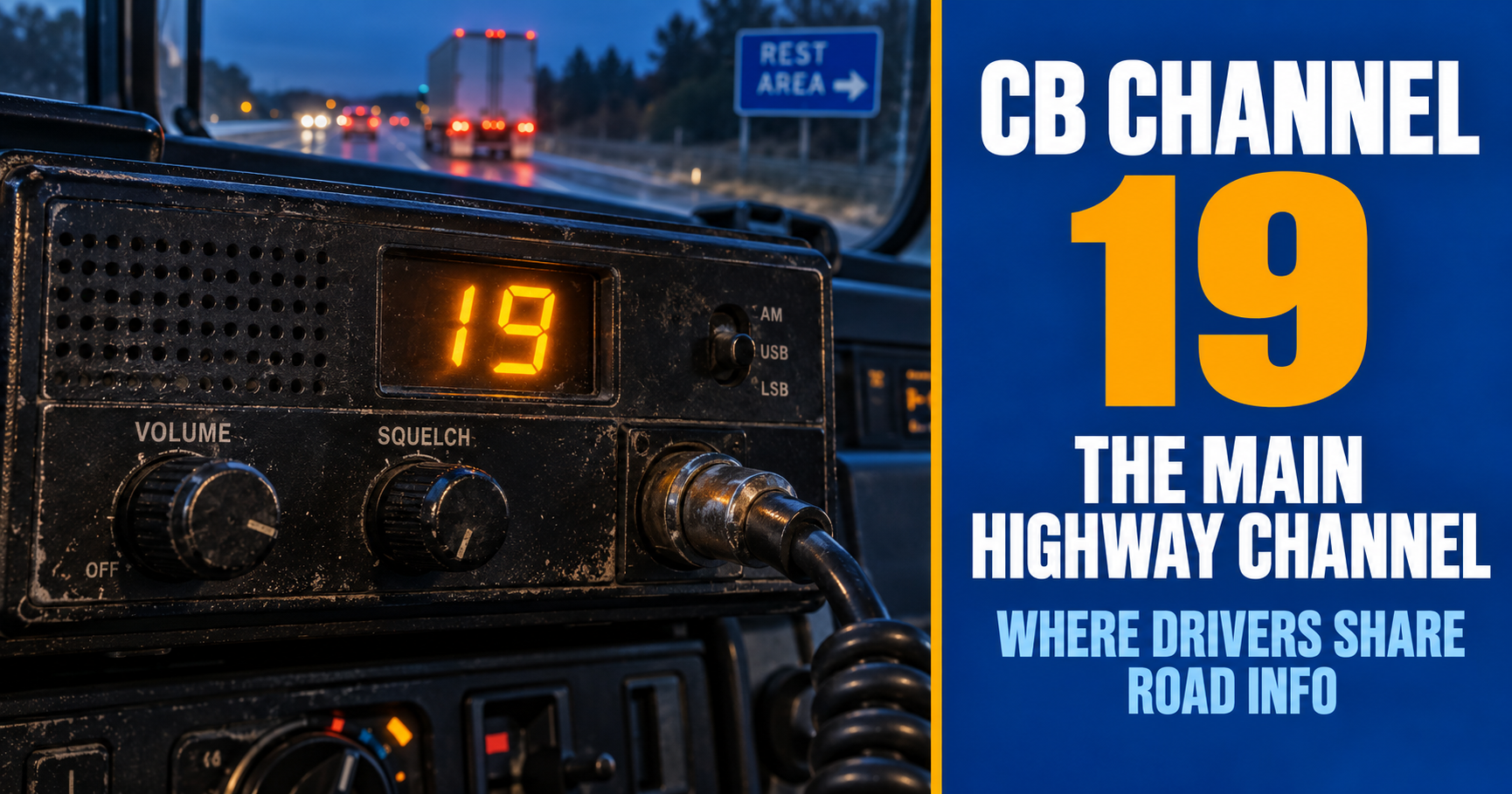
Our full guide to what CB channel truck drivers use explains Channel 19, AM versus FM, Channel 9 and why local operations sometimes use something completely different.
AM Is Still the Logical Starting Mode
Modern U.S. CB radios can support FM as well as AM.
But traditional American trucking CB communication has been overwhelmingly AM.
If your goal is hearing other truckers on Channel 19, I’d start with AM.
FM gives compatible users another option, but both stations need to be using compatible modes to communicate as intended.
That’s another reason an AM/FM radio like the Cobra gives you useful flexibility without taking away compatibility with traditional AM CB use.
Test the Radio With Another Known CB
Once you’ve installed everything and checked SWR, I like the idea of testing with another radio you know works.
That gives you a much better baseline than calling randomly into an empty channel and deciding nobody can hear you.
Start fairly close.
Confirm transmit and receive.
Then increase the distance.
That helps separate an installation problem from the simple fact that nobody happened to answer you.
Weather Channels Are Worth Setting Up Too
If your CB includes NOAA weather reception, don’t ignore it.
For truck drivers, farmers, construction crews and anybody spending long days outside, weather can change the entire workday.
The Cobra 29LX can receive NOAA weather channels and monitor for emergency weather alerts, which is one of the reasons I think it fits a working commercial truck particularly well.
A CB may be old technology, but severe weather hasn’t become any less relevant.
CB Isn’t the Only Communication Tool Worth Carrying
I wouldn’t expect a CB to handle every communication need.
It isn’t supposed to.
CB is excellent for nearby drivers you don’t know.
A Bluetooth headset is better for phone conversations.
Cellular push-to-talk can be better for communicating with your own crew across much greater distances.

For phone calls in a noisy truck cab, the LEVN Bluetooth Trucker Headset is useful because it gives you a boom microphone, noise cancellation and long battery life without trying to pretend it’s a replacement for CB.
Different tools solve different problems.
Frequently Asked Questions
Where should I mount a CB radio in a semi truck?
Some trucks have a factory overhead or dashboard location for a CB. Otherwise, choose somewhere the radio can be securely mounted without interfering with visibility, controls or safe operation of the truck.
What’s the best CB channel for truckers?
Channel 19 is the traditional highway trucking channel in the United States, although local operations may use other channels.
Do I need to tune a new CB radio?
The radio itself isn’t necessarily what you’re tuning. The important step is checking and adjusting the antenna system so its SWR is within an acceptable range.
Can high SWR damage a CB?
Severely high SWR can reflect transmitter power back toward the radio and potentially damage the transmitter. Don’t repeatedly transmit into an antenna system with an obviously poor match.
Does a better CB radio automatically give me more range?
No. Antenna quality, antenna placement, SWR, coax, terrain and interference can have an enormous effect on range.
Is one CB antenna enough for a semi truck?
Yes. A properly installed single antenna can work very well. Dual antennas can also work, but they require the correct installation and aren’t automatically superior.
Do I need a CB license?
Ordinary eligible CB operation in the United States is authorized by rule and doesn’t generally require an individual station license.
Can I use a CB without cell service?
Yes. Traditional CB communication is direct radio-to-radio communication and doesn’t rely on a cellular network.
A Good Setup Matters More Than a Fancy Radio
That’s probably the biggest thing I’d want someone to take away from this.
Don’t buy an expensive CB, plug in whatever antenna is nearby and expect miracles.
Treat the whole thing as a system.
Get a radio that fits what you actually need.
Install the antenna properly.
Use good coax.
Power the radio correctly.
Check the SWR.
Set the controls.
Then see what kind of performance you get.
When all of those pieces are working together, CB makes a lot more sense.
And if the range still isn’t what you expected, you’ll have a much better idea where to start troubleshooting instead of immediately blaming the box mounted inside the cab.
Author: Tyler Grant
Tyler Grant writes about commercial truck equipment, driver communication and everyday life behind the wheel for TruckingResource.com. His guides focus on practical equipment drivers actually use and straightforward ways to get more out of it.