
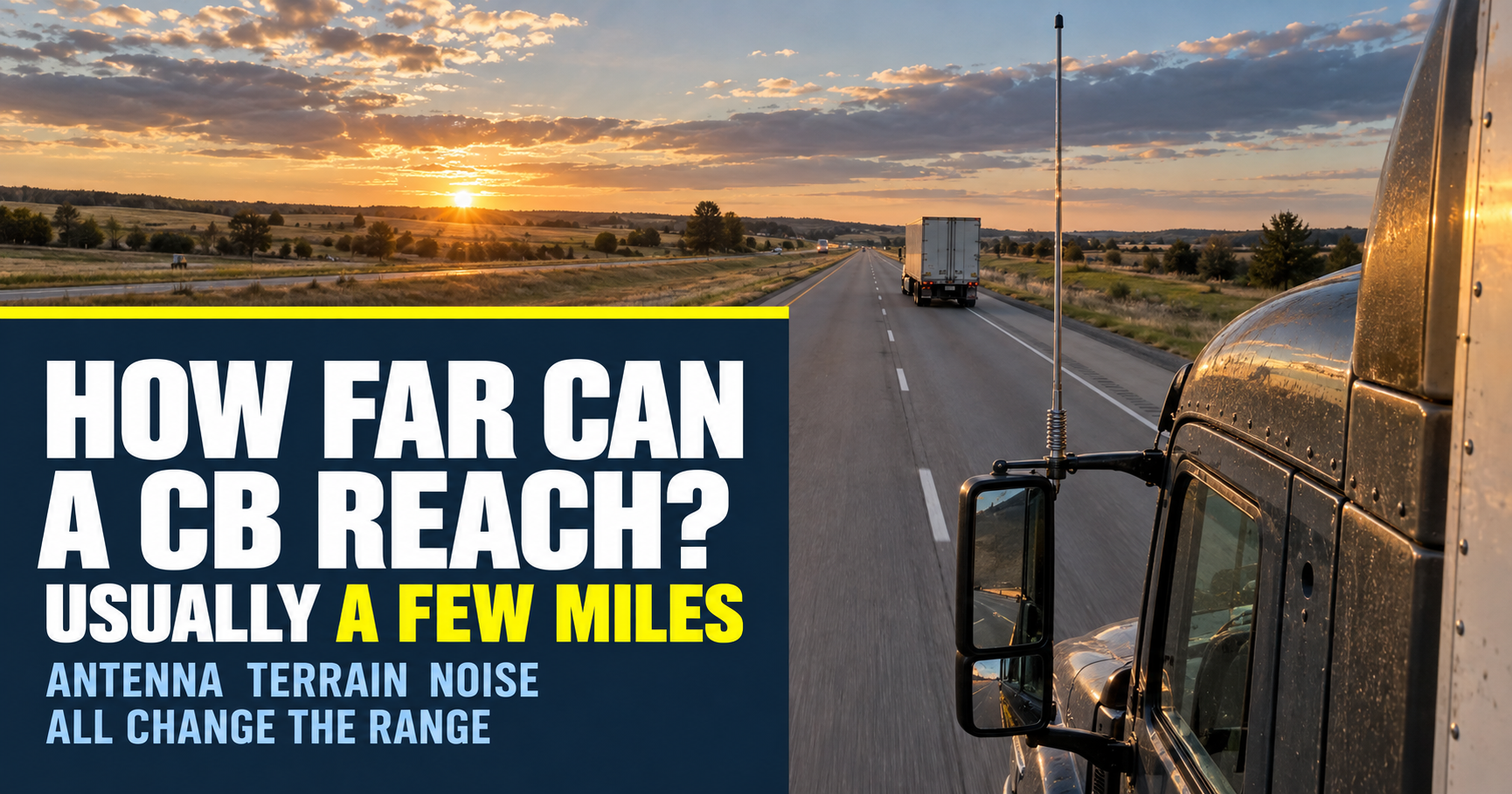
Buy a CB radio, install it in the truck, turn to Channel 19 and there’s one question that usually doesn’t take long to come up.
How far can this thing actually reach?
Five miles?
Ten?
Twenty?
The frustrating answer is that CB radio range doesn’t work like cell service where somebody can give you a coverage map and call it done.
Two identical radios installed in two different trucks can have completely different usable ranges.
The radio matters, but the antenna, antenna location, SWR, terrain, interference, surrounding buildings and even the equipment on the other truck can matter just as much.
For a typical mobile CB installed properly in a truck, something around 5 to 7 miles under favorable conditions is a reasonable expectation. Sometimes you’ll get less. Under especially good conditions you may communicate considerably farther.
That’s why somebody telling you their CB “talks 20 miles” doesn’t automatically mean yours is broken because you’re getting three.
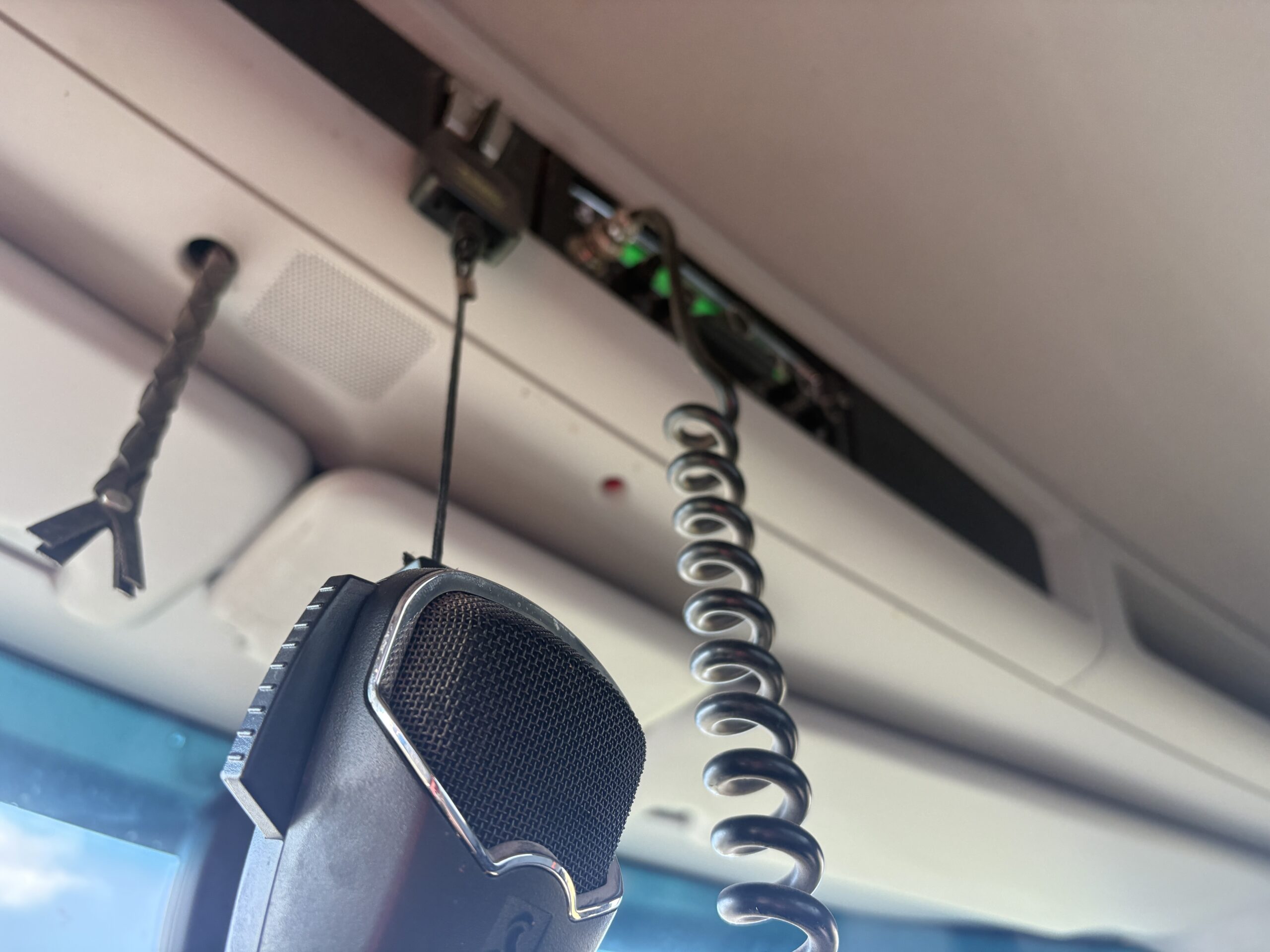
What Is a Realistic CB Range From a Semi Truck?
Cobra, one of the best-known CB manufacturers, says a properly set-up mobile CB can communicate roughly 5 to 7 mileswhen negative environmental factors are removed.
That’s a useful starting point.
Real-world conditions aren’t always that friendly, though.
Drive through hills, trees, buildings, power-line interference, or an electrically noisy area and usable range can shrink considerably.
Get out on flat, open country with good antennas on both trucks and the opposite can happen.
The FCC has described direct-wave CB communication at distances of approximately 15 miles under appropriate conditions.
So rather than expecting one exact distance, I’d think about CB range like this:
A few miles is completely normal.
Five to seven miles from a good mobile installation is realistic under favorable conditions.
Longer communication can happen when terrain, antennas, and conditions cooperate.



Why Doesn’t Every 4-Watt CB Have the Same Range?
Because transmitter power is only part of the equation.
A legal AM CB isn’t suddenly producing more power because you installed it in a Kenworth instead of a dump truck.
What changes is everything surrounding the radio.
The antenna system determines how efficiently the radio’s signal actually gets out of the truck.
Then terrain and the environment determine what happens to that signal after it leaves.
That’s why the antenna can matter more than spending another hundred dollars on the radio itself.
The Antenna Is a Huge Part of Your CB Range
This is probably the single biggest thing beginners underestimate.
They spend money on the radio because that’s the part with the screen, knobs and microphone.
Then they connect it to whatever antenna happens to be available and wonder why the range is terrible.
Cobra specifically lists antenna condition, antenna location, physical antenna length and SWR as major factors affecting CB range.
A properly installed antenna allows the radio to radiate its available power much more efficiently.
A poor antenna setup can waste much of the potential you already paid for.
Higher Antennas Generally Work Better
Antenna placement matters.
The higher and more unobstructed the antenna is, the better opportunity the signal has to get out.
Antenna systems surrounded by metal structures, mounted too low, or poorly positioned can perform worse than expected.
Semi trucks create their own challenges because you’ve got mirrors, exhaust stacks, sleepers, trailers and a lot of metal around the antenna.
That’s why copying an antenna setup from a pickup truck doesn’t necessarily produce the same result on a tractor-trailer.

Longer Antennas Generally Perform Better
There’s a reason CB antennas aren’t all six inches tall.
CB operates around 27 MHz, which corresponds to a fairly long wavelength.
A physically longer antenna generally provides better efficiency than an extremely short one, assuming the installation is otherwise correct.
Of course, there’s a practical limit on a working commercial truck.
You still have bridges, trees, loading areas and everything else hanging over the roadway.
So CB antenna selection becomes a compromise between radio performance and having something practical enough to survive on the truck.
What Is SWR and Why Does It Matter?
SWR stands for Standing Wave Ratio.
This is one of those CB terms that sounds much more complicated than it needs to.
Your radio sends power toward the antenna.
Ideally, the antenna radiates that energy efficiently.
If the antenna system isn’t properly matched, some energy is reflected back toward the radio instead.
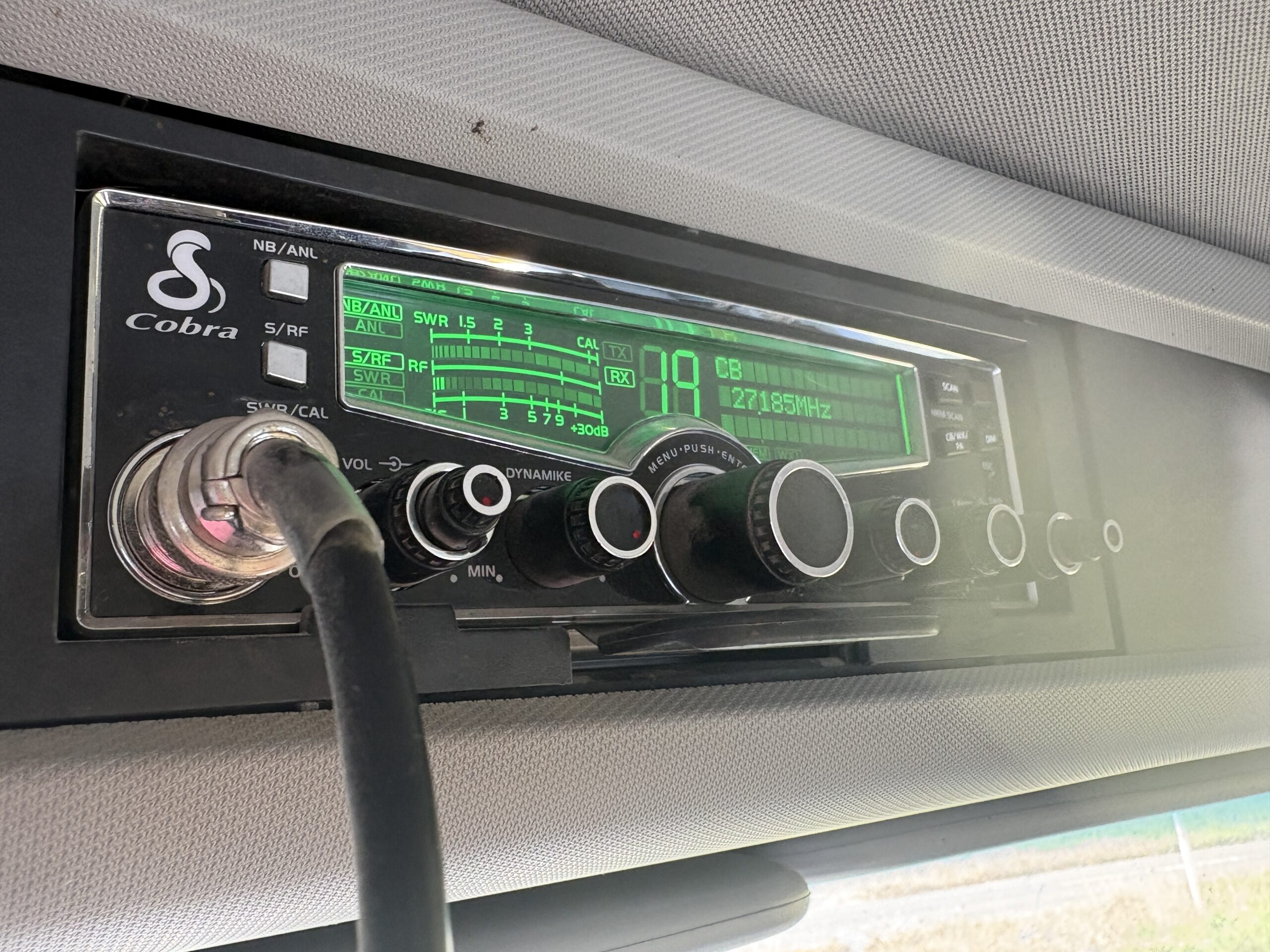
SWR gives you an indication of how well the antenna system is matched.
A poor SWR can reduce performance, and an extremely poor antenna match can potentially damage the radio’s transmitter.
That’s why tuning the antenna matters.
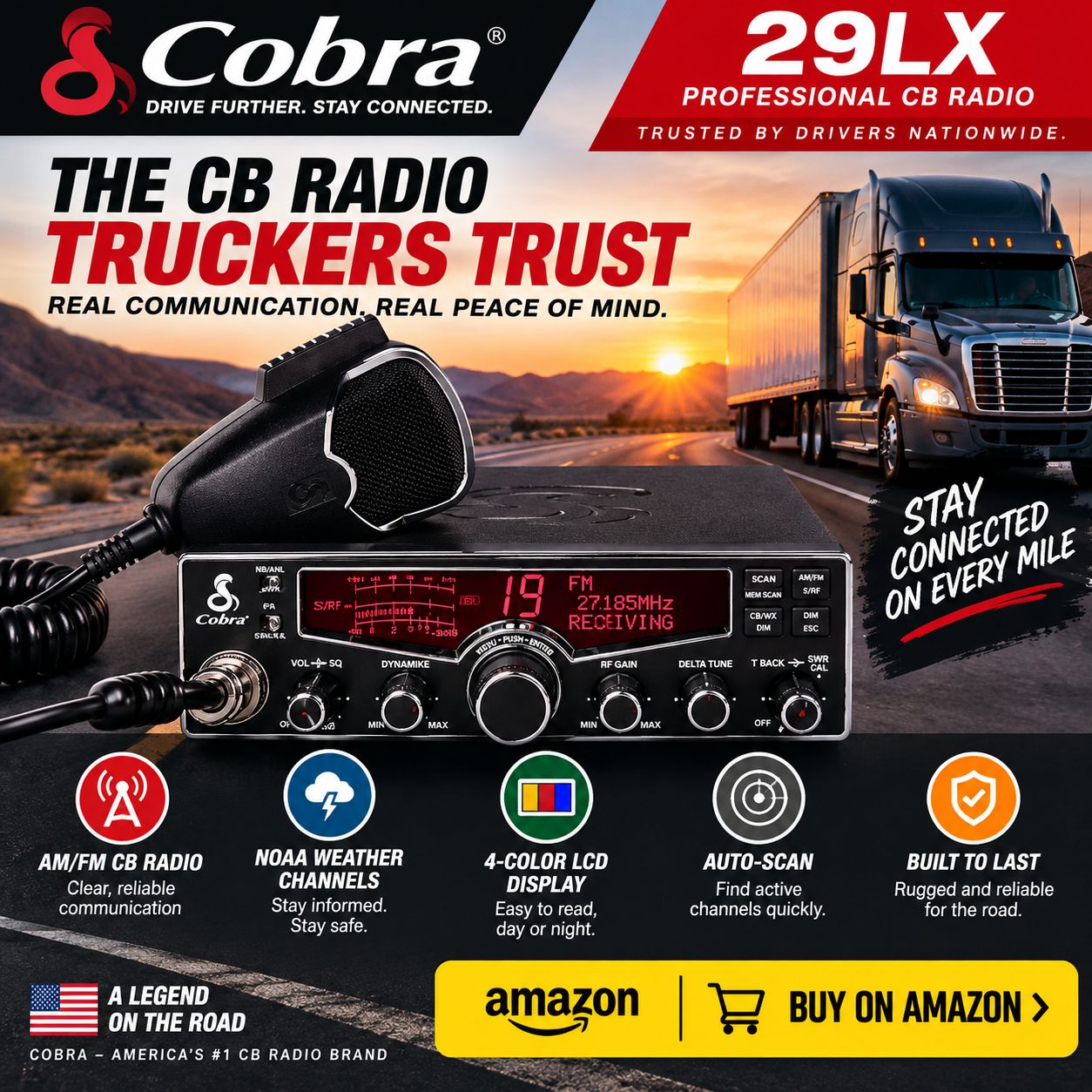
The Cobra 29LX AM/FM Professional CB Radio is particularly useful for somebody putting together a truck installation because it includes built-in antenna SWR and radio diagnostic information. Instead of buying a nice CB and simply hoping the antenna installation is right, you’ve got tools built into the radio that can help you check the setup.
It also gives you AM/FM CB operation, NOAA weather channels and emergency alerts, which makes it a much more complete truck radio than a bare-bones CB.
Channel 19 Doesn’t Reach Farther Than Other Channels
This is worth clearing up.
Channel 19 isn’t the trucker channel because it somehow has better range.
It became useful because truck drivers agreed to use it.
The frequency differences between neighboring CB channels don’t create some magical range advantage for Channel 19.
Its advantage is people.
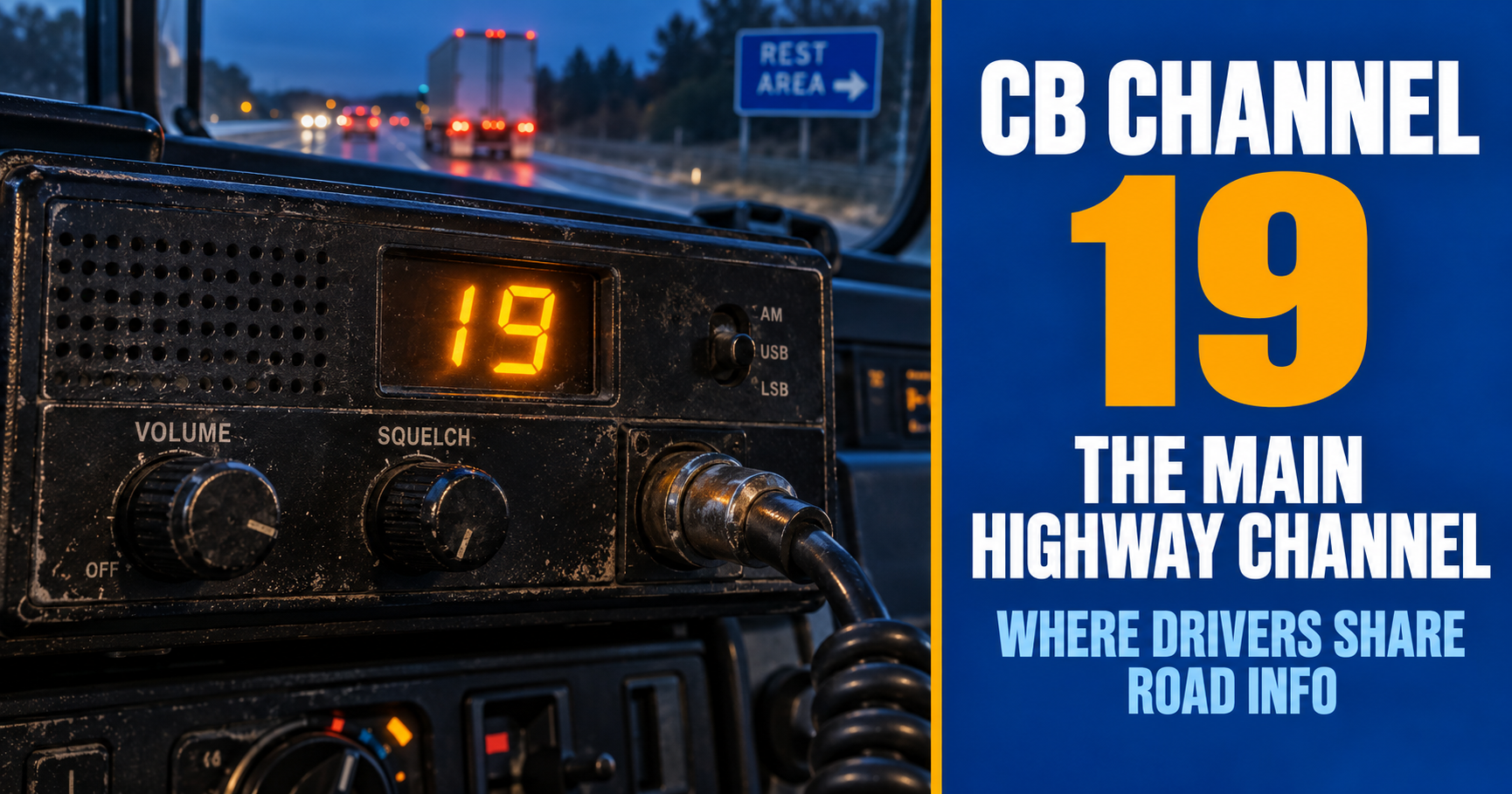
If you want to understand why truckers ended up there, our guide to what CB channel truck drivers use explains Channel 19, its frequency and how drivers use it today.
Flat Country Can Be Great for CB
Terrain makes a huge difference.
Think about a truck running across open farmland.
There aren’t tall buildings everywhere.
There may be relatively few large obstacles between two trucks.
That can be a much friendlier environment for direct radio communication than driving through hills, dense woods or downtown buildings.
This is one reason two drivers can argue about CB range and both be telling the truth.
One might regularly communicate five or more miles across open country.
Another may struggle to get a clean signal a couple miles away in difficult terrain.
Their radios aren’t necessarily different.
Their environments are.
Hills Can Kill Your Range Quickly
CB signals don’t magically pass through a mountain because your radio says Cobra on the front.
Large terrain obstacles can dramatically reduce communication.
You may hear a truck clearly while you’re both on relatively open ground.
Then one of you drops behind a ridge and the signal becomes weak or disappears.
That’s normal radio behavior.
Sometimes changing position by a surprisingly small amount can make a big difference.
Buildings and Cities Create Their Own Problems
Urban areas aren’t always friendly to CB either.
You’ve got buildings blocking signals.
Electrical equipment generating interference.
Power lines.
Other radios.
Vehicles.
All kinds of electronic noise.
That means a CB setup that performs beautifully on open interstate may feel much less impressive downtown.
Again, that’s not necessarily a radio failure.
Why Can I Hear Somebody Who Can’t Hear Me?
This happens with radio communication all the time.
Maybe their transmitter and antenna system are better than yours.
Maybe they’re running a better antenna location.
Maybe electrical noise inside your truck is making it harder for you to receive.
Maybe something about the terrain favors one direction.
Radio communication involves equipment at both ends.
Just because you can hear someone doesn’t guarantee your signal reaches them equally well.
Why Can Somebody Hear Me but I Can’t Hear Them?
Same basic problem in reverse.
Your transmitter may be getting out well while your receiver is dealing with heavy interference.
The other driver’s radio might not be transmitting as effectively as yours.
Their antenna could be poor.
There are too many variables to diagnose an entire CB installation based on one conversation.
What About Dual CB Antennas on a Semi?
Those twin antennas mounted on both mirrors look like classic trucking equipment.
But two antennas aren’t automatically twice as good.
A properly designed co-phased antenna system requires the correct antennas, spacing and coax arrangement.
Simply adding another antenna with the wrong splitter isn’t guaranteed to improve anything.
A good single antenna installation can outperform a badly configured dual setup.
If you’re setting up a CB from scratch, I’d rather have one antenna installed correctly than two installed because they look good.
Does More Expensive CB Equipment Give You More Range?
Not necessarily.
A nicer radio can give you better controls, noise filtering, weather functions, diagnostics, display quality and other useful features.
But legal transmitter power and the laws of radio propagation still exist.
Putting a $300 radio on a terrible antenna isn’t a recipe for amazing range.
This is another reason I like putting money into the entire installation rather than just the box on the dashboard.
Can You Legally Increase CB Power?
Standard CB operation is regulated by the FCC.
Trying to overcome a bad antenna installation by adding illegal power isn’t the answer.
Fix the antenna.
Check the coax.
Check SWR.
Improve the installation.
Those are the legitimate places to start.
A properly set-up legal CB is capable of doing exactly what most truck drivers actually need: communicating with other nearby drivers.
Why Do You Sometimes Hear People Hundreds of Miles Away?
Here’s where CB gets weird.
CB operates in a portion of the HF radio spectrum where signals can sometimes interact with the ionosphere and travel far beyond ordinary local range.
This is commonly called skip.
Under favorable atmospheric and solar conditions, you may suddenly hear stations from surprisingly far away.
That doesn’t mean your normal truck-to-truck range suddenly became 500 miles.
It’s a different propagation condition.
For ordinary trucking communication, direct local range is what matters.
CB Range vs Cellular Push-to-Talk Range
This is where traditional CB and newer communication systems become completely different tools.
A CB communicates directly from one radio to another.
Its practical range is therefore limited.
Cellular push-to-talk radios use cellular infrastructure to carry the communication.
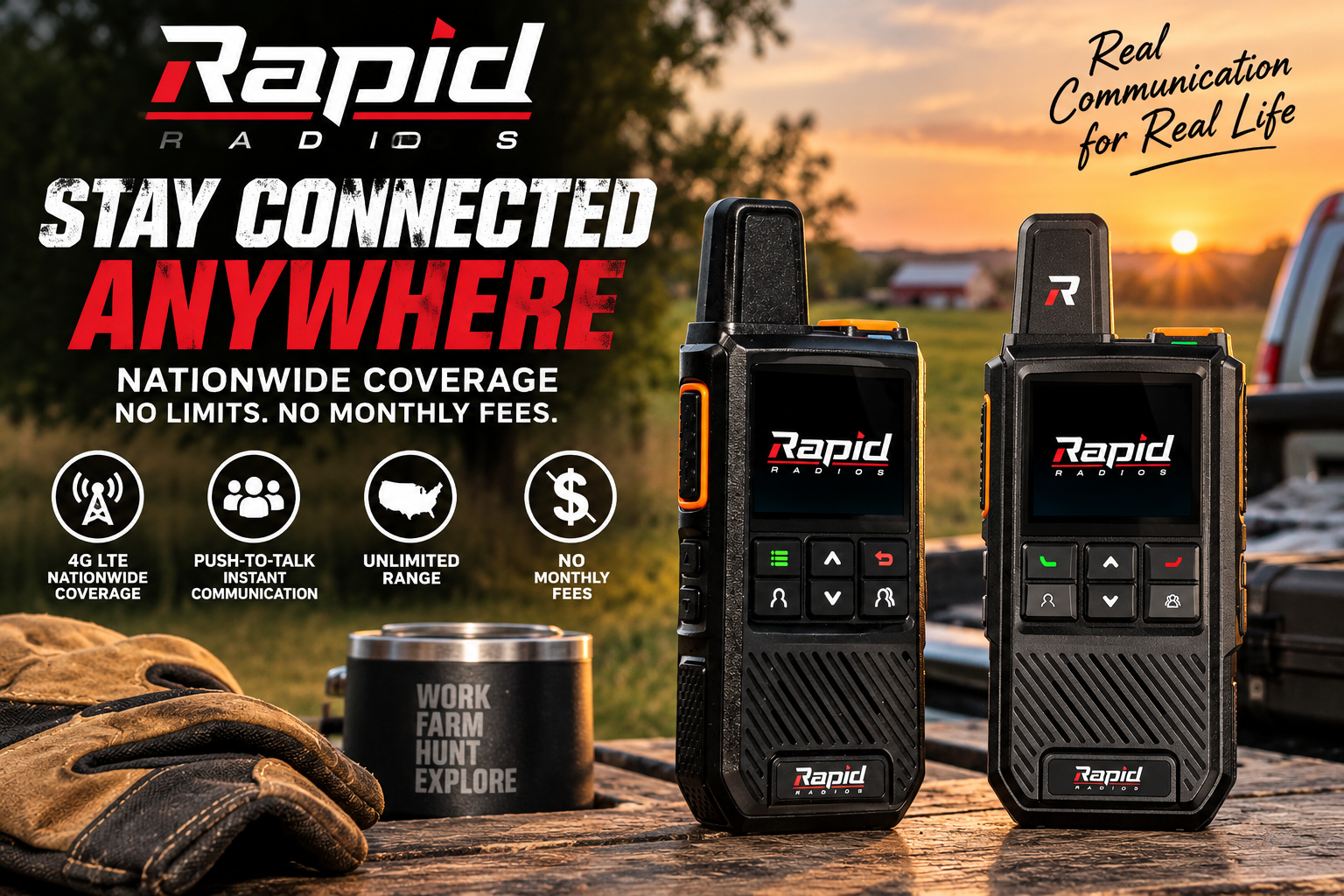
That means something like the Rapid Radios G1 Nationwide LTE Push-to-Talk Radios can communicate across vastly greater geographic distances wherever the supported cellular network is available.
For a business trying to keep trucks connected across different counties or states, that’s a huge advantage.
But it doesn’t replace one of CB’s biggest strengths.
CB lets you talk to unknown CB-equipped drivers nearby.
LTE push-to-talk is better suited to communicating with your own people.
How Can You Improve CB Range in a Semi Truck?
Before buying another radio, I’d work through the basics.
Check the Antenna
Make sure it’s appropriate for CB and physically in good condition.
Check Antenna Placement
Higher and less obstructed is generally better.
Check the Coax
Damaged, pinched or corroded coax and connectors can hurt performance.
Check the Ground
Many mobile antenna installations depend heavily on having a proper RF ground or ground plane.
Check SWR
An improperly matched antenna system can dramatically hurt performance.
Reduce Electrical Noise
Alternators, LED lighting, inverters and other electronics can introduce interference that makes weak signals harder to hear.
Test Against a Known Good Radio
Having another truck at known distances is much more useful than saying, “Nobody answers me, so my CB must not work.”
Maybe nobody was listening.
How Far Should You Expect Channel 19 to Reach?
If you’ve got a properly installed mobile CB and antenna, several miles of usable truck-to-truck communication is a perfectly reasonable expectation.
Cobra’s own guidance suggests roughly 5 to 7 miles for a properly set-up mobile unit under favorable conditions.
Real life may give you less.
Sometimes it’ll give you more.
The goal isn’t trying to talk across three states.
If another driver several miles ahead can warn you about stopped traffic, road debris or a problem around the next curve, the CB has already done its job.
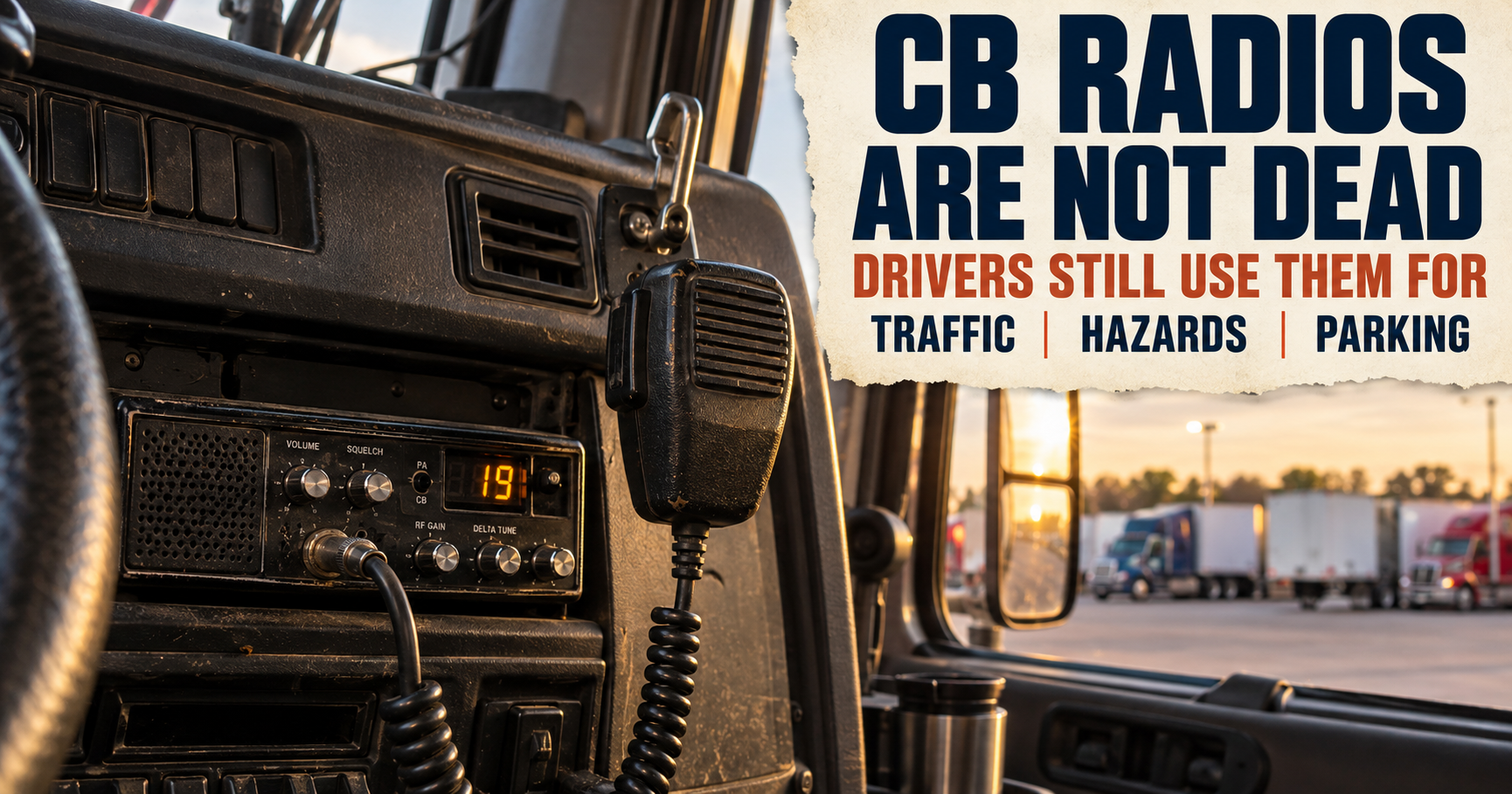
If you’re still deciding whether CB is worth installing at all, Do Truck Drivers Still Use CB Radios? covers where CB still fits alongside phones, Bluetooth headsets and modern push-to-talk equipment.
Frequently Asked Questions
How many miles will a CB radio reach from a semi truck?
Cobra estimates roughly 5 to 7 miles for a properly set-up mobile CB under favorable conditions. Actual range may be shorter or longer depending on the antenna, SWR, terrain, interference and equipment at both ends.
Can a CB radio reach 20 miles?
It can under favorable circumstances, but I wouldn’t buy a mobile CB expecting reliable 20-mile communication every day. Typical direct mobile communication is generally much shorter.
Why does my CB only reach one mile?
Antenna problems, poor SWR, bad coax, poor antenna placement, difficult terrain, electrical interference or problems with the other station can all reduce range.
Does a bigger antenna increase CB range?
Generally, a longer, properly installed CB antenna can improve efficiency and range compared with an extremely short antenna. Installation and tuning still matter.
Does Channel 19 have better range?
No. Channel 19 is popular because truck drivers traditionally monitor it, not because it inherently travels farther.
How far does a handheld CB reach?
Cobra estimates approximately two miles under favorable conditions for a handheld unit, although actual performance varies considerably.
Does SWR affect how far my CB transmits?
Yes. Poor SWR indicates an inefficient antenna match and can reduce transmitted performance. An extremely poor match can also put unnecessary stress on the transmitter.
Can two semi trucks communicate farther than a truck and handheld CB?
Often, yes. Two properly installed mobile antennas generally have an advantage over the short antenna found on a handheld radio.
Don’t Judge Your CB by One Magic Mileage Number
The question sounds simple:
How far does a CB reach?
The answer isn’t.
Your radio is only one part of the system.
The antenna matters.
SWR matters.
The coax matters.
The truck matters.
Terrain matters.
And the equipment on the other end matters.
That’s why I wouldn’t obsess over whether somebody online claims their truck talks 15 miles while yours reliably reaches five.
If your CB lets you communicate clearly with the drivers around you when you actually need it, it’s doing the job it was installed to do.
Get the antenna setup right, tune the system properly and understand the limits of local radio communication.
That’s how you get the most out of CB without chasing unrealistic range claims.
Author: Tyler Grant
Tyler Grant writes about commercial truck equipment, driver communication and everyday life behind the wheel for TruckingResource.com. His guides focus on practical equipment and older trucking technology that still earns its place in modern commercial trucks.