
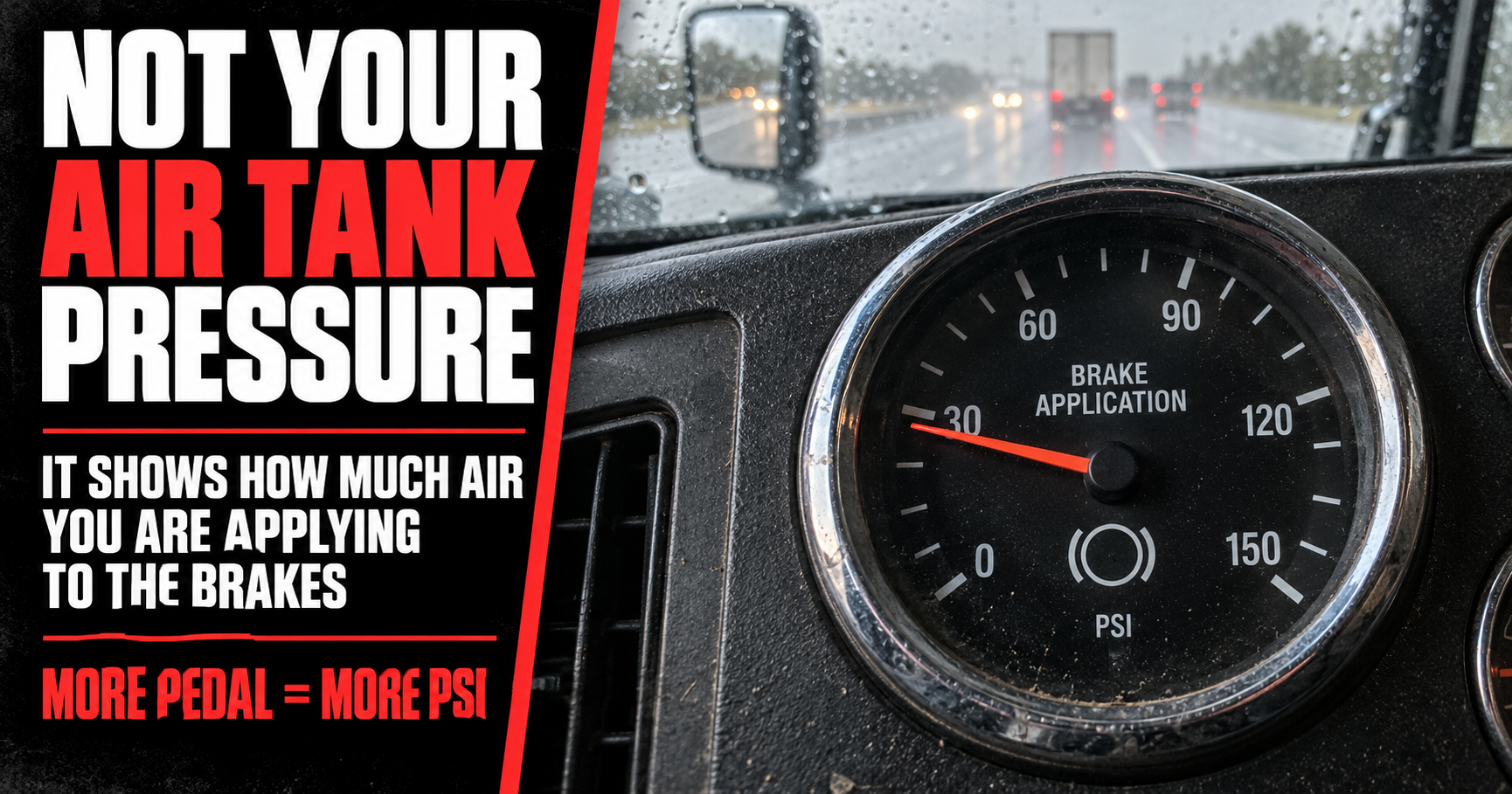
Press the brake pedal lightly and the needle barely moves.
Push harder and it climbs.
Let your foot off the pedal and it falls right back down.
That’s exactly what a brake application gauge is supposed to do.
It can look confusing because a semi truck may already have primary and secondary air pressure gauges sitting nearby. But the brake application gauge isn’t showing how much air you have stored in the tanks.
It’s showing how much air pressure you’re applying to the service brakes when you press the brake pedal.
Once you understand that difference, this becomes one of the easiest gauges on the dashboard to read.
What Does the Brake Application Gauge Measure?
An application pressure gauge shows the air pressure being sent to the service brakes when you push down on the brake pedal.
Press lightly and you apply relatively little air pressure.
Push harder and application pressure increases.
FMCSA’s CDL manual describes the brake pedal, also called the foot valve or treadle valve, in basically the same way: pushing farther down applies more air pressure, while letting up reduces the pressure and releases the brakes.
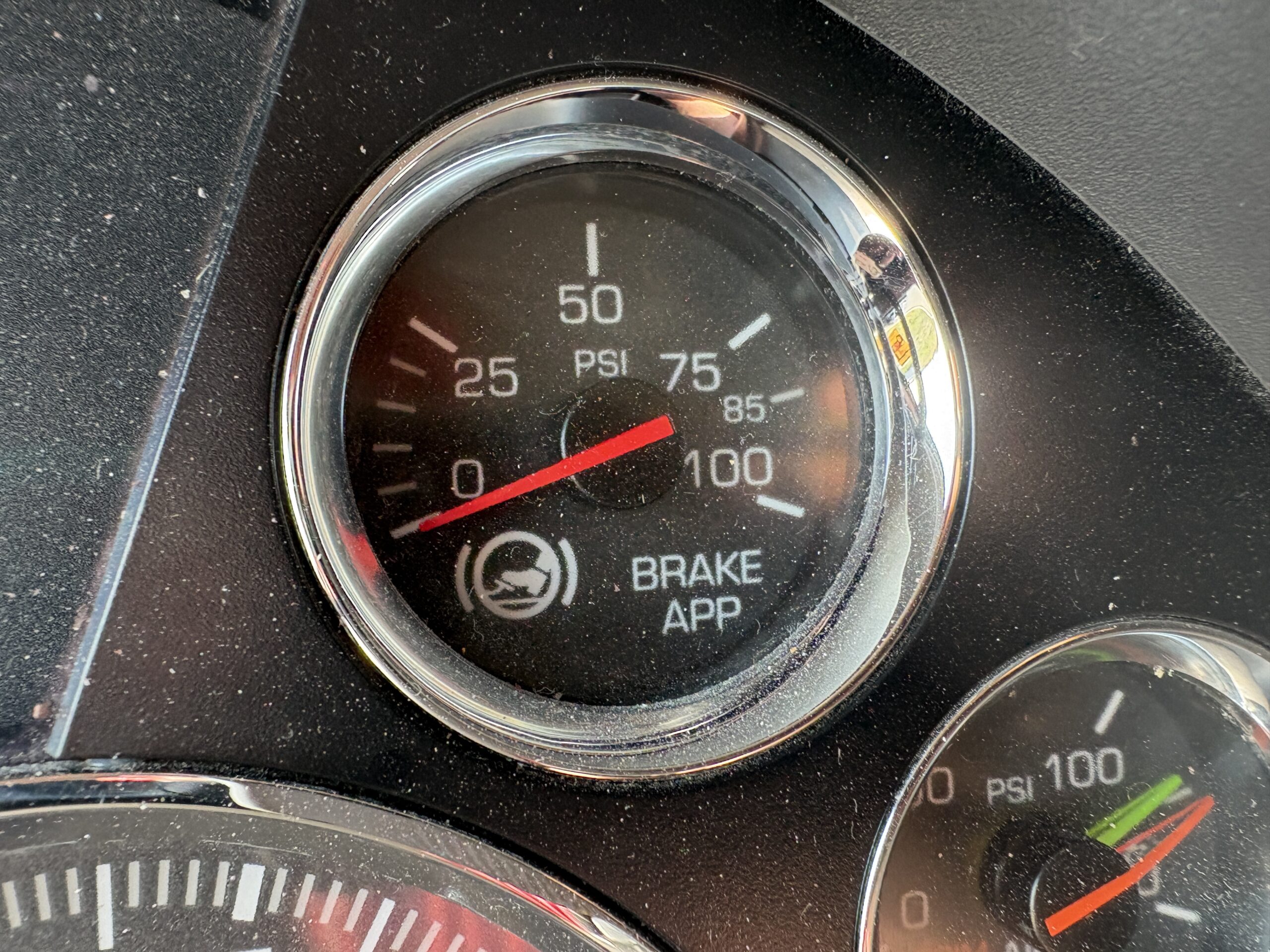
The application gauge gives you a visual indication of that pressure.
Not every air-braked truck has this gauge, so don’t be surprised if you move between trucks and one dashboard has it while another doesn’t.



This Is Different From Your Primary and Secondary Air Gauges
This distinction matters.
Your primary and secondary gauges show stored air pressure in the truck’s air brake system.
The brake application gauge shows how much pressure you’re commanding when you use the service brakes.
Think of it this way:
Primary and secondary gauges: How much air do I have available?
Brake application gauge: How much braking pressure am I asking for right now?
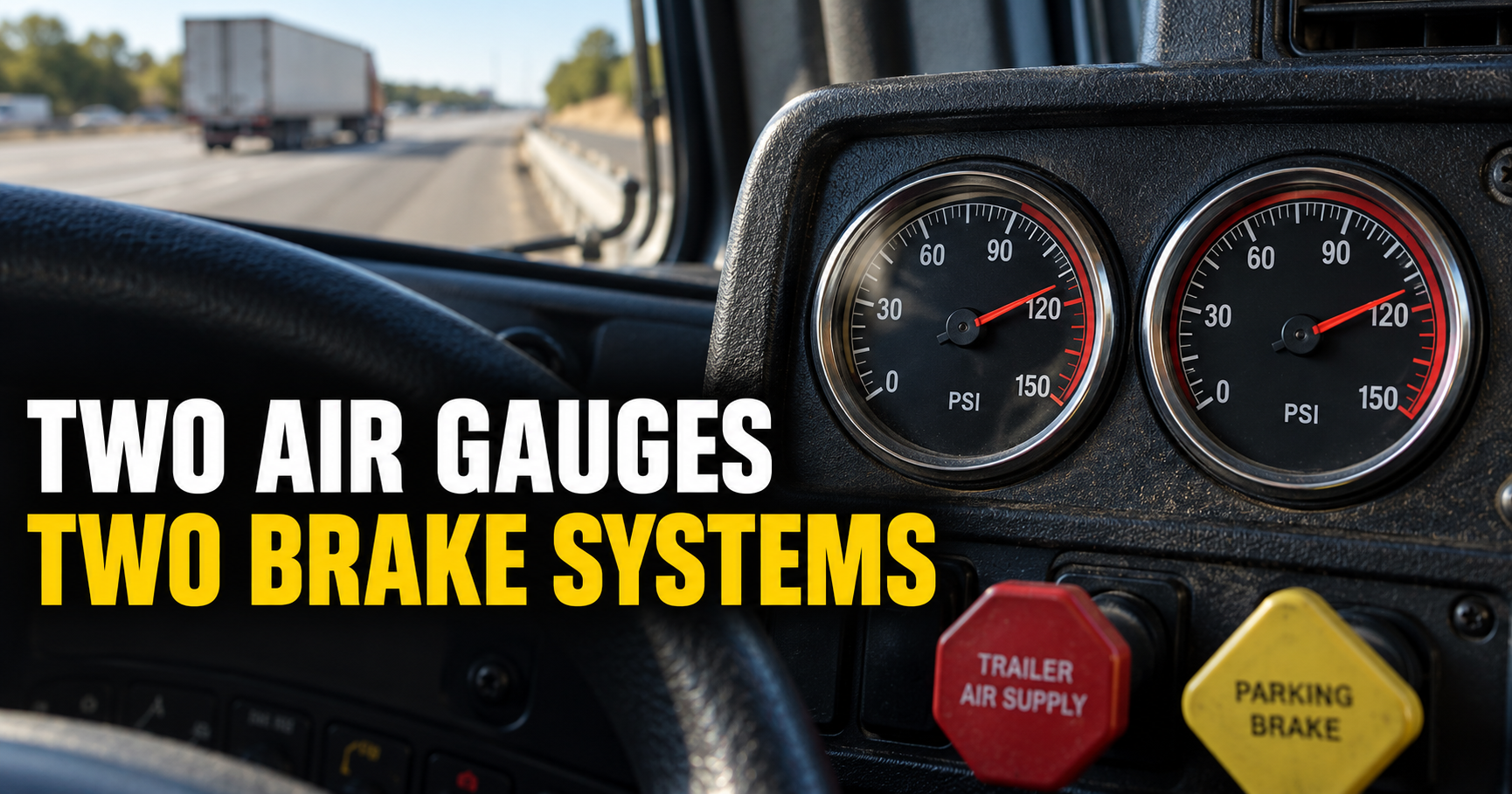
If the two primary and secondary gauges still confuse you, our guide to why semi trucks have two air pressure gaugesgoes through the dual air system and normal operating pressure in much more detail.

Why Does the Needle Move When You Press the Brake?
Air brakes don’t work like the hydraulic brakes in a normal passenger vehicle.
When you push the brake pedal, the foot valve controls compressed air going to the brake chambers.
That air pressure moves components inside the brake system and ultimately creates the force that applies the brakes.
Press the pedal harder and more pressure is applied.
That’s why the needle climbs.
Release the pedal and the service brakes release, causing application pressure to fall back toward zero.
What Is a Normal Brake Application Pressure?
This is another gauge where trying to give everyone one perfect PSI number would be misleading.
There isn’t one application pressure you’re supposed to use for every stop.
That’s the whole point of the gauge.
Application pressure changes depending on how much braking you need.
A gentle slowdown on level pavement may require relatively little pressure.
Stopping a heavily loaded truck from a higher speed may require considerably more.
Going down a grade creates another completely different situation.
Road conditions, vehicle weight, brake condition, speed, grade, and how quickly you’re trying to stop all matter.
So instead of asking:
“What PSI should my brake application gauge always show?”
A better question is:
“Is the truck responding normally to the amount of pressure I’m applying?”



Light Braking Shouldn’t Require a Huge Application
Imagine you’re cruising through town and the traffic light ahead changes.
You’ve got plenty of distance.
You ease into the brake pedal and begin slowing gradually.
You shouldn’t need the same brake application you’d use for an emergency stop.
That’s one reason smooth drivers tend to make driving a heavy truck look easy.
They’re looking ahead.
They’re planning their stops.
They’re applying the brakes gradually instead of waiting until the last second and demanding a huge amount of braking force.
A Loaded Truck Can Feel Very Different From an Empty Truck
This is something every new driver eventually notices.
The same truck behaves differently depending on what’s behind it or how much it’s carrying.
An empty truck may slow easily with a relatively light brake application.
Put a heavy load on it and you’ve got much more mass to slow down.
That doesn’t mean you should stare at the application gauge trying to hit a particular number.
It means you should expect braking feel and required stopping distance to change with vehicle weight.
Your job is still to look far enough ahead that you can brake smoothly and safely.
Why Does Application Pressure Matter on Long Grades?
Long downhill grades are where brake technique becomes especially important.
Holding the service brakes continuously can build tremendous heat.
As drum brakes become excessively hot, braking effectiveness can decrease. That’s brake fade, and it’s one of the reasons CDL training puts so much emphasis on proper downhill speed control and correct gear selection.
The application gauge can show you what you’re asking from the brakes, but it can’t tell you brake temperature.
A normal-looking application pressure does not mean overheated brakes are okay.
That’s why you still need proper downhill braking technique instead of using the application gauge as permission to ride the brakes.
What If You Suddenly Need More Pressure Than Usual?
This is where knowing the truck becomes valuable.
Suppose you’ve driven the same truck every day.
You know roughly how the brakes normally feel.
Then you notice that routine stops seem to require noticeably more pedal pressure than they did before.
That’s worth paying attention to.
Possible reasons can include brake adjustment problems, worn friction material, contaminated brakes, brake fade from excessive heat, problems at one or more wheel ends, or other air brake system issues.
The application gauge won’t tell you which part is bad.
It can help confirm something has changed.

What If the Gauge Barely Moves?
If you press the brake pedal and the gauge doesn’t respond the way it normally does, don’t immediately assume the brakes themselves have failed.
The gauge, sender, plumbing, or related components could also have a problem.
What matters most is how the vehicle actually responds.
If the truck isn’t braking normally, that’s a safety problem regardless of what the gauge says.
If the truck brakes normally but the application gauge suddenly stopped responding, the gauge system itself may need inspection.
What If the Gauge Shows Pressure After You Release the Brake?
Normally, application pressure should fall when you release the service brake.
If the gauge continues showing substantial application pressure after your foot is completely off the pedal, especially if the truck feels like the brakes are dragging, something deserves attention.
Possible issues could involve the treadle valve, relay valves, sticking brake components, or the gauge itself.
Dragging brakes create heat quickly.
That’s not something I’d ignore and continue driving indefinitely.
Brake Application Pressure and Air Tank Pressure Work Together
Every service brake application uses some of the compressed air stored in the system.
That’s why repeatedly pressing and releasing the brake pedal while the truck is sitting still causes your primary and secondary air pressure to fall.
The compressor eventually has to replace that air.
FMCSA specifically warns that unnecessary repeated brake applications can release air faster than the compressor can replace it.
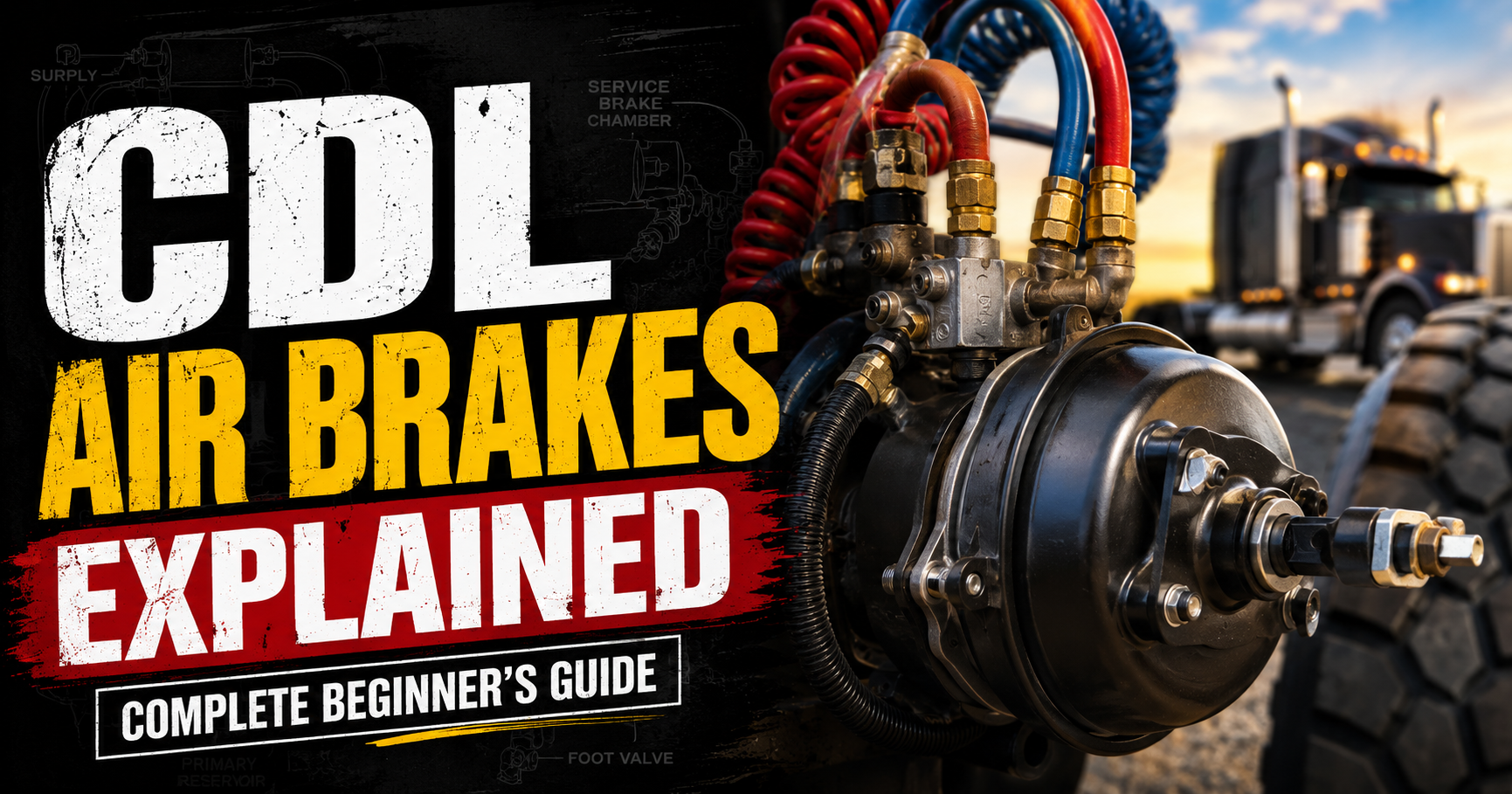
This is why understanding the application gauge makes more sense when you also understand the entire CDL air brake system.
The application gauge is only showing one small part of a much larger system.
Harder Pedal Doesn’t Always Mean Better Braking
New drivers sometimes think pushing harder is automatically safer.
It isn’t.
Smooth, controlled braking is usually the goal.
Slamming on the brakes unnecessarily can create several problems.
Cargo can shift.
Traction can be lost.
Drivers behind you may not react quickly enough.
Passengers or equipment inside the cab can get thrown forward.
And on slippery surfaces, aggressive braking can create an entirely different set of problems.
The gauge isn’t there to challenge you to make the needle go higher.
It’s there to show how much air pressure you’re applying.
ABS Changes What Happens During Hard Braking
Modern commercial trucks use anti-lock braking systems to help prevent wheel lock during hard braking.
If ABS activates, you may feel or notice changes in braking behavior.
The important thing is to maintain appropriate brake pressure and let the ABS do its job rather than repeatedly pumping the brakes like drivers were sometimes taught decades ago with non-ABS vehicles.
Your brake application gauge may still show substantial pressure because you’re commanding a hard stop.
ABS is managing wheel slip at the individual braking system level.
Can This Gauge Tell You if Your Brakes Are Out of Adjustment?
Not directly.
A high application pressure by itself does not prove the brakes are out of adjustment.
The gauge shows how much pressure you’re applying.
It doesn’t measure brake lining thickness, pushrod stroke, drum condition, rotor condition, or adjustment at individual wheel ends.
That’s why a proper pre-trip inspection still matters.
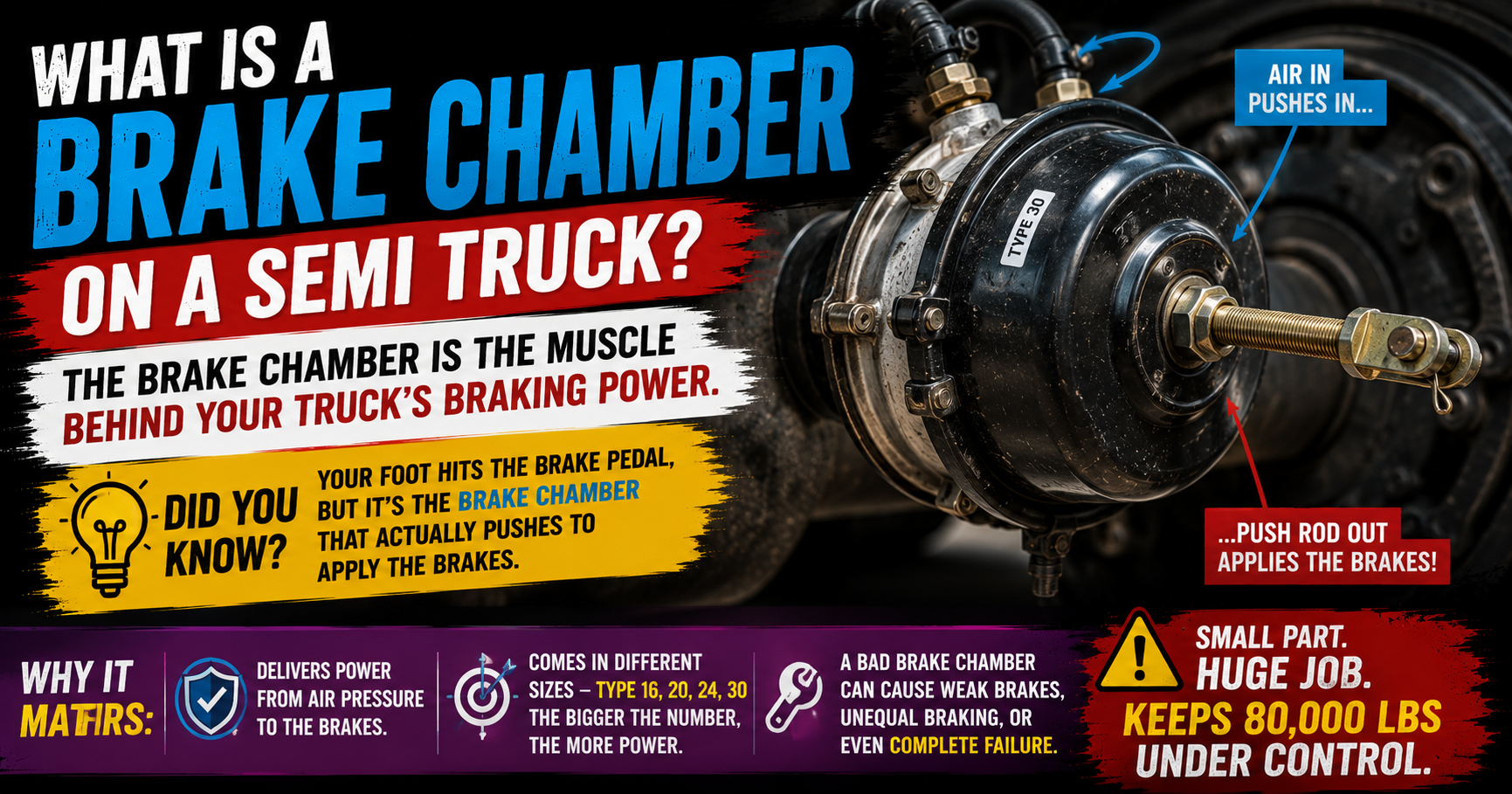
If you want to understand the components doing the actual work at the wheels, our guide to brake chambers on a semi truck explains how air pressure is converted into mechanical movement at the brake.
Don’t Use the Gauge Instead of Looking Ahead
It’s interesting to watch application pressure once you understand what it means.
But while driving, your eyes belong on the road.
The best braking habit isn’t trying to achieve a particular PSI.
It’s looking far enough ahead that you rarely need sudden, aggressive braking in the first place.
Scan traffic.
Watch lights.
Leave following distance.
Expect other drivers to do something stupid.
Then use the brakes smoothly.
The gauge is information, not a target.
Frequently Asked Questions
What does a brake application gauge measure on a semi truck?
It shows how much air pressure you’re applying to the service brakes when you press the brake pedal.
Is the brake application gauge the same as the air pressure gauges?
No. The primary and secondary gauges show stored air pressure in the brake system. The application gauge shows the pressure being applied during braking.
What should the brake application gauge read?
There isn’t one normal number for every stop. Light braking uses less application pressure, while harder braking generally requires more. Vehicle weight, speed, road grade, and other conditions affect how much braking is needed.
Should the gauge return to zero when I release the brake?
Normally, yes. Application pressure should fall as the service brakes are released.
Does every semi truck have a brake application gauge?
No. FMCSA’s CDL manual specifically notes that this gauge is not installed on every vehicle.
Does high application pressure mean my brakes are bad?
Not necessarily. A hard stop can legitimately require substantial pressure. What matters is whether the truck’s braking behavior has changed or routine stops suddenly require much more application than usual.
Can the gauge tell me if my brakes are overheating?
No. It measures application pressure, not brake temperature. Excessive brake use can create dangerous heat even when the pressure reading itself looks normal.
Why does tank air pressure drop when I keep pressing the brake pedal?
Every service brake application uses compressed air. Repeated applications release air from the system faster than normal driving would, and the compressor has to replace it.
It’s Really a Gauge Showing What Your Foot Is Doing
That’s probably the simplest way to understand the brake application gauge.
Your primary and secondary gauges tell you what’s available in the air system.
The application gauge tells you what you’re asking the brakes to do.
Light pedal, lower application.
More pedal, more pressure.
Release the pedal and the pressure goes away.
Once you understand that, the gauge stops looking like another mysterious air-pressure dial and starts making perfect sense.
More importantly, if you’ve driven the same truck long enough to know how it normally stops, the gauge gives you one more piece of information when something suddenly doesn’t feel right.
Author: Marcus Bennett
Marcus Bennett writes about commercial truck braking systems, driver safety, and heavy-duty equipment for TruckingResource.com. His articles focus on explaining the mechanical systems drivers use every day without turning them into complicated shop manuals.